life
[Book Review] Your Brain Is Lying to You: Why You Stare at Attractive People and Can Never Get Your Money's Worth at an All-You-Can-Eat Buffet
This is a review of Your Brain Is Lying to You (都是大腦搞的鬼) by Po-Jang Hsieh, a well-known Taiwanese neuroscientist who has a real gift for making cognitive research accessible and fun. If you’re into brain science or psychology, this is absolutely one of the top popular science picks.
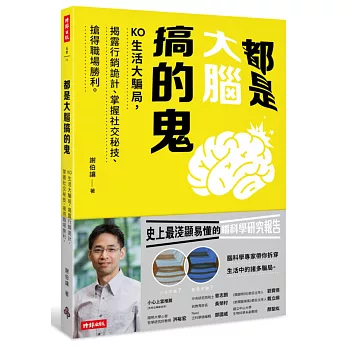 Your Brain Is Lying to You, Po-Jang Hsieh, China Times Publishing (image source: Books.com.tw)
Starting from Everyday Scams — A Science-First Approach
I honestly can’t remember exactly when I started following Po-Jang Hsieh’s work — it might have been the whole white-gold vs. blue-black dress saga that went viral XD
I’ve always thought of him as a rigorous and outstanding researcher, and what really sets him apart is how clearly he writes — whether or not you’re in the field, you can follow what he’s saying without getting lost.
So when I was working at my previous company and looking for a great science communicator to bring in, he was the first person I thought of XD And we actually got him! I was so excited I told my friends: my dream came true!
To this day, whenever his podcast Brain Playground drops a new episode, I’m one of the first to listen XD
Okay, let me put down my fan-mode hat and actually talk about the book.
The book is about “the brain” — but some readers might wonder why there’s so much psychology in it.
This probably has to do with the traditional Chinese distinction between “heart” (心) and “brain” (腦), which often get conflated in everyday language. And honestly, early brain research was limited by technology — scientists could only run behavioral experiments back then. It wasn’t until tools like EEG and MRI became available that we could actually observe how the brain works, and cognitive neuroscience really took off.
Long story short: every psychological question and finding we know of ultimately traces back to the brain.
If you’re generally curious about psychology or brain science, Your Brain Is Lying to You is genuinely not to be missed.
The book covers several key areas:
- Consumer traps: e.g., how plate size affects how much you eat at a buffet; how insurance salespeople use language to get you to buy
- Workplace traps: e.g., whether looks and intelligence are actually related; whether appearance affects your salary; the link between political leanings and body odor
- Social traps: e.g., why scammers use attractive profile photos; what kind of photo makes you look most appealing
- Knowledge traps: e.g., does a high-sugar diet make you dumber; the myth of right-brain development; whether sleep learning actually works
Hsieh always wraps these studies in entertaining stories, and because the examples are so relatable, you’re constantly surprised by how much everyday life is connected to brain cognition.
Below I’ll share a few of the examples that stuck with me most :)
From All-You-Can-Eat to Insurance: Consumer Traps You Need to Know
In the first chapter, Hsieh picks the most down-to-earth examples to talk about the consumer traps we encounter in daily life.
Here are a few of the more interesting ones.
Want Higher Table Turnover? Restaurant Owners, Take Note!
Food is central to life, and a lot of eating-related behavior is tied to brain science and psychology.
For instance, when we go to a buffet, we usually want to starve ourselves for three days beforehand to “get our money’s worth” —
but here’s the thing: plate size actually affects how much you eat.
Hsieh cites Brian Wansink’s research, which found that the size of a plate or package quietly influences how much people consume. When you’re handed a large bucket of popcorn, you’ll eat more without realizing it than someone who got the medium size. Experiments also showed that bigger plates tend to lead to more eating — smaller plates create the visual impression that the food is piled high, which makes you feel satisfied sooner.
Also, if a buffet server never comes to clear your plates, you get this visual cue of “wow, I’ve eaten so much,” and you’ll gradually stop eating without even noticing XD
Side note: the music playing in a restaurant isn’t just about ambiance (or the owner’s taste) — it also affects how fast you eat!
Slow, soft music makes customers linger and spend more; fast-paced music speeds up eating.
Next time you’re at a buffet, notice what they’re playing XD
A Good Name and Nice Weather Will Make You Buy Stocks
The book spends a fair amount of time on restaurants — definitely worth reading XD Another fun example in this chapter is about the power of a name.
Parents pick names for their kids hoping they’ll live up to them, so names tend to be pleasant-sounding — and of course the same logic applies to company names, maybe even more so.
The book reveals that weather and a company’s name might actually influence the stock market and share prices. Really?!
That immediately reminded me of Friends S02E21, “The One With the Bullies,” where Monica buys stock in a company just because its ticker symbol is MEG — same as her name XD
This name effect on stock prices has actually been confirmed in experiments.
Of course, it doesn’t apply to huge companies like Foxconn or TSMC — it’s more relevant for newly listed small companies with catchy, memorable names, which investors are more likely to buy into.
And of course the “magic” of the name fades as the company’s actual performance becomes known.
Honestly, this feels like a business case I could pitch to my linguistics department as a career path… XD
Warmth, Hot Coffee, Soft Chairs, and Chocolate: Boosting Your Impression of a Store
You’d think your feelings about a store come from actually interacting with it — but some experiments show that external environmental cues and small gestures from the staff can have a big impact on how favorably you view a place.
If you’re a shop owner and a customer walks in, should you offer them hot coffee or iced coffee?
The answer may vary with the weather (nobody wants hot coffee on a sweltering day), but one experiment found that participants who received hot coffee gave noticeably higher ratings in a survey afterward. Maybe it really does give people a sense of “warmth”? XD
Other things that soften people up: the cushiness of chairs, and chocolate! Softer chairs apparently make people willing to pay more for things, and eating chocolate tends to put people in a self-indulgent mood.
All of this shows that human social decisions are easily influenced by all kinds of sensory input.
Next time you’re shopping and someone offers you chocolate — don’t take it XD
The Art of the High-Low Trap
Has anyone read Hunter × Hunter?
In the election arc, Ging sets up a situation where he proposes five rules to the Zodiacs. After hearing all five, most of them are unhappy.
One member says: “Setting aside rules one through four, shouldn’t the matter of the facilitator [rule five] be decided separately?”
Ging immediately agrees: “Then rules one through four are fine.”
Everyone looks surprised — “Really? That’s okay?” — and they accept, just like that.
Looking back at that scene, you realize rule five (the most unreasonable one) was set up specifically to make rules one through four feel acceptable. Whether rule five passes doesn’t matter at all.

I always thought Yoshihiro Togashi was a genius at plotting, even if his hiatus game is legendary (but please, let Kurapika off the ship). And reading Your Brain Is Lying to You’s section on the anchoring effect, I realized what Ging pulled off was just another application of the same principle.
Let’s talk about the anchoring effect.
When making decisions, we tend to rely heavily on the first piece of information we encounter as an “anchor” for comparing everything else.
In simple terms: if your first boyfriend was Takeshi Kaneshiro, then every guy after him gets measured against that benchmark — looks, height, wealth, intelligence, everything (though if you’re dating Takeshi Kaneshiro, why would you ever look elsewhere XD).
The anchoring effect was discovered by cognitive psychologist Amos Nathan Tversky and Nobel laureate in economics Daniel Kahneman.
Participants were asked to solve a multiplication problem within 5 seconds. One group got 8×7×6×5×4×3×2×1, the other got 1×2×3×4×5×6×7×8.
The first group’s average answer was 2,250; the second group’s was 512 (the correct answer is 40,320).
They concluded that when the first number is larger, people tend to give higher estimates.
The anchoring effect has since been applied in all kinds of ways. One little girl selling Girl Scout cookies would first ask: “Could you donate $3,000?” Almost everyone said no — but when she followed up with “Could you at least buy a box of cookies?” almost everyone said yes XD
She went on to sell over 3,000 boxes of cookies in three weeks XD
Back to Ging’s example.
He wasn’t working with numbers, but the Zodiacs were still making value judgments about every rule. When the last rule was completely unreasonable and got rejected, lifting it made the others feel suddenly acceptable by comparison.
Voting, the Workplace, and Political Leanings: How to Avoid Being Manipulated
Beyond consumer behavior, workplace decisions and political choices are also tied to psychology and brain science. There are some genuinely fascinating studies here too XD
Small Favors Open Big Doors
The first ask matters. This section introduces the beachhead effect — if you can secure a beachhead first, the rest becomes much easier.
Robert B. Cialdini’s book Influence cites a classic example: if you randomly ask homeowners to put a large sign in their yard, almost no one will agree (success rate: 17%). But if you first ask them to put a small sticker in their window, then come back two weeks later with the bigger request, the success rate jumps to 76%.
Does Appearance Affect Your Salary?
Everyone says “it’s good to be pretty” — and yes, attractive people do tend to earn more.
A study of NFL players found that those with more symmetrical faces (which we generally associate with being good-looking) earned higher salaries.
Why would looks matter even in a professional sport?
Hsieh cites psychological research: people often use facial symmetry and distinctiveness as cues for judging someone’s health.
This connection between facial symmetry and perceived health has indeed been supported by research.
But Hsieh also flags the causal question: is it really that being attractive leads to higher pay? Or is it that attractive people feel more confident, which positively affects their behavior and performance? The causation here needs careful thought.
Body Odor and Political Leanings: A Surprising Correlation
Political and social psychologists have found that married couples in the US tend to hold very similar political views — and it’s not just survivorship bias XD. Newlyweds already share similar political leanings.
This got researchers curious, and Rose McDermott found that people with similar political views also tend to prefer each other’s body odor.
Wait, that’s hilarious XD
Here’s how the experiment worked:
146 participants were recruited and classified by political leanings.
21 of them were asked to shower with unscented soap and shampoo, then wear odor-collecting patches under their arms (and avoid activities that change body odor).
The next day, the patches were collected, and the remaining 125 participants were asked to smell and rate them.
The result: when the scent came from someone with similar political leanings, the rating was higher.
This experiment is so fascinating — maybe genetics really does have something to do with our political tendencies.
Hardwired to Stare? How to Be More Attractive? Unpacking Social Traps
Another area where we constantly fall for traps or make biased decisions is social interaction. Your Brain Is Lying to You has some great examples here.
The Power of an Attractive Photo
Sometimes random “attractive women” will add me on Facebook or Instagram — not that it works on me XD
But that said, attractive photos are generally effective for everyone.
Science confirms that photos of attractive women don’t just create sexual attraction in men — they also affect men’s financial judgment.
An experiment by a bank showed that if a loan advertisement featured a photo of an attractive woman, men were willing to accept interest rates 4.5% higher than when the ad featured a man XD
Looking Better in a Group?
Want to look more attractive? If you’ve watched How I Met Your Mother, you’ll remember Barney’s “cheerleader effect” theory.
Barney claims that a group of cheerleaders standing together all look beautiful — but pull any one of them out individually and they’re just… okay.
You can look up the original clip for a refresher XD
Hsieh uses this famous pop-culture example to introduce a real psychological experiment that confirmed the effect:
When participants rated attractiveness from profile photos, group shots received higher ratings than individual shots!
Wait — so Barney’s ridiculous theory was actually correct?! XD
Hsieh explains further: vision automatically averages out the many objects it perceives (average size, angle, etc.), and researchers think the same averaging may happen with faces — producing a kind of “average face” that people tend to find more appealing.
Alright, go update your group photos XD
The Truth About Right-Brain Training, Sleep Learning, and Other Knowledge Myths
When you talk about brain science, people inevitably bring up left- vs. right-brain development. But are these ideas that sound plausible actually true? Hsieh takes a hard look at the “knowledge” floating around out there.
Language Isn’t Just in the Left Brain. Art Isn’t Just in the Right.
Thanks to early split-brain research (which has a fascinating scientific history — read the book for that story), many people adopted the neat shorthand of “left brain for language, right brain for art.” That idea became deeply embedded in popular culture.
Even now, you’ll see people selling “right brain development” materials based on this claim — but Hsieh uses his own neuroscience expertise to push back.
What’s more accurate to say is that language is lateralized to the left — not that it only lives there.
When you speak, both hemispheres are active. And artistic abilities (like music) also require participation from both sides of the brain.
He also points out: being right-handed doesn’t mean you’re “right-brained,” and vice versa.
So go ahead and unfollow those left-brain/right-brain development pages XD
Sleep Actually Helps Memory
There’s currently no solid evidence for sleep learning per se (though that doesn’t make it impossible), but sleep does genuinely help with memory.
In one experiment, participants memorized the positions of objects on a screen while rose scent was released in the air.
Once they fell asleep, one group inhaled the scent again; the other inhaled unscented air.
The group that smelled the rose scent while sleeping had a memory accuracy of 97.2% upon waking — versus 85.8% for the other group.
In another experiment, 50 object sounds (a cat meowing, a horn honking, etc.) were played during learning; then 25 of those sounds were replayed during sleep. Participants remembered those 25 objects significantly better when they woke up.
So it seems like certain stimuli during sleep can strengthen our memories! I’m excited to see what future research turns up XD
Wrap-Up
This review ended up much longer than I planned — I was initially worried I’d give away all the best parts, but then I realized the book has way more gems than I could possibly spoil XD
Every example Hsieh presents is delivered in a relatable, story-like way — it doesn’t feel like reading dry scientific papers.
You can feel his genuine passion for the research in every paragraph, and his sense of humor shines through too XD
I’ve had a few chances to chat with him since, and he’s mentioned that many of the studies in the book still need to be replicated before they can be considered definitive conclusions —
in other words, the experiments were done, but whether they hold up is still an open question.
I’ll close with a little anecdote from an interview.
A colleague once asked Hsieh: “What do you do for fun?”
He thought for a moment and said: “Research, I suppose."
"Wait, doesn’t that get boring?” the colleague asked.
Hsieh smiled and replied: “Not at all — research is my hobby.”
Title: Your Brain Is Lying to You
Author: Po-Jang Hsieh
Publisher: China Times Publishing
Thanks for reading :D
If you enjoyed this post, feel free to click the coffee button in the lower right to support us and give Lottery a can 🐾
Comments