Linguistics → UXR | Contextual Inquiry: Go Shopping with Your Users
Contextual Inquiry is a research method built for observing real-world, offline behavior. Here's what it is, when to use it, and how I actually ran one — by going to the supermarket with ShopBack users.
The Disappearing “Offline” Behavior
Before diving into Contextual Inquiry as a method, let me share the context that led me to use it.
My main product at ShopBack is Receipt Scanning — an O2O (Online to Offline) service. Users interact with the product online, then earn cashback by completing real-world purchases offline. The basic flow looks something like this:

We can track what deals users claim, and what they bought — all the online behavior is visible in our data. I even regularly monitor metrics across the entire user journey for the receipt scanning product (more on that another time).
But what we couldn’t see was what happened offline.
- Under what circumstances did they claim a deal?
- How did they choose products?
- Did they use our app while in-store?
- What factors were they weighing as they shopped?
- What happened at checkout?
Offline behavior was essentially invisible to us. And because receipt scanning is an O2O service, understanding the offline context is critical for building the right product. That’s where this research began.
What Is Contextual Inquiry?
A quick linguistics note first. “Context” — in linguistics, it refers to the surrounding circumstances of an utterance: who said it, where, when, to whom, and why. Context shapes meaning. The same sentence can mean completely different things depending on the situation.
For example: “I will find you.” Said between childhood friends being separated — it’s a tender promise. Said by the teenage detective Kindaichi toward his nemesis Takato — it’s a declaration of war. Said in a horror movie — deeply unsettling.
The point: context shapes everything.
In UX, especially for app products, we want to understand:
The full circumstances — who, when, where, what situation — under which users interact with our product.
Contextual Inquiry (脈絡訪查 in Chinese) is research designed to answer exactly that. While a standard 1:1 interview asks users to demonstrate how they use a product, Contextual Inquiry has the researcher accompany users into their actual usage environment — observing and interviewing in context. The result is far richer contextual data.
Since our goal was to understand offline shopping behavior, this method fit perfectly.
Contextual Inquiry vs. Diary Study — Which One?
A colleague of mine, Amy, had already run a Diary Study the previous year. (Here’s her excellent write-up on the ShopBack Tech Blog if you’re interested.) In a diary study, participants record their own experience over time — like a video diary — and researchers analyze those records.
So what’s the difference? Both can reveal context. But there are meaningful distinctions:
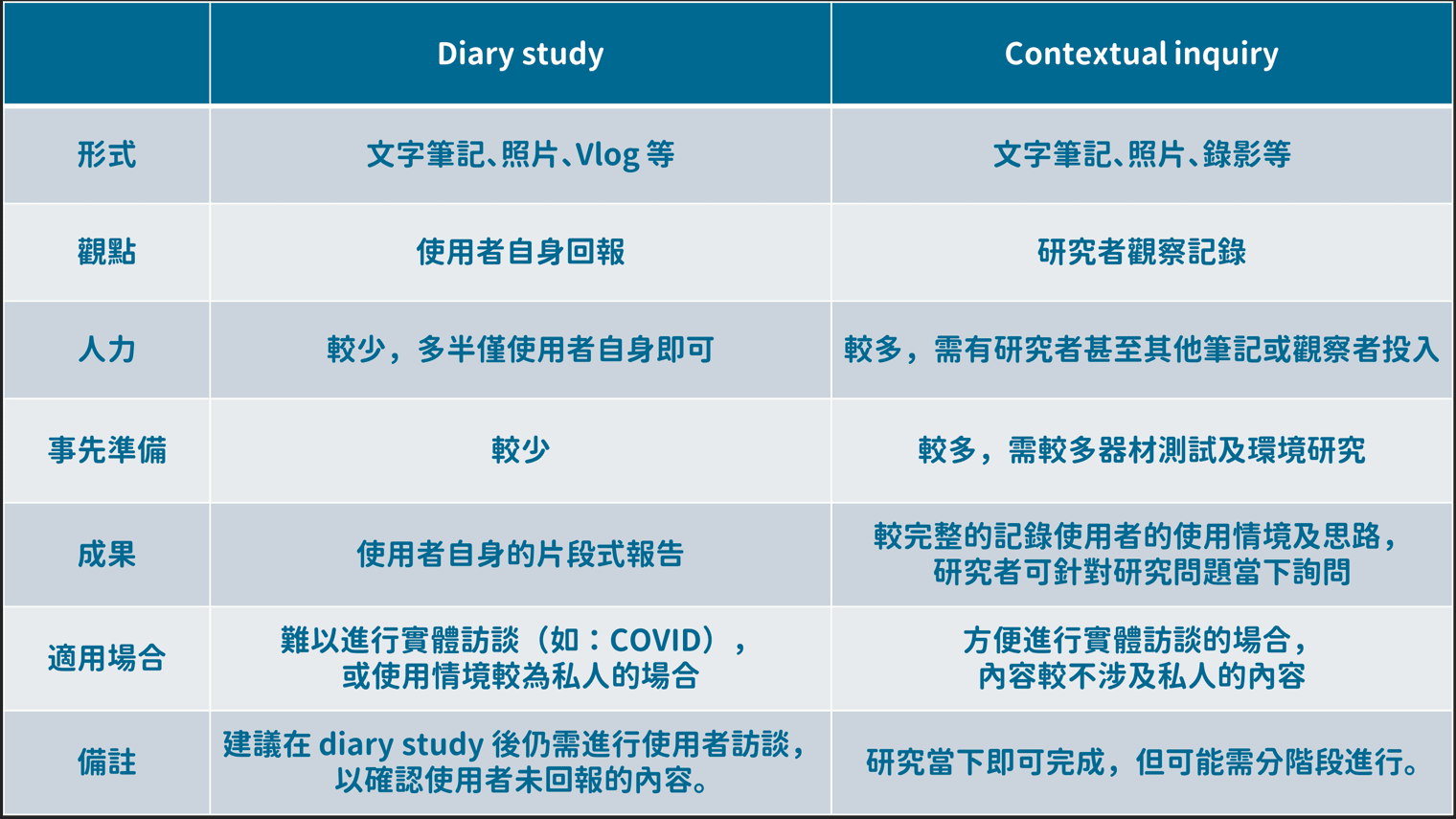
The key gap in diary studies: participants self-report, so they don’t always capture the subtle, unconscious decisions they’re making. For example:
What actually happened: User picks up Product A, then Product B, compares price and contents, puts B down, and opens the app to claim a deal for A. What the diary says: “I chose Product A and claimed the deal.”
The middle — the comparison, the hesitation, the reasoning — gets lost. In Contextual Inquiry, when I see a user pick up two products, I can ask in the moment: “What are you thinking right now?”
That said, Diary Studies have real advantages too. When resources are limited or in-person sessions aren’t feasible, diary studies still yield valuable data. Amy’s original plan was also for in-person observation, but COVID made that impossible — and the diary study still gave us incredibly useful insights. I ran Contextual Inquiry the following year when conditions allowed.
So: choosing the right method also depends on your current context. 😄
How to Prepare a Contextual Inquiry
Beyond the standard research planning covered in my User Research 101 post, here are some Contextual Inquiry-specific considerations.
Format
Contextual Inquiry is all about context — including the human element. Even though we want to observe users as naturally as possible, the act of being observed will affect their behavior. The goal is to minimize that effect as much as possible.
I recommend structuring the session in three stages:
- Warm-up: Before entering the observation environment, meet the user somewhere neutral — the subway entrance, outside the store. Chat casually, explain what’s happening. Build rapport and help them relax. This is your best chance to build trust. Keep it conversational, like talking to a friend.
- Contextual Inquiry (the observation): Once they’re comfortable, accompany them into their natural environment. Ask them to think aloud — narrate what they’re doing and thinking. Your role here is primarily observer: watch their behavior, body language, and facial expressions, and ask questions at the right moments.
Note: the moment you ask a question, they’re no longer in their most natural state. But staying silent means missing valuable data. When something’s worth asking about, just ask. - Wrap-up: After the session, invite them to a café or quiet spot to debrief. Revisit things you didn’t get to ask, show them photos or notes from the session, prompt their memory, and dig deeper.
Number of Participants
Users: One at a time. Observing multiple people simultaneously is too chaotic.
Researchers: Depends on the study. For my study (targeting everyday consumers), I went alone — too many researchers makes participants nervous. That said, a colleague told me that when their participants were professionals doing routine work, having more researchers wasn’t disruptive. Read the room.
Equipment
- Note-taking tool (notebook, iPad — whatever you prefer)
- Recording tool with timestamps (makes note-taking much easier later)
- Video recording if possible
- Camera for photos
Highly recommend doing a pilot test with all your equipment before the real thing.
In my pilot, I used my iPad for notes and my phone for audio. Notes were easy to organize later, but I kept getting distracted by typing and missing things live. I also couldn’t take many photos.
For the real sessions, I switched to going fully hands-free for notes — just audio recording and photos on my phone. Harder to organize afterward, but the data was more complete.
Other Tips
I was lucky to get advice from a senior researcher before running this study. Here are the most useful reminders:
- Record video if you can. It’s the gold standard — gives you an objective, complete record, and lets teammates who weren’t there feel the atmosphere.
- Live-stream for remote note-taking. I did this alone, but in hindsight, having remote colleagues take notes during the Wrap-up phase would have been much more efficient.
- Max 2 sessions per day. Even at under 2 hours each, the post-session organizing — video, audio, photos, notes, screen recordings — is enormous. Write down your key observations the same day before you forget.

Going Shopping with Users — ShopBack Receipt Scanning
Sessions: 6
Duration: Under 2 hours each
Participants: ShopBack users who use Receipt Scanning at supermarkets
Research goal: Understand offline shopping habits and how users interact with our product in-store
Locations: Supermarkets in Taipei, New Taipei, Tainan, and Kaohsiung
Pre-Session Prep
- Review participant background and online behavior data
- Arrive 30 minutes early to scout the location — check the space, layout, surrounding environment
- Make sure all equipment is charged
- Confirm with participants: “Hi XX, this is Iju from ShopBack. We’re meeting tomorrow at [time] in front of [location]. I’ll be wearing [color]. See you then! :)”

Warm-Up
Location: Subway exit or store entrance
I arrive 5–10 minutes early and wait. When I see the user, I say hello and chat casually — just a few minutes of conversation before starting the warm-up questions:
- Shopping motivation today
- Why they chose this store
- Whether they prepared anything beforehand
- Whether they used Receipt Scanning before coming
Remember: this part looks simple, but it’s your best window for building trust and helping them relax. Keep the tone friendly, not formulaic. The more comfortable they feel now, the more natural they’ll be in the next stage.
Contextual Inquiry
Once they’re relaxed, I accompany them into the store:
“While you’re shopping, I’ll be observing nearby. Just shop the way you normally would. If you’re thinking something or wondering about something, feel free to say it out loud!”
From this point, there’s no script — it’s all real-time observation. Things I’m watching for:
- What does the user pick up?
- What are they looking at?
- What are their facial expressions and body language?
- What actions are they taking?
If they’re not naturally narrating their thoughts, I prompt gently:
- “What are you holding there? Why that one?”
- “What did you just see? What’s your reaction?”
- “You looked a little confused — what’s going on?”
- “I noticed you just picked up your phone — can I see what you’re doing? Why did you reach for it?”

A lot of these questions seem obvious, but remember: keep them neutral. Guide users to articulate their own reasoning. You’ll often get answers that surprise you. 😉
Wrap-Up
I invite the user to a nearby café, sit down, and catch up on questions I didn’t get to ask. This is where the script comes back — pull out your prepared question list. Interestingly, my Wrap-up conversations usually ran longer than the in-store observation itself.
Topics I typically cover:
- General shopping behavior — online and offline habits
- Rebate services — how else they save money beyond ShopBack
- Product awareness — how they first heard about ShopBack and Receipt Scanning
- Product usability — have them walk through the product to test ease of use
- Ratings — overall ShopBack satisfaction
- Contextual inquiry feedback — thoughts and suggestions on the session itself
And finally, I’d photograph the items they bought — a nice way to close out the session.

Wrap-Up
Contextual Inquiry felt a lot like fieldwork in linguistics, or my days doing on-location reporting as a TV journalist — just from a product perspective instead of a journalistic one. Getting to actually talk with users and follow them through their real experience was fascinating, and I learned an enormous amount. (One user had earned enough cashback to buy a motorcycle. True savings legend.)
It’s a demanding method, but genuinely fun. Grateful to have a team that gave me the space to try it.
If your product involves offline behavior, I’d strongly encourage evaluating Contextual Inquiry. The insights it unlocks can be a real breakthrough.
Special thanks to all the participants in this research. 🙂
Thanks for reading :D
If you enjoyed this post, feel free to click the coffee button in the lower right to support us and give Lottery a can 🐾
Comments