life
[Book Review] The Design of Everyday Things: More Than Design and Psychology — A Personal Growth Course, Too. Ch.01: The Psychopathology of Everyday Things
This post covers the introduction and Chapter 1 of The Design of Everyday Things: Revised and Expanded Edition by Donald A. Norman. Norman holds dual backgrounds in engineering and psychology, and he uses vivid, engaging examples to break down the core concepts of design and cognitive science. Recommended for anyone interested in cognitive science or UX — and honestly, for anyone in any field that involves communicating with an audience.
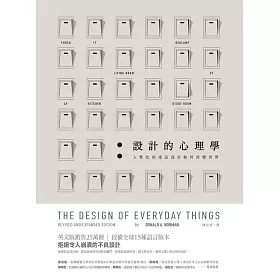 The Design of Everyday Things, Donald A. Norman / translated by Chen Yi-hsiu, Yuan-Liou Publishing (image source: Books.com.tw)
About The Design of Everyday Things
My own background is in cognitive linguistics, so I’ve always gravitated toward books about cognition — Po-Jang Hsieh’s brain science book is one of my favorites (see my review: Your Brain Is Lying to You).
The Design of Everyday Things: Revised and Expanded Edition has been on my reading list for ages, but I kept putting it off, thinking “design” felt a bit removed from my world.
It wasn’t until I started getting into UX (User Experience) that I finally picked it up — and immediately couldn’t put it down XD
Donald A. Norman is a truly cross-disciplinary mind with backgrounds in both engineering and psychology. His integration of design and behavioral science has made a major contribution to the contemporary design field.
I’m still slowly working through the English original alongside the Chinese translation, but my impressions up to Chapter 2 are very positive: the explanations are clear, the examples are well-chosen, and it bridges design and behavioral science beautifully. There’s also always more depth to dig into in each section, making it accessible for beginners and rewarding for those already familiar with the field.
In the prefaces, multiple contributors bring up an interesting observation: this is also a personal development book. One of them, Tsai Ming-che, writes:
On the surface, this is a book about cognitive psychology and design — yet the principles and case studies extend into the humanities, technology, society, and organizational management. It can serve as a foundation for personal growth as well as a framework for product design thinking.
Forewords tend to overstate things, but when several different writers all independently say the same thing, I took notice.
I’m usually skeptical of anything framed as “personal growth” — but reading this book genuinely changed how I think about everything I do on a daily basis, not just design or cognitive science.
We’re living in an age where user experience reigns supreme.
I’ve been taking a lot of courses recently — things like information design, visual storytelling, and UI/UX with Figma — and all of them come back to the same core idea: start from the audience’s perspective.
It’s becoming clear that every field is shifting its focus from “machines” and “knowledge” toward people.
So I started asking myself: in everything I’ve done (and will do in the future), what could be improved?
Research papers → Writing for experts: Am I presenting new insights? Is the argument logical? Does it address the core research question?
Science communication → Writing for general audiences: Am I finding ways to make new ideas feel relevant to everyday life? Can I present new information so it gets absorbed effortlessly?
Talks → Speaking for interested audiences: Can I build from the simple to the complex, clearly and logically?
Teaching → Working with students: Does the content actually meet the stated goals? Am I helping them convert information into real knowledge?
Design → Writing and layout for general audiences: Am I using clear information architecture to explain new things well?
I’m convinced these reflections will meaningfully improve everything I do — writing papers (XD), designing things, teaching, and speaking.
Highly recommended for everyone, especially if your work involves reaching any kind of audience. This book can genuinely be a reference standard XD
I usually write a complete review all at once, but with this one I decided to go chapter by chapter and add my own reflections as I go.
So let’s take it slow :P
The Chinese translation is solid, though some English terms feel clearer in the original. I’ll include both where I can.
Chapter 01: The Psychopathology of Everyday Things
Have you ever had this experience:
You’re standing in front of a door. You push, you pull, you try everything — and it won’t open. Then you realize it slides sideways.
Yeah, me constantly. And every time, I think: I’m so dumb.
It’s interesting that the book opens with the word “psychopathology” — that felt heavy at first. But it’s actually borrowed from Freud’s The Psychopathology of Everyday Life, which is really about mistakes and slips in everyday life.
As technology gets more complex, everything becomes more complicated. A TV remote that used to need only on/off now has fifteen buttons; a watch that used to just tell time now monitors your heart rate, counts your steps, and takes calls. This is exactly when badly designed things start to pile up.
Norman uses that mysterious door as an example of “bad design” — what it does to us — and then flips the question to ask what “good design” actually looks like.
So what makes good design? Norman says it needs to satisfy two things:
- Discoverability: Can the user figure out what actions are possible? And how to perform them?
- Understanding: What does this mean? How is this product supposed to be used? What does each setting do?
A user should be able to easily discover what a product can do and quickly understand how to operate it and what will happen as a result.
If this can be achieved effortlessly, that’s good design.
Moving beyond traditional industrial design, interaction design, and experience design, Norman advocates for Human-Centered Design (HCD) — ensuring that design meets the needs and abilities of actual users.
He then introduces several key concepts:
Affordances
An affordance is a relationship between the properties of an object and the capabilities of the agent that determine just how the object could possibly be used.
In simple terms, it’s the relationship between a person (the actor) and an object.
A chair’s purpose is to “support,” so it can be “sat upon.” Some chairs are light, which means they have the affordance of being “lifted”; but some chairs are very heavy, or a small child simply can’t lift them — so in those cases (or for those people), the chair doesn’t have the “liftable” affordance.
So affordance isn’t a property of the object itself — it’s a relationship.
Some affordances are obvious: a person can quickly perceive the function and act on it (a cup with a concave interior clearly signals it can hold liquid).
But some affordances aren’t obvious — just looking at something won’t tell you what it does. That’s where the next concept comes in.
Signifiers
In this book, a signifier is something that indicates where an action should occur.
As mentioned above, some objects have a perfectly good affordance, but users don’t know how to act on it. A signifier can be added to tell users what to do or how to use it.
Things like “Push” or “Pull” labels on doors, or icons on app buttons — those are signifiers.
The concept of “signifier” has roots in semiotics and is also used in linguistics (where I usually render it as “signifiant,” as opposed to “signifié”).
In linguistics, it refers to a sign that triggers a mental image in people’s minds — the word “dog,” for instance, summons up a fuzzy, four-legged creature in our minds.
Norman uses “signifier” a bit differently from semiotics or linguistics, but the key function is the same: it’s a signal that points you toward an action, helping users know what they can and can’t do.
A button, for example, has the affordance of being pressed — but pressed to do what? If you see a 🔇 symbol on it (a signifier), you naturally think “mute” and understand that pressing it will turn off the sound.
Unlike affordances, signifiers must be perceivable and clear — otherwise they fail. If the mute symbol is 🔇 but it’s so tiny you can’t find it, or if the symbol doesn’t match the mental image we have, it doesn’t work.
Mapping
Mapping is about finding the relationship between two elements or two sets.
For instance, if five light switches are arranged left to right along a wall, and five lights are similarly arranged on the ceiling, good mapping would mean the leftmost switch controls the leftmost light.
Mapping is often conveyed through spatial arrangement, with two small Gestalt psychology concepts at play:
- Grouping: Related things should be grouped together (e.g., light switches and air conditioning controls should be in separate groups)
- Proximity: Related things should be placed near each other (e.g., the switch for a light should be near that light)
Feedback
Feedback communicates the result of an action, and it should be immediate.
If you press the button on a recorder and a message says “Recording started” — that’s good feedback.
If you press it and nothing happens, you naturally feel frustrated and confused: is this thing broken?
But the amount of feedback matters too.
You can’t just flood users with messages every time they do anything. Feedback needs to be appropriately timed and informative enough to let users know what’s happening — too much becomes annoying.
Conceptual Models
A conceptual model is a simplified, conceptualized explanation of how something works.
For example, a computer uses “folders” and “files” to describe how data is organized — but of course there are no actual folders and files inside a computer. These are just mental constructs that help you understand how to work with the data.
Conceptual models are mainly derived from the structure of the thing itself.
But they can vary from person to person based on their background and prior experience. A software engineer and a regular user will have very different conceptual models of how the same program works.
Why does this matter? Because conceptual models provide a way to predict what will happen and a way to troubleshoot when things go wrong.
A good conceptual model lets you use something intuitively; without one, you’re stuck following instructions one step at a time, with no idea what consequences each action might have down the line.
The System Image
A designer may have a clear conceptual model of their product — but users can’t interact with the designer directly. How do they form their own conceptual model? That’s what the system image is for.
The system image includes everything that communicates what a product is and how it works: prior experience with similar products, marketing copy, manuals, what a salesperson says, related articles, and more.
When all of this information integrates well, it helps users build a solid conceptual model.
When it doesn’t integrate, using the product feels very difficult.
Chapter 01: Wrap-Up
These five concepts might feel a bit abstract at first, but they come up again and again throughout the book and eventually become second nature.
Subsequent chapters (like Chapter 2) will gradually explore how these concepts relate to human behavior and product design, so you don’t need to fully absorb them all right away.
I also recommend reading alongside the English original — it really helps clarify the context.
Norman argues that by mastering these five concepts, it’s possible to design products that make life genuinely simpler.
One of the real challenges, he notes, is that different disciplines have such different priorities — marketing cares about price, engineering cares about function, manufacturing cares about feasibility — and getting everyone aligned is hard.
The hardest part is convincing people to understand each other’s perspectives, let go of their own professional biases, and think from the consumer’s and user’s point of view.
Title: The Design of Everyday Things: Revised and Expanded Edition
Author: Donald A. Norman
Translator: Chen Yi-hsiu
Publisher: Yuan-Liou Publishing
Thanks for reading :D
If you enjoyed this post, feel free to click the coffee button in the lower right to support us and give Lottery a can 🐾
Comments