life
[Book Review] The Design of Everyday Things: How Psychology Shapes Action — Starting with a Terrible Thermometer. Ch.02: The Psychology of Everyday Actions
This post covers Chapter 2 of The Design of Everyday Things: Revised and Expanded Edition by Donald A. Norman — “The Psychology of Everyday Actions.” Starting from learned helplessness, this chapter digs deep into the relationship between human psychology, emotion, and action. Recommended for anyone interested in cognitive science or UX, and really for anyone in a field that involves communicating with an audience.
 The Design of Everyday Things, Donald A. Norman / translated by Chen Yi-hsiu, Yuan-Liou Publishing (image source: Books.com.tw)
A Quick Recap of The Design of Everyday Things
In the previous post, I covered how The Design of Everyday Things introduces Human-Centered Design (HCD) — the philosophy of designing from the user’s perspective — along with five foundational psychological concepts. Let me try to illustrate those concepts with a single example before diving into Chapter 2 (for a fuller introduction, see the Chapter 1 review):
Imagine I just bought a Dyson bladeless fan. It looks nothing like a traditional fan.
- Affordances: Based on its structure, I can tell the circular opening is meant to blow air (and for some people, it also has an air purification function)
- Signifiers: It comes with a remote control, and the icons on the buttons tell me what each one does
- Mapping: Temperature-related buttons are grouped together on the remote and arranged vertically — up for stronger, down for weaker, which matches my mental model; directional airflow buttons (narrow vs. wide) are arranged horizontally, suggesting they’re in the same category
- Feedback: When I press a button, the fan’s display shows me the current setting (strength, mode, etc.)
- Conceptual Model: I have a clear enough model to use it — there’s a remote to turn it on, hot/cold modes, strong/weak settings, narrow or wide airflow, and a night mode (though I don’t actually know how a bladeless fan blows air; the designer’s conceptual model would be far more detailed)
- System Image: From information I found online, the manual, and the icons on the remote, I can figure out how to operate it (I’ve built my own conceptual model); and when the display shows “Error,” I know where to look for help
These five concepts will keep coming up in later chapters — this is just a quick recap.
Chapter 02: The Psychology of Everyday Actions
Chapter 2 gets into the heart of it: the relationship between human cognition and behavior.
Let me reorganize the material in the order that makes most sense to me.
You Keep Using It Wrong. Is It Just You?
A while back, my parents got vaccinated, and we dug out a thermometer to test it.
I pressed the only button, held it to my forehead — and it beeped once and showed “Error,” then shut off automatically.
I tried again and again. Nothing worked. I finally went online to find the manual.
Reading documentation for a similar model, I discovered it wasn’t just a forehead thermometer — it was also an ear thermometer, with different error codes and different operating procedures for each mode.
In the end, I gave up and went back to a trusty old mercury thermometer.
That’s a true story from a few days before I wrote this. I’m someone who’s usually pretty comfortable with technology, and it was the first time I felt that helpless. The manual said: “If Error displays at startup, the battery might be dead.” I swapped in a fresh battery. Still Error.
So I quit.
That thermometer had so many problems: its “feedback” was unclear — I didn’t know what kind of Error; there were no clear indicators for which mode to use for the forehead, or for the ear.
This failure made me completely give up on that thermometer and go back to the most basic option available.
That thermometer stands in for any product you’ve ever encountered and had no idea how to use. I notice this especially when helping older adults with apps like LINE — and it has a name: learned helplessness.
Learned Helplessness
Learned helplessness is the feeling of resignation that sets in after repeated failures — the sense that something is impossible, or that you personally can’t do it — which causes you to stop trying altogether.
It’s why some people are scared of math, and why older adults often resist or refuse to engage with technology.
The strange thing is: when we run into this problem, if we don’t know that other people have had the same struggle, we tend to assume it’s our own fault.
Over time, we start calling ourselves “technologically useless” or a “device killer,” and we just avoid those kinds of products entirely.
But Norman’s point is that the real problem is the design — not the user’s ability. The fault lies with the product.
The Relationship Between Emotion and Action
A badly designed product triggers frustration.
But what about a well-designed one?
Norman cites Mihaly Csikszentmihalyi’s research and introduces the concept of “flow”:
In a state of “flow,” people lose track of time and external surroundings, fully absorbed in the activity.
In other words, someone in flow doesn’t feel outside interference — they’re completely immersed.
Think about playing a game you love: if it’s engaging enough, you’re totally in it, and suddenly three hours have passed XDDD
This quote hits even harder when you think about games:
In flow, you and what you’re doing become one. The activity has to be at just the right level of difficulty — challenging enough to keep your attention, but not so hard it leaves you frustrated or anxious.
When I played Persona 5 Strikers, I’m genuinely bad at action games, so I started on Normal — and got absolutely destroyed, repeatedly XDDD My mood was terrible. I was almost ready to quit.
Then the game suddenly asked if I wanted to switch to Easy mode.
And I… said yes. No shame XD
After that, I sailed through it. There were still difficult moments, but nothing that triggered learned helplessness.
I finished it quickly and happily :P
Controllability is a core feature of games, so difficulty scaling is natural. By finding the right balance, players get drawn into flow and enjoy the game more.
But for tool-type products, ease of use should always be the goal:
The less mental effort it takes to use something, the better — ideally, you shouldn’t even notice it’s there, as long as it helps you achieve your goal.
It’s a lot like typeface design: a good typeface is invisible. You never consciously register it — you just read smoothly.
From the learned helplessness example to the concept of flow, something becomes clear:
Our cognition and emotions have a huge impact on our behavior.
Human Cognition and Emotion
In almost all of our interactions with the world, both “cognition” and “emotion” are involved.
Cognitive activity tends to generate emotion, and emotion in turn drives cognition and thought (which comes first is still an open question). Simply put:
- Cognition: understanding the world
- Emotion: assigning value to what we understand
But not all of our actions are conscious — many happen subconsciously.
When you’re learning to drive for the first time, you might be nervous about which gear to use and how to work the throttle. You’re not yet familiar with it, so it takes a lot of cognitive effort — slow and taxing.
But an experienced driver who sees a red light, a hill, or a gear change handles it effortlessly, without needing much conscious attention at all.
Why the difference? When we learn and become familiar with something, the brain “generalizes” — it categorizes familiar experiences so they can be handled without much deliberate thought. They become intuitive reflex responses.
(This mirrors flow: learning to drive at first is too challenging, so it takes a lot of cognitive effort; once the knowledge is internalized, it becomes smooth and automatic.)
(For more on the brain’s amazing ability to generalize, check out Po-Jang Hsieh’s book — see my review: Your Brain Is Lying to You)
Norman chooses a simplified three-level framework to introduce the human cognitive-emotional system:
Visceral Level
The most basic level — instinctive, subconscious reactions that generate emotional responses without any analysis of the cause.
Examples: fear of heights, fear of the dark, taste preferences, aesthetic preferences for design styles.
These are rapid, automatic, gut-level responses.
Behavioral Level
Learned skills that get triggered in familiar situations. You’re aware that you’re doing something, but you’re not thinking about the details. Also largely subconscious.
Examples: picking up a cup of water, grasping objects, eating — routine physical actions like these.
Reflective Level
Conscious cognition involving deliberate thought, reasoning, and decision-making. This generates the most complex emotions, because you’re evaluating causes, anticipating future responses, and reflecting on meaning.
All three levels are tied to cognition and generate different kinds of emotion.
The visceral level involves the least consciousness — emotional reactions come fast and fade fast. The reflective level involves the most consciousness — emotional reactions are more complex and linger longer.
In design, these map onto different priorities:
- Visceral level: Related to “design aesthetics” — people may not be able to articulate it, but color, shape, typography, and sound all trigger instinctive responses
- Behavioral level: Every action the user takes comes with an expectation; giving clear feedback reassures the user at this level
- Reflective level: Because these emotions last longest and can become memories, they have the most lasting impact on how someone feels about a product
Here’s how this plays out in practice. When you first encounter a product, you might be annoyed by the color scheme or typography — but you might get used to it over time.
Then you start using it. If you’re guided well and the result is good, you learn how to operate it.
But if the product pushes you into negative reflective processing (like that thermometer) — you’ll never want to use it again, and you’ll avoid everything made by that company.
The Seven Stages of Action
With cognition and emotion covered, here are the seven stages of human action:
- Goal: Form a goal
- Plan: Choose an action
- Specify: Decide on a sequence of steps
- Perform: Execute the action
- Perceive: Observe the state of the world
- Interpret: Make sense of what was perceived
- Compare: Evaluate how the outcome compares to the goal
These seven stages have a directional flow, but can be triggered in two ways:
Goal-driven: An action motivated by a goal
Data-driven / Event-driven: Triggered by something that happens in the world
These seven stages are a valuable design tool — whenever users run into trouble at any stage, you can identify the problem and improve the design.
Each stage also maps onto the cognitive and emotional levels discussed above. Here’s the table I put together based on the book:
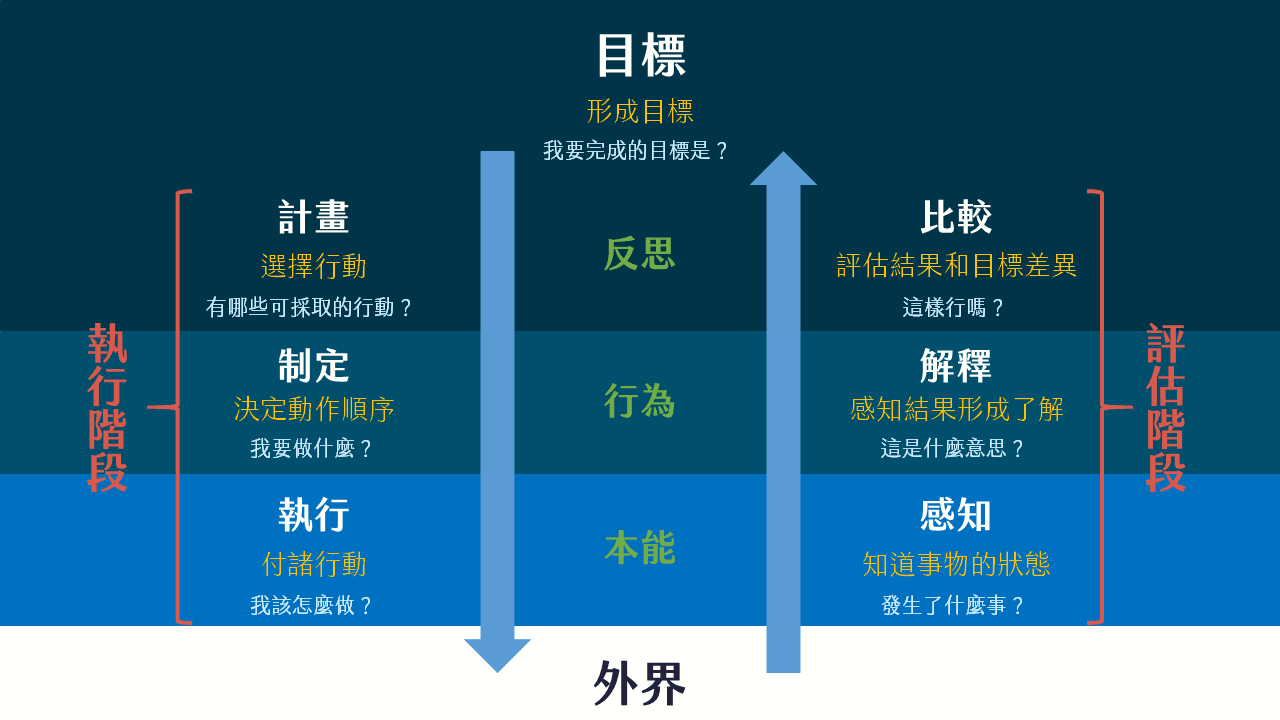 Table adapted from figures 2.2, 2.4, and 2.7 in The Design of Everyday Things
The left-side stages — Plan, Specify, Perform — make up the execution phase:
- Plan: Reflective level — you think about what actions are available
- Specify: Behavioral level — the user decides on a sequence of steps
- Perform: Visceral level — having already thought it through, you just act; minimal conscious involvement
The right-side stages — Perceive, Interpret, Compare — make up the evaluation phase:
- Perceive: Visceral level — you take in what happened, observing the state of things
- Interpret: Behavioral level — making preliminary sense of what you perceived, asking “what does this mean?”
- Compare: Reflective level — evaluating the gap between goal and outcome: did this work? Should the goal be adjusted? Is there a better approach?
These seven stages form a loop — and they’re also a valuable design checklist, helping designers verify that the design is complete. Every stage comes with questions users need answered, and good design addresses each of them.
The Seven Fundamental Principles of Design
We’ve moved from learned helplessness to understanding why people develop negative feelings toward products, and how those feelings are rooted in cognition. Then we looked at the three levels of cognitive emotion and mapped them onto the stages of human action. By now, we understand:
What cognitive and emotional levels drive human action, and the critical questions at each stage.
Since this can serve as a checklist for evaluating design quality, what tools can help us answer the user’s questions at each stage?
Norman proposes seven fundamental design principles:
- Discoverability: The design helps users know what actions are possible and what state the product is currently in
- Feedback: Provides full information about the result of the current action, letting users know what’s happened and what state things are in
- Conceptual model: Provides the right information for users to build a good mental model and know how to operate the product
- Affordances: Uses appropriate affordances to draw the user’s attention to necessary interactions
- Signifiers: Uses appropriate signifiers to ensure discoverability and support good feedback
- Mappings: Deliberately arranges controls in time and space so users understand the relationship between actions and their effects
- Constraints: Uses physical, logical, semantic, and cultural constraints to guide action and reduce unnecessary explanation
You’ll notice that all of these — except the last one — were already introduced in Chapter 1.
Chapter 2 is where we finally understand that all these design principles are grounded in human cognition, emotion, and action. Now the “why” behind each one becomes clear.
Chapter 02: Wrap-Up
I’ve reorganized Chapter 2 a bit from its original order — toward the end of the chapter, Norman actually begins talking about errors in use, which leads into Chapter 3.
This chapter is quite heavy on cognitive science, but it’s grounded throughout in real examples (like fire doors and badly designed sink drains) that make everything click.
All the content is tightly connected, and seeing how the key design principles from Chapter 1 emerged from this framework is genuinely satisfying.
Title: The Design of Everyday Things: Revised and Expanded Edition
Author: Donald A. Norman
Translator: Chen Yi-hsiu
Publisher: Yuan-Liou Publishing
Thanks for reading :D
If you enjoyed this post, feel free to click the coffee button in the lower right to support us and give Lottery a can 🐾
Comments