Learning Chinese with Podcasts (1): 3 Reasons TCSL Teachers Should Know Podcasts
Riding the podcast wave, using podcasts for learning Chinese offers tremendous benefits for TCSL. This post is based on a paper presented at the 2020 Taiwan TCSL Conference — 'More Than Just Learners: The Diverse Applications of the New Generation of Podcasts for Chinese Learners and Teachers' — and covers why Teaching Chinese as a Second Language teachers should pay attention to podcasts.
Podcasts Are Everywhere — But What Actually Are They?
The word “podcast” is a portmanteau of “Pod” (from iPod) and “broadcast.” If you’ve never come across the term before, think of it as internet radio — except there’s no regulatory body controlling who can publish. Anyone with a phone or computer can start one, and anyone can listen using any number of apps or platforms.
We used to learn languages with CDs, then we migrated to MP3 files. Now, in the age of streaming, podcasts are the medium of choice. Since most podcasts are audio-only (a small number include video, but that’s still niche), they’re a natural fit for supplementary language materials — textbook audio tracks, post-class content, you name it.
The podcast boom in Taiwan started around late 2019, though it’s actually closer to the second or third wave. There were smaller ripples in 2009 and 2016, but those didn’t catch on widely — the barrier to entry was too high, and listener habits hadn’t formed yet (which also relates to the rise of wireless earbuds). Most of the early creators were institutions or group projects that required significant time and technical expertise.
This more recent wave succeeded because the barrier to entry dropped significantly. More creators joined, content diversified, and formats multiplied.
Reason 1: Diverse Formats, Rich Content
Because anyone can become a podcaster, the Chinese-language podcast landscape has grown into something quite varied. If you map existing Teaching Chinese as a Second Language (TCSL) podcasts along two axes — structural completeness and proportion of Chinese used — you get something like this:
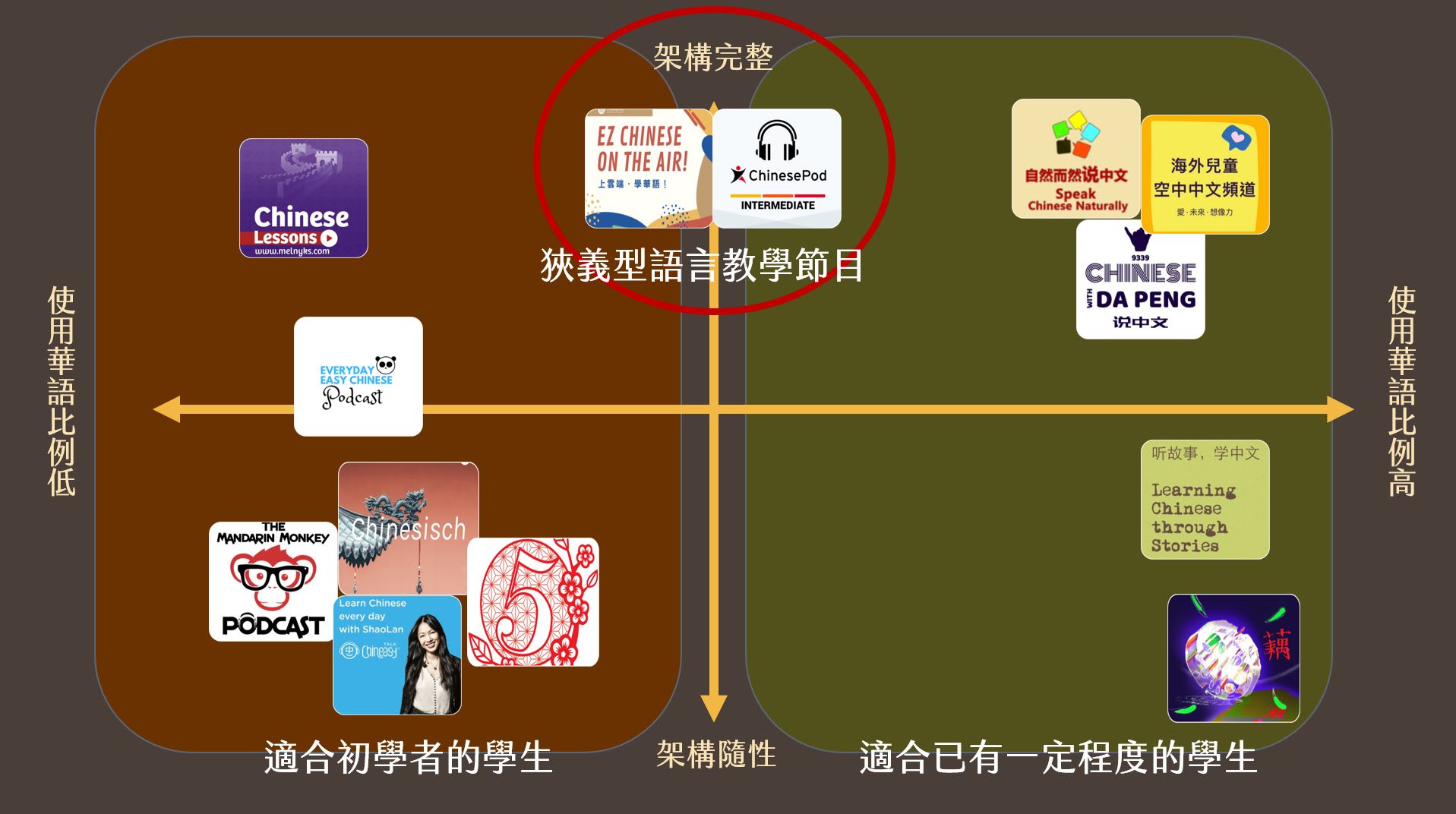
Traditional, narrowly-defined language learning shows tend to be structurally complete and use less Chinese. Shows with a high proportion of Chinese are better suited for students with a stronger foundation. Students at lower levels have plenty of options on the left side of the chart.
Some people might assume a language podcast should have a rigid structure — lesson text, vocabulary, sentences, cultural notes, and so on. But is that format actually the best fit for Chinese learners? I think we need to consider how users actually listen.
Reason 2: Most Users Already Have a Podcast Habit
According to a survey reported in Taiwan Podcast Data: Who’s Listening? A Deep Dive into Listener Profiles and Habits, the listener base grew rapidly in just one year — and among those listeners, half were tuning in five or more days per week. That’s a remarkable usage habit.
Think about it: how many times have you told students to go practice with MP3 files and they just… didn’t? But if they already have a podcast habit, switching to a Chinese-language show is barely more effort than changing a channel.
(Chart: listening tenure vs. days per week — source survey)
The data on listening context is even more telling:
(Chart: listening context — source survey)
People are mostly listening during downtime, while doing chores, or commuting — fragmented, low-focus moments. Think about it honestly: in those situations, would you choose something dense and rigorous, or something more relaxed?
Personally, if my time is fragmented, I’d rather save the meaty, note-worthy content for when I can actually sit down and concentrate.
The takeaway:
Given how people actually listen to podcasts, the medium is well-suited for pushing to language learners — it’s convenient and many already have the habit.
But show producers need to think carefully about purpose and listening context when deciding on a format.
If a student is motivated and likes to self-study systematically: point them toward a traditional structured language learning show.
If a student just wants low-effort, regular exposure: almost any format works.
Reason 3: Podcasts Do More Than Build Listening Skills
A lot of people assume podcasts only train listening comprehension. Not at all! For one thing, the podcast format technically supports visual content too — it’s just not widely used yet. But even audio-only podcasts have far more applications than listening practice alone.
(1) Speaking Practice with the Echo Method
You’ve probably heard of the Echo Method, pioneered by Karen Steffen Chung at National Taiwan University.
If you haven’t seen it yet, take a look:
Or you can read the transcript of my interview with her: Why Your Spoken Language Isn’t Improving — And It’s Not What You Think
Her argument: the root cause of poor spoken language isn’t lack of confidence — it’s not listening closely enough. Improving your listening actually improves your speaking. Here are the steps of the Echo Method:
- After hearing a sentence, pause for the same length of time, listen to the echo in your head, then say it aloud. Repeat until fluent, then advance to the next stage.
- After hearing a sentence, immediately repeat it aloud. Repeat until fluent, then advance.
- Shadow the original audio in real time.
Applied to TCSL, Podcasts are excellent input material — and exposure to authentic spoken Chinese also helps students in everyday language use.
(2) Podlog? Audio Journaling
Some people keep written diaries; others use vlogs to document daily life. Maybe a “podlog” (?) could serve as an audio journal for language learners.
Some shows are already run by learners documenting their self-study journeys. Since the barrier to entry is low, students really can use this format to record their daily lives — even five minutes a day can be a meaningful speaking practice routine.
(3) The TCSL Teacher’s Extended Classroom
Podcasts can also become an extended classroom for TCSL teachers, in two different directions.
One is the teacher’s own professional development (see related posts).
The other is treating it as a virtual classroom extension — record supplementary materials or reference content, giving learners something to engage with after class.
(4) Building an International Reputation (Maybe?)
If a show takes off and reaches learners abroad, it could become a source of income (some shows already run subscription or membership models) and even a way to attract future students when they come to Taiwan looking for a teacher.
It’s the kind of thing you can’t force — but there’s no reason to rule it out. :P
Those are the three reasons I think TCSL teachers should pay attention to podcasts. Given how accessible and useful the medium has become, there’s every reason to make the most of it.
Thanks for reading this series! You’re also welcome to dig into the original academic paper: More Than Just Learners: The Diverse Applications of the New Generation of Podcasts for Chinese Learners and Teachers XD
Other posts in this series:
Learning Chinese with Podcasts (2): 10 Recommended Podcasts for Learners
Learning Chinese with Podcasts (3): 7 Thematic Podcast Categories for Learners
Learning Chinese with Podcasts (4): 7 Teaching-Related Podcasts for TCSL Teachers
Feel free to share any questions or thoughts in the comments. Thanks! <3
Thanks for reading :D
If you enjoyed this post, feel free to click the coffee button in the lower right to support us and give Lottery a can 🐾
Comments