travel
[Iceland] Pre-Trip Planning Guide: Itinerary, Transport, Weather, Aurora Hunting & Accommodation
You can view the full day-by-day route and accommodation on Wanderlog here 🙂
Other Iceland posts:
- Iceland | South Coast Part 1: Seljalandsfoss, Skógafoss & Reynisfjara Black Sand Beach
- Iceland | Golden Circle: Þingvellir National Park, Geysir Hot Spring Area & Gullfoss
- Iceland | Reykjavík City: Parking, Hallgrímskirkja, Rainbow Street, Best Hot Dogs & Harpa
- Iceland | Pre-Trip Planning Guide: Itinerary, Transport, Weather, Aurora Hunting & Accommodation
How It Started & Daily Itinerary
Iceland always comes up in conversations about beautiful places — it wasn’t on my bucket list, but it was on my family’s. So we planned a trip for autumn 2025.
Five of us in total: me, my husband, my younger sister (30s), and my parents (60s). Excluding flights and the arrival night (we landed very late), we had 11 actual days of travel. Our backbone was the Ring Road — we skipped the Westfjords and the northern villages, moved through the east fairly quickly, and spent most of our time in the south, around Lake Mývatn, and the Snæfellsnes Peninsula.
Full route on Wanderlog here 🙂
- Day 1 (2025/09/24) | Arrival TPE (China Airlines) → London LHR T3 → LHR T2 (Icelandair) → KEF → Lotus car rental → Vogar [Stay: Ocean Front Villa]
- Day 2 (2025/09/25) | Reykjavík City Vogar → Reykjavík (Hallgrímskirkja, Rainbow Street, Icelandic Street Food, Tjörnin, Bæjarins Beztu Pylsur, Starbucks, Harpa, Sun Voyager) → Vogar [Stay: Ocean Front Villa]
- Day 3 (2025/09/26) | Golden Circle Vogar → Lögberg, Öxarárfoss, Strokkur Geyser, Gullfoss → Selfoss: Bónus supermarket [Stay: Hotel Vatnsholt]
- Day 4 (2025/09/27) | South Coast Part 1 Selfoss → Urriðafoss → Lava Center → Seljalandsfoss → Mia’s Country Van → Skógafoss → Reynisfjara Beach → Vík → Kirkjubæjarklaustur [Stay: Lakeview cabin near Kirkjubæjarklaustur]
- Day 5 (2025/09/28) | Glacier Hike Kirkjubæjarklaustur → Vatnajökull glacier → Fjaðrárgljúfur Canyon → Kirkjubæjarklaustur [Stay: Lakeview cabin near Kirkjubæjarklaustur]
- Day 6 (2025/09/29) | Glacier Lagoons & Höfn Kirkjubæjarklaustur → Fjallsárlón → Jökulsárlón (boat tour) → Höfn: Pakkhús Restaurant [Stay: Höfn Inn Guesthouse]
- Day 7 (2025/09/30) | Heading North Höfn → Djúpivogur: Eggin í Gleðivík → Egilsstaðir: Askur Pizzeria → Lake Mývatn [Stay: Sel-Hotel Myvatn]
- Day 8 (2025/10/01) | Mývatn Horseback Riding, Hot Springs, Goðafoss & Akureyri Mývatn: Safari Horse Rental, Dimmuborgir, Krafla, Námafjall Hverir, Mývatn Nature Baths → Goðafoss → near Akureyri [Stay: Charming Cabin close to Akureyri]
- Day 9 (2025/10/02) | Akureyri → Heading West Akureyri → Blönduós: Blönduóskirkja (Black Church) [Stay: Laxás Cottage Blönduós]
- Day 10 (2025/10/03) | Hvítserkur Rock & Snæfellsnes Blönduós → Vatnsdalshólar → Hvítserkur → Selvallafoss → Grundarfjörður: Bjargarsteinn Mathús [Stay: Stöð Guesthouse and Apartments]
- Day 11 (2025/10/04) | Snæfellsnes Peninsula Kirkjufell & Kirkjufellsfoss, Ólafsvíkurkirkja, Ingjaldshóll Church, Skarðsvík Beach, Svörtuloft Lighthouse, Djúpalónssandur Black Beach, Lóndrangar, Dagverðará ruins, Bard of Snæfellsás monument, Búðakirkja, Ytri Tunga seal beach → Grundarfjörður [Stay: Stöð Guesthouse and Apartments]
- Day 12 (2025/10/05) | Back to Reykjavík Grundarfjörður → Ytri Tunga → Borgarnes → Indjánahöfði → Lotus car return → Keflavík: Völlur Mathöll food hall [Stay: Konvin Hotel by Reykjavik Keflavik Airport]
- Days 13–14 (2025/10/06–07) | Return Home KEF (Icelandair) → London LHR T2 → T3 (China Airlines) → Taipei TPE
Transport
Flights
We went with China Airlines because we’re members and didn’t want my parents to deal with too many connections — so we flew through London and transferred to Icelandair. Round-trip tickets came out to around NTD 50,000–60,000 each; it was probably peak season. If you want to save money, check routes with more connections.
A few notes:
-
If you’re not based in Taoyuan, Taiwan’s main carriers (China Airlines, EVA Air, StarLux) offer combined THSR + flight tickets — worth checking
-
We booked through-tickets, so check-in at TPE covered us all the way to Iceland. Since we transited airside at LHR, no UK ETA was required, and we didn’t collect our bags
-
Transfer between LHR T2 and T3 is by shuttle bus — you clear security but not immigration
-
Icelandair has no included meals, no free seat selection, and entertainment costs extra. Treat it like a budget airline and bring snacks
-
For the return, I strongly recommend online check-in. At the airport, scan your boarding pass at a kiosk and it prints baggage tags directly — much faster than queuing for counter check-in
Car Rental
Driving yourself is by far the most practical way to get around Iceland. With five people, a car made everything easy. If you can’t self-drive, tours out of Reykjavík can still get you to the Golden Circle and glacier hikes.
We rented from Lotus: a Toyota RAV4 4WD with platinum insurance, from 23:30 on 09/24 to 22:00 on 10/05 — 11 full days, with two additional drivers (three drivers total). Total: NTD 61,184. Not cheap, but Iceland has too many unpredictable situations to scrimp on a rental. Outside summer, you may hit heavy rain or snow, so 4WD is genuinely necessary if you’re visiting in autumn or winter or going anywhere near mountain roads.
Five people plus a Toyota RAV4 means luggage puzzle-solving. The boot isn’t large, so we cut down:
- 2 large suitcases
- 2 small carry-on cases
- 3 backpacks (one usually stayed in the back seat)
- 1 large hiking pack
This required Tetris-level packing. If you have more luggage, or plan to self-cater heavily, go with a bigger vehicle.
Insurance
Get the full coverage. Seriously. Iceland’s weather is wildly unpredictable, you can hit loose gravel at any time, and sheep are everywhere.
I looked at third-party add-ons like Rental Cars, but their coverage had gaps and potential post-trip scrutiny. We ended up going with Lotus’s platinum insurance, which in practice meant: no inspection on pickup, and when we returned the car they couldn’t even find it in the lot and just said “all good” 😂
When comparing insurances, check whether they cover:
- SCDW (Super Collision Damage Waiver)
- GP (Gravel Protection)
- SAAP (Sand and Ash Protection)
- TI (Tire Insurance)
Also confirm it covers door damage (strong wind can literally rip car doors off in Iceland) and animal collisions. I thought the animal coverage was just marketing — until we actually had sheep running in front of the car multiple times. Not a joke.
Lotus platinum insurance includes: a free pocket WiFi (very useful), 6 free coffees at N1 stations, and an N1 fuel discount card.
Fuel
Fuel in Iceland is fully self-serve. Two main setups:
- N1: Insert credit card (mine didn’t require a PIN, but have a 4-digit PIN ready just in case) → select pump → fill up → hang up nozzle. It charges for the actual amount used. For a receipt, insert card again after.
- Other stations: Insert card → select a spending cap (e.g. ISK 10,000) → select pump → fill up → hang up.
Our Lotus platinum card gave us the N1 discount. That said, Orkan is often a bit cheaper than N1, so it’s worth checking. Prices also vary by location — keep an eye out when you’re somewhere different.
Some stations are tiny. Others are large enough to have restrooms and a restaurant — great for a mid-drive break on long stretches.
Roads
Always check road conditions at Vegagerðin before heading out — it shows closures and alerts. We actually had a section of the Ring Road close on us during our trip, and that’s how we found out.
- Capital area: Streetlit roads from the airport to Reykjavík — no worries at night
- Ring Road (Route 1): Iceland’s main artery. Generally smooth and well-maintained, but unlit at night outside the capital area. If you want to play it safe, stick to Route 1
- F-roads: Mountain roads (fjalla = mountains). Closed outside summer. Four-wheel drive only. The scenery can be stunning, but you may cross streams and hit pure gravel tracks. Every pothole is 10+ cm deep. If you’re not prepared, don’t go. We did one stretch — once was enough 😅
Iceland is also much larger than it looks. A comfortable daily driving range is around 3 hours; over 5 hours and it gets genuinely exhausting. Always open Google Maps and check driving time when planning. In winter or early spring, daylight is short and conditions unpredictable — factor in a lot more buffer.
Parking
Parking in Reykjavík and most tourist spots costs money. Download Parka — it uses your phone’s GPS to find nearby lots and shows whether they’re compatible for in-app payment. You can also pay at the physical machine with a credit card if you prefer.
Tourist attraction parking is usually ISK 800–1,200 per visit; one payment covers the full day (until 23:59).
Important: Some parking zones have cameras, and non-payment results in a fine. Pay every time.
One caveat: for attraction-specific lots, I found the physical machine slightly cheaper than Parka. Use your judgment.
Tunnel Toll
There’s only one tolled tunnel in Iceland: Vaðlaheiðargöng, between Lake Mývatn and Akureyri. You need to pay within 24 hours of passing through at the official website — enter your license plate number and pay.
Miss the window and you’ll get a fine.
2025 rates (one way):
- Under 3.5 tonnes: ISK 2,152
- 3.5–7.5 tonnes: ISK 2,968
- Over 7.5 tonnes: ISK 6,255
Some people take the bypass road to avoid the toll — apparently it doesn’t add much time. But in winter conditions, the tunnel is safer.
Weather
Insane. That’s my entire summary 😄
In autumn, the weather shifts constantly — and I mean constantly. A typical day: torrential rain in the morning → brilliant sunshine at noon → downpour after lunch → sun shower with a rainbow at dusk → heavy rain in the evening, but an hour later you’re looking at the northern lights.
If you learn to read the forecast, you can actually work with this. Except for Day 3 (Yellow Alert, no escaping that one), we used the forecast to move attractions around and mostly stayed dry while in motion. Rain usually only caught us back in the car.
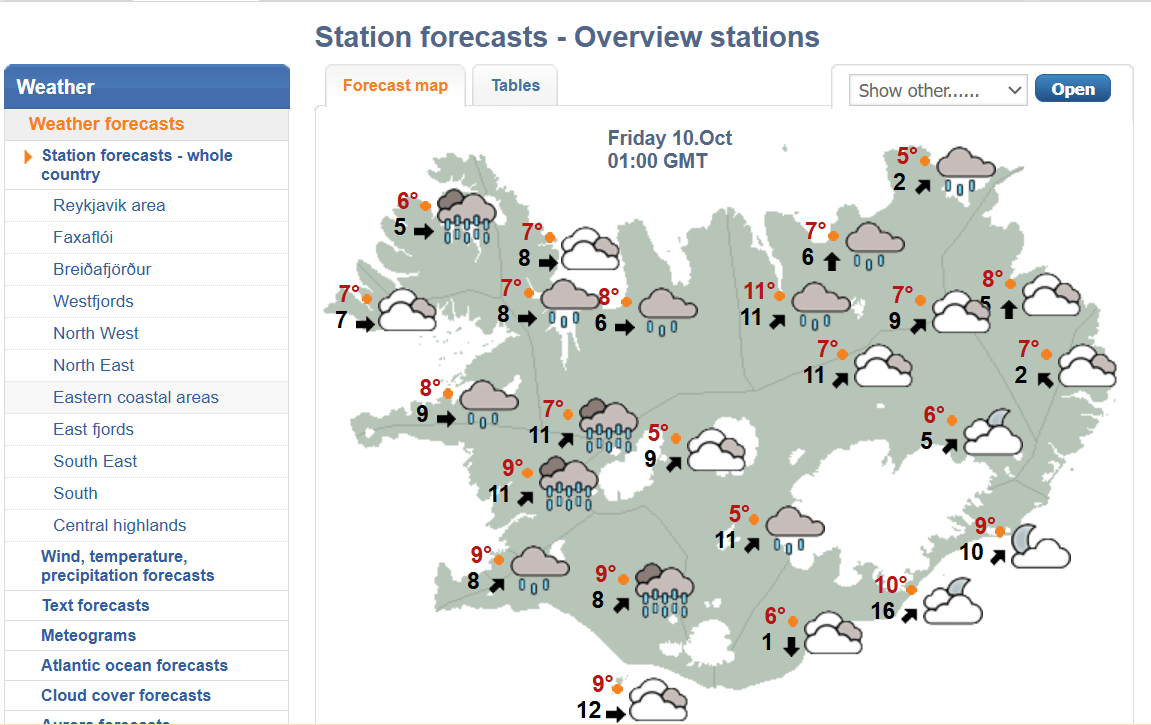
The best weather source: Veður (Vedur.is) — Iceland’s official meteorological service. I find the desktop version more useful than the app.
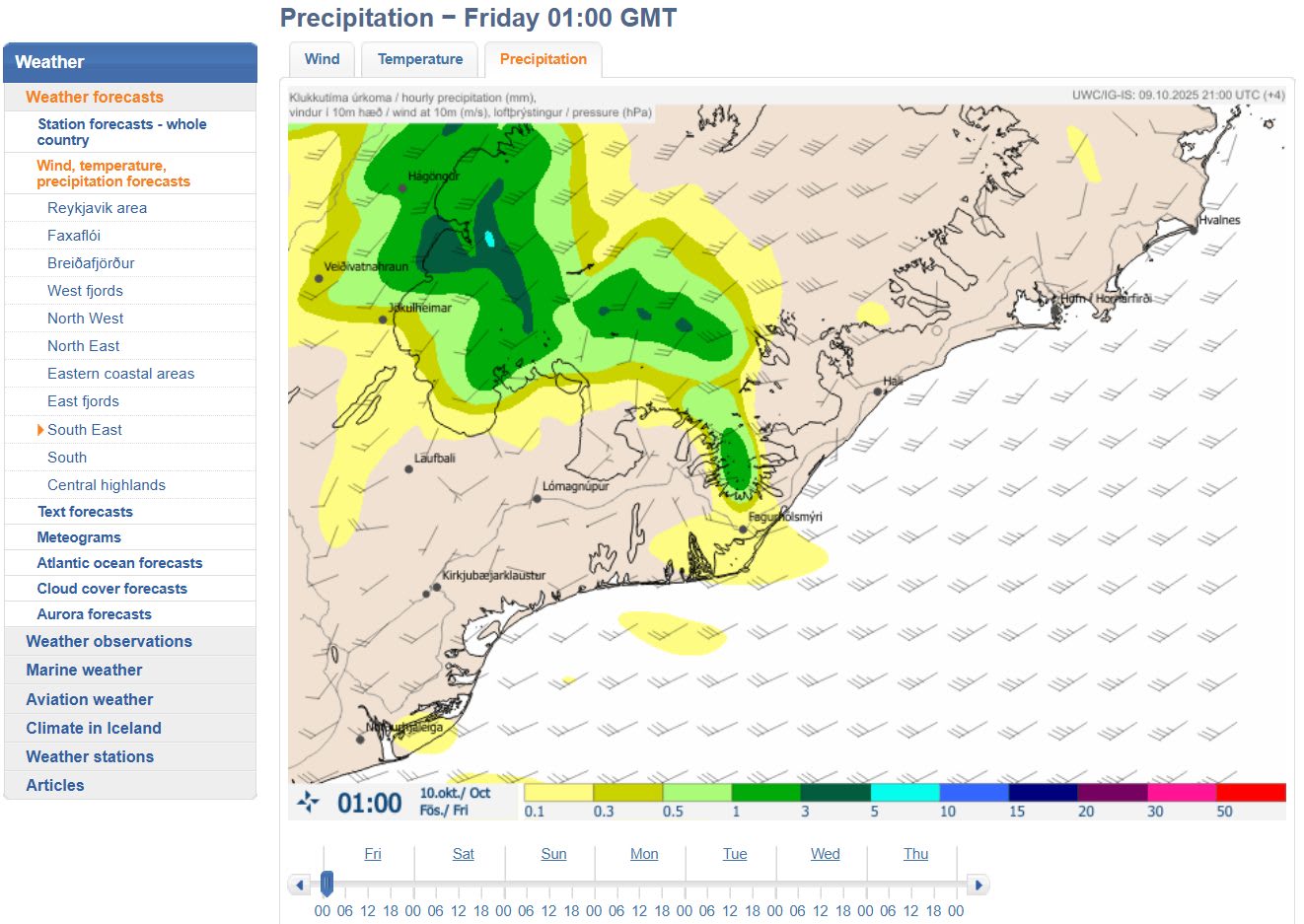
Most people default to the Weather Forecast view, but I think it’s too broad. Instead, go to Wind, temperature, precipitation forecasts → select a specific region (e.g. Southeast) → choose Precipitation → drag the time slider. Darker areas mean heavier rain. Check what time the rain clears for your location and plan around it.
Northern Lights
We saw aurora three times on this trip. Other nights probably had some too — we just didn’t go out 😄
A few tools that genuinely helped:
Veður (Vedur.is): Under Aurora forecasts, you’ll see a map of Iceland. Greener = more cloud cover, so aim for the white areas. The KP index on the right shows activity strength — higher is better.
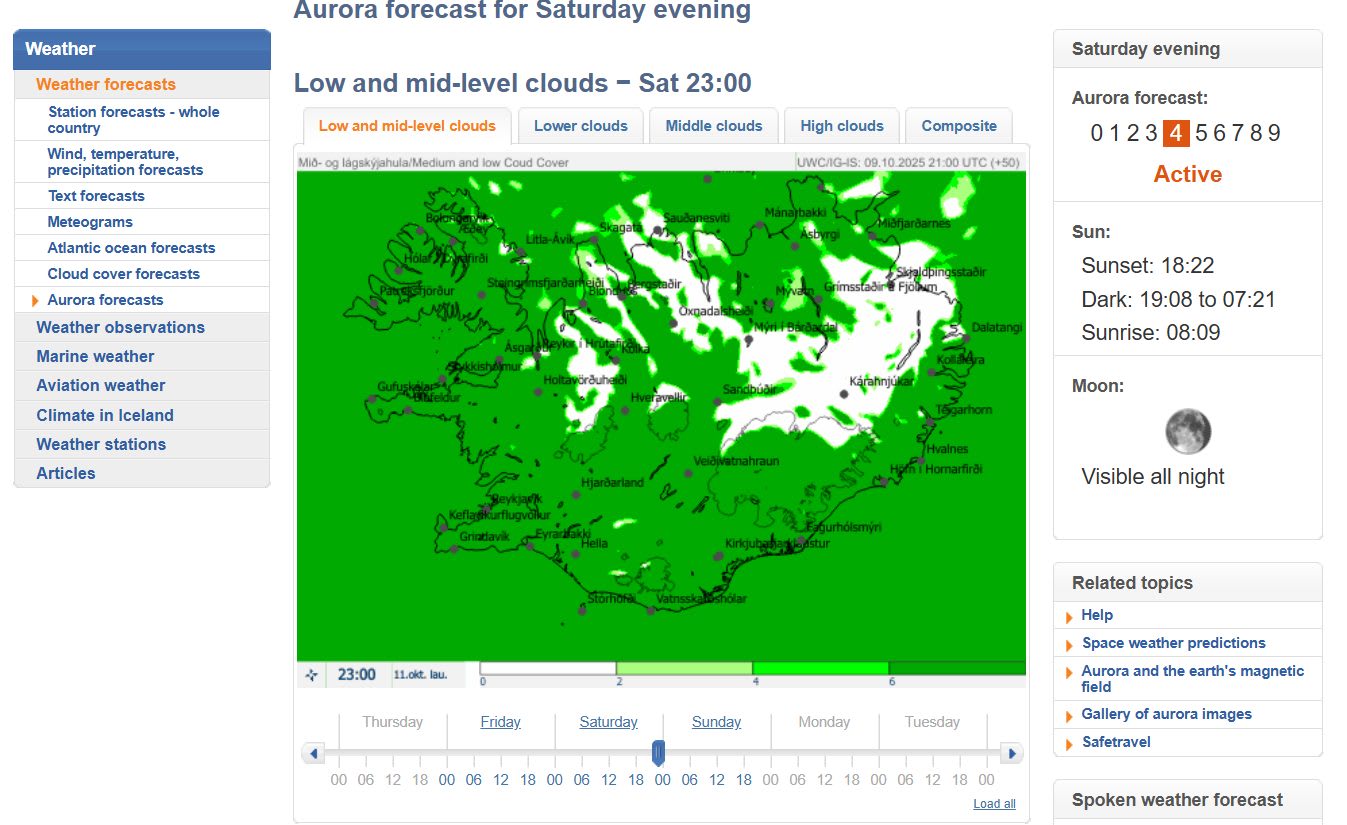
That said, KP alone doesn’t tell the whole story. One night we watched a full-sky aurora display when the KP was only ~2 — and it had been pouring rain an hour earlier. So don’t dismiss low-KP nights.
Other tools I used:
- Northern Lights Iceland: Facebook group run by serious aurora hunters. They post real-time sightings and explain the science.
- Hello Aurora: Best of the apps — clear forecasts, active user base, and it notifies you when people nearby are seeing lights.
- Aurora (Google Play): Also has a user-report feature.
- Aurora Alerts: The first one I downloaded; less useful than the others.
Tips for spotting aurora:
- You need to be able to see stars first
- Look north
- If you see something faintly bright, open your phone’s night mode camera — if it shows green, that’s aurora 😄
Costs & Money
You don’t need cash. Bring none. Iceland is fully card-based.
We didn’t use a single note for the entire trip — not even for public toilets (which only accept cards). Bring a card with good foreign transaction rewards.
Some places might ask for a 4-digit PIN, so activate that before you go. Personally I only encountered signature-only machines.
Iceland is expensive. A sit-down meal is basically NTD 600+ per person minimum; what you’d pay NTD 300–500 for in Taiwan will run NTD 2,000+ here. Staying somewhere with a kitchen and cooking most meals will save a significant amount.
Fuel is also expensive — we topped up roughly every two to three days at ISK 10,000+ each time.
Our total for five people, 12 nights in Iceland (excluding flights but including accommodation, car rental, fuel, food, and activities): approximately NTD 309,000 — about NTD 61,800 per person. Summer would cost more; winter less.
We mostly self-catered breakfast and dinner (two evenings at nicer restaurants), and went for casual affordable options at lunch. Mid-range budget overall.
Accommodation
Traveling with family plus our habits meant consistent requirements:
- Not too far from the next day’s sights
- Kitchen preferred
- Private bathroom required
- At least two separate bedrooms
In Iceland: Booking.com (what we used exclusively), Airbnb, or Iceland’s own Bungalo platform are all options.
Tips for finding good accommodation:
- Book early. Good places fill up fast. We booked nearly six months out and choices were already limited.
- Compare across platforms — same property, check Booking, Airbnb, Bungalo, and the place’s own website.
- Choose free cancellation — too many variables in Iceland.
- Check back periodically for better options.
Also: Icelandic accommodation almost never provides a toothbrush. Bring your own.
Clothing
I’m sharing the autumn experience. Personally I run warm — in winter I’m still wearing a T-shirt with a light jacket, even in Hokkaido. Family members who run cold packed differently.
- Regular long sleeves
- Sweater + warm socks (I wore these once or twice; family members wore them daily)
- Thermal base layers — for cold-sensitive people; I didn’t touch mine
- Neck gaiter (balaclava-style): Essential. Wind in Iceland is intense. A regular scarf will blow right off.
- Beanie / hat: Essential. The wind is genuinely serious.
- Gloves: Essential — unless you really don’t feel the cold, or don’t plan to use your phone much
- Swimsuit: Required if visiting hot springs
- Windproof, waterproof jacket: Essential. Umbrellas are useless in Iceland’s wind. Required at waterfalls, especially Seljalandsfoss.
- Windproof, waterproof pants: Essential. My legs aren’t cold-sensitive, but you’ll want these when it rains.
- Shoes: High-ankle, waterproof, non-slip. If you can’t get all three, prioritize waterproof.
Wrap-Up
This post got long. Detailed trip reports are in the individual posts — see the links at the top!
Thanks for reading :D
If you enjoyed this post, feel free to click the coffee button in the lower right to support us and give Lottery a can 🐾
Comments