life
[Book Review] No Rules Rules: Netflix's Management Philosophy — Makes You Want to Send a Copy to Every Boss You've Ever Had
This is my review of No Rules Rules: Netflix and the Culture of Reinvention (the subtitle is way too long, so let’s just call it No Rules Rules). The book breaks down how Netflix’s seemingly “laissez-faire” management style actually works — built on high talent density, radical candor, and minimal controls. Reading it will make you want to send a copy to every boss you’ve ever had.
No Rules Rules is co-written by Reed Hastings, one of Netflix’s co-founders, and management professor Erin Meyer. Having one insider and one outsider paint a picture of Netflix together gives the book a genuinely balanced perspective — and honestly, after finishing it, you’ll really want to send a copy to every former boss you’ve had. :P
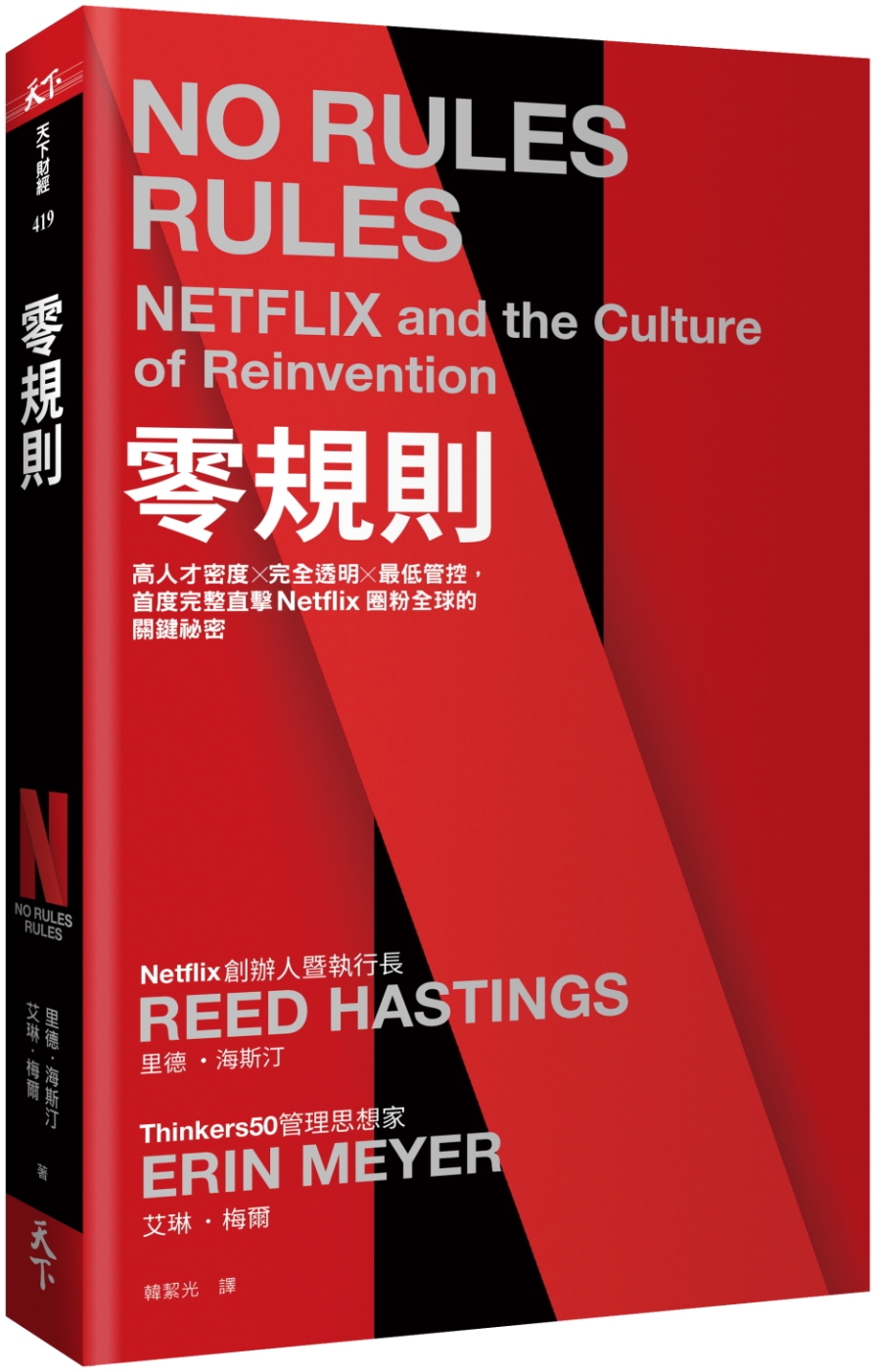 No Rules Rules, Reed Hastings & Erin Meyer, Commonwealth Publishing (image: Books.com.tw)
No Rules Rules Netflix
I’d heard vague rumblings that Netflix was a great company — not in terms of its service, but in terms of how it’s run. After finishing No Rules Rules, I can confirm: their company culture is genuinely impressive.
A while back, I left a job to focus on my thesis — and working within a corporate structure always comes with its share of frustrations. I used to wonder whether being a manager just meant micromanaging everything. What I didn’t expect was that Netflix would completely shatter that assumption, and succeed doing it.
I’ll be honest — I went in expecting a self-congratulatory read XD (and it might still be, because by the end I genuinely wanted to work there). But the fact that Reed writes from inside the company while Erin writes from outside does give the whole thing some real credibility.
More than the bloated Chinese subtitle (why is that a trend lately?), I love the clean, punchy English title. It cuts straight to the point:
No Rules Rules.
Rather than talking about what management systems Netflix uses, it’s more accurate to say they don’t really “manage” at all.
That’s not the same as a free-for-all, but:
- No cap on expense accounts
- No restrictions on vacation time
- No need to run decisions up the chain of command
This seemingly “unmanaged” management style turned out to be the key to their success.
But I think there are some absolutely crucial prerequisites.
Netflix’s Three Phases of Management
Netflix’s management philosophy unfolds in three phases:
| Talent | Candor | Control | |
|---|---|---|---|
| Phase 1 | Build talent density | Encourage candor | Begin loosening control |
| Phase 2 | Reinforce talent density | Deepen candor | Loosen even more |
| Phase 3 | Maximize talent density | Maximize candor | Remove most controls |
Essentially, they’ve created a culture called F&R — Freedom & Responsibility. They give employees an almost unimaginable degree of freedom, but employees are expected to be worthy of that freedom.
Let me walk through each of the three dimensions. But in my view, the whole thing starts and ends with one thing:
High talent density.
High Talent Density
Before getting into the “freedom” part, you need to understand that every Netflix decision is built on this foundation: high talent density. Only when a company is staffed entirely by exceptional people can this kind of culture take root. Netflix is deeply focused on innovation — they know the world changes fast, so they’d rather spend more money than set rigid targets. That also means they need to be ready to change at any moment.
Change isn’t easy, and it requires people who are genuinely paying attention to the world.
Netflix isn’t worried about that, because the people they hire are the best in their field.
Always Pay Industry-Top Salaries
They insist on paying what they call “top of market” salaries — not to be nice, but to keep the best talent. And this doesn’t mean fixed annual raises. Instead, they actually encourage employees to pick up calls from headhunters and find out what the market rate currently is. If it’s higher than what you’re making, the company will match it.
Great people spark great ideas and creativity. When every colleague is talented and imaginative, the energy in the room is electric. When the talent pool is uneven, some people end up dragging others down — and that kills momentum over time.
Great people also attract great people, in what they call the “hierarchy of picking.” Excellence clusters. That’s how you end up making the best decisions with the best people.
In contrast to the high salaries offered to keep top performers, average performers are given generous severance packages. Because Netflix believes it’s better to quickly hire someone exceptional than to let a mediocre performer stay and slow things down.
So how do you know where you stand? That’s what the “Keeper Test” is for.
The Keeper Test
Managers regularly ask themselves: if this employee told me they were leaving, would I fight hard to keep them? Or would I let them go without much resistance?
This exercise helps identify who’s truly worth keeping.
But that’s only top-down — employees don’t automatically know what their boss thinks of them. So Netflix also has what they call the “Reverse Keeper Test.”
The Reverse Keeper Test
Employees can proactively ask their manager directly: if I said I wanted to leave, how hard would you try to keep me?
If your manager says they wouldn’t push hard to retain you, that’s a signal to take seriously. If they say they’d fight to keep you, you’re the kind of talent they need.
Of course, you might wonder: how do you know they’re being honest? That’s where the second big principle comes in — radical candor.
Radical Candor
Netflix strongly champions being completely transparent with everyone.
The thinking is that secrets breed miscommunication, prevent quick course-corrections, and can foster mistrust or suspicion.
So why not just be open about everything?
For example, financial data and internal metrics that most companies keep closely guarded are open to all employees at Netflix. They even shared all internal information with staff before the company went public — without worrying about leaks.
In practice, though, this is easier said than done.
Think about how hard it is to be completely open with your own family, friends, or partner. At Netflix, they try to achieve this at work. Employees are expected to speak their mind directly with anyone — including senior leadership, or even the founders.
No Rules Rules walks through real examples of what this candor looks like in practice — the benefits it brings, and the initial friction it causes. Some people struggle to receive criticism; it can generate tension. But Netflix has found various ways to work through those challenges (Erin’s research suggests this is genuinely true, not just corporate spin).
Because feedback flows constantly from all directions, everyone knows how they’re doing and what needs to improve. In a culture built on candor, you always have the chance to grow — you won’t get fired out of the blue without having had an opportunity to course-correct. Unless you refuse to improve, there’s always a path forward.
There’s also a fascinating idea in the book: if you have negative thoughts about the company but stay silent, that silence is actually a form of disloyalty.
The idea that you’re encouraged to openly tell your company what’s wrong with it? That’s kind of incredible.
That said, feedback can’t just be venting — it has to come with concrete suggestions for improvement.
On that note, Netflix doesn’t use performance reviews. Instead, they use 360-degree reviews.
360-Degree Reviews
Since traditional performance reviews only flow downward and reflect one person’s opinion — and since Netflix doesn’t use KPIs — they opted for 360-degree feedback instead.
Colleagues review each other and give specific, actionable feedback. Interestingly, the format started anonymous, but people found that uncomfortable — so reviews ended up being signed. XD
No Rules Rules lays out how to run a 360 well:
Best for small groups (8 people or fewer)
Feedback must be actionable:
25% positive (“you should keep doing…”), 75% constructive (“you should start/stop doing…”)
When first rolling it out, lead with someone who can graciously receive critical feedback and model gratitude
I love the “keep/start/stop” framework — it cuts down on emotional venting and gives people something concrete to act on.
Before a review session, colleagues write their thoughts directly in a shared document’s comments section. Reed has also mentioned using a -10 to +10 scoring system to gather broader impressions.
Of course, No Rules Rules also discusses the downsides — some people are deeply uncomfortable with criticism, and cultural differences can cause misunderstandings. But the overall commitment is to keep being honest in order to keep improving.
No Rules Really Does Mean No Rules
Built on those two foundations — exceptional people and radical candor — Netflix is able to operate with minimal controls. And some of the specifics sound almost too good to be true.
For example, there’s no cap on expenses. Nobody has to stress about whether their dinner bill is too high or their hotel is too fancy.
The guiding principle is simple: “act in the company’s best interest.”
(Naturally, if someone abuses this, they get fired.)
Even more enviable is the vacation policy — or rather, the lack of one.
Take as much time off as you want.
Reed’s view is that Netflix is a creativity-driven company. If rest and travel inspire people and fuel their drive, you can take all the time you need.
Erin did question early on: without a formal policy, would people feel too nervous to actually take vacations? And yes, that was an issue at first — until the company started requiring managers to lead by example and actually take time off. XD Only then did employees feel comfortable doing the same.
The obvious caveat: coordinate with your team before going, and as long as everyone’s aligned, it’s fine.
But as great as the expense and vacation flexibility are, what I find most remarkable is how Netflix handles decision-making authority. A multi-million dollar purchasing decision doesn’t need the CEO’s signature — it needs the signature of the employee who made the call.
Because if every decision requires layers of approval, things slow to a crawl. And when everyone’s responsible, nobody really is.
So managers set high-level direction, and employees make their own calls. If you think it’s right, you do it.
What if it goes wrong?
Netflix doesn’t fire people for one mistake. “Radical candor” means the person responsible publicly acknowledges what happened, shares what they learned, and helps the whole team avoid making the same mistake in the future.
And because every employee knows they’re trusted and that their choices can meaningfully move the company, they naturally make decisions with more care.
Wrapping Up
Finishing No Rules Rules, you can’t help but be a little envious of the work environment — and genuinely impressed that someone actually thought this through.
Compared to the more conventional “control-based” management (rules and requirements for everything), Netflix practices something closer to “context-based” management — share the necessary information, don’t micromanage the details. Reed notes that not every company should run this way. If a company’s goal is error prevention (think: building aircraft, healthcare), control-based management makes sense. But if the goal is innovation, the context-based approach fits perfectly.
Finally, Reed distills Netflix’s management philosophy into three conditions:
- High talent density
- Goal: innovation
- Loosely coupled: decentralized, distributed decision-making
I’ll leave you with the quote from Antoine de Saint-Exupéry that closes the book — it captures everything:
If you want to build a ship,
don’t drum up the men to gather wood,
divide the work and give orders.
Instead, teach them to yearn
for the vast and endless sea.
Imagine a team of exceptional, passionate people — not hemmed in by rules and rigid tasks — setting out to sea. What kind of ship would they build?
Postscript
Thank you all for the response after this review went up.
My goal was just to introduce the book — but I do want to note: can Netflix’s management model really apply universally? Could this book represent survivorship bias? These are questions worth sitting with as a reader. Just like reading academic papers, it’s good to bring both curiosity and skepticism. That side of the analysis is beyond the scope of this post, but I’d love to hear your thoughts in the comments. :)
Title: No Rules Rules: Netflix and the Culture of Reinvention
Authors: Reed Hastings, Erin Meyer
Publisher: Penguin Random House
Thanks for reading :D
If you enjoyed this post, feel free to click the coffee button in the lower right to support us and give Lottery a can 🐾
Comments