Podcast Prep: From Research to Titles — A Case Study with Language Is Fun [Updated: 2021/04/22 Audacity Editing]
This post walks through how I prepare solo episodes of Language Is Fun (語言好好玩) — from collecting and organizing research in Notion, to shaping that material into something listeners actually want to hear, to structuring the flow and writing the title. The same process applies to preparing a presentation or report.
Since 2019, more and more people have been jumping into the Taiwanese podcast scene. One of the most common questions from aspiring podcasters is: how do you actually prepare your content? This post walks through how I prepare my own podcast, Language Is Fun (語言好好玩), including how I use Notion to collect and organize research, how I turn raw material into something listeners want to hear, and how I structure episodes and write titles. The same approach works for preparing a presentation or talk too.
A while back, I was invited by NTU Linguaphiles to give a talk called “Why Language Is Fun.” Part of that talk covered exactly how I prep my show. If you haven’t listened yet, you can find it here (Seasons 1–4 are mine):
https://www.mirrormedia.mg/rss/category_knowledgeprogram.xml
The show ran for four seasons (Season 5 was handed off to my good friend Sabrina :D). I wouldn’t call myself a proper science communicator — my episodes aren’t exactly heavy on “science” — but hopefully this can be a useful reference for anyone trying to get started and figure out how to structure their content.
I later picked up audio editing too. If you want to know how I use the free software Audacity to clean up recordings, check this out:
Podcast Editing: Using the Free Tool Audacity to Process Audio in One Click
Background
Language Is Fun sits within the Knowledge Is Fun channel, alongside shows on philosophy, psychology, the brain, criminal psychology, and gender — all aimed at the general public as accessible, popular-science content.
So from the beginning, my target audience was: people who have zero background in this subject, or at most a vague idea of what it is.
And compared to other subjects on the channel, “linguistics” has an even bigger image problem. (Stranger: “Oh you studied linguistics? So you speak a lot of languages?”)
So how do you get people to click, and then actually finish the episode? You need a very clear, intentional plan for the content — that’s what keeps listeners following your thread all the way through.
Below I’ll walk through my episode design process. Since my show has two formats — solo episodes and interviews — this post covers the solo format first.
Back when I was doing my master’s at NCKU, one of my professors, Zhang Gaoping, somehow managed to publish a huge number of papers every year. People always wondered: how does he stay so productive? He said:
It’s like cooking. If you prep and organize your ingredients right after you buy them, cooking is much faster every time.
I love this framing. So let’s use the metaphor of shopping for ingredients and cooking a meal to describe the content creation process. 😛
Step 1: Go Shopping
First, you need to gather material on the topic you’re covering. The richer your sources, the more value your listeners get (and the more they’ll love you). So step one: go “shopping.” Here are my favorite “markets”:
Social Media
If you’re anything like me and spend a lot of time online, social media is a goldmine for research material. You can find both primary sources and real reactions from people — which is great raw material in itself.
Most of this comes from accounts related to topics you’re interested in. Don’t overlook trending people and conversations either — anyone’s post could become a valuable source.
On Facebook, whenever I see something interesting that might turn into an episode topic, I save it using Facebook’s built-in Saved feature. Then I organize it when I have time (more on that below).
Books
Books are the most systematic and comprehensive source of material. For my linguistics-focused show, popular science books on linguistics are a must-read. But I also dip into psychology, cognitive science, philosophy, and other fields — they often give me a completely different angle to work from.
“Popular science” is kind of a contradictory concept (that’s a whole other conversation), but drawing from adjacent disciplines almost always opens up fresh entry points.
Everyday Life
Don’t lock yourself in an ivory tower — pay attention to what’s happening around you!
I’m pretty much a homebody, so I find inspiration in manga and games. Love music? Great. Into TV shows or films? Also great. There’s interesting material everywhere.
For example, I was recently playing Persona 5 Royal, which touches on “cognitive science” (loosely speaking). That gave me a ton of angles to explore — though I still haven’t gotten around to writing that episode yet.
Step 2: Prep Your Ingredients — Organizing What You’ve Collected
Once I have material on a topic, I usually organize it in Notion (👉 see: Cross-Platform Note App Notion: Your Best Friend for Organizing Research, Resumes, and Travel Plans).
Make good use of Notion’s Tags. If you categorize your material systematically, you can find anything again even months later. Here’s a peek at my (admittedly messy) Notion folder:
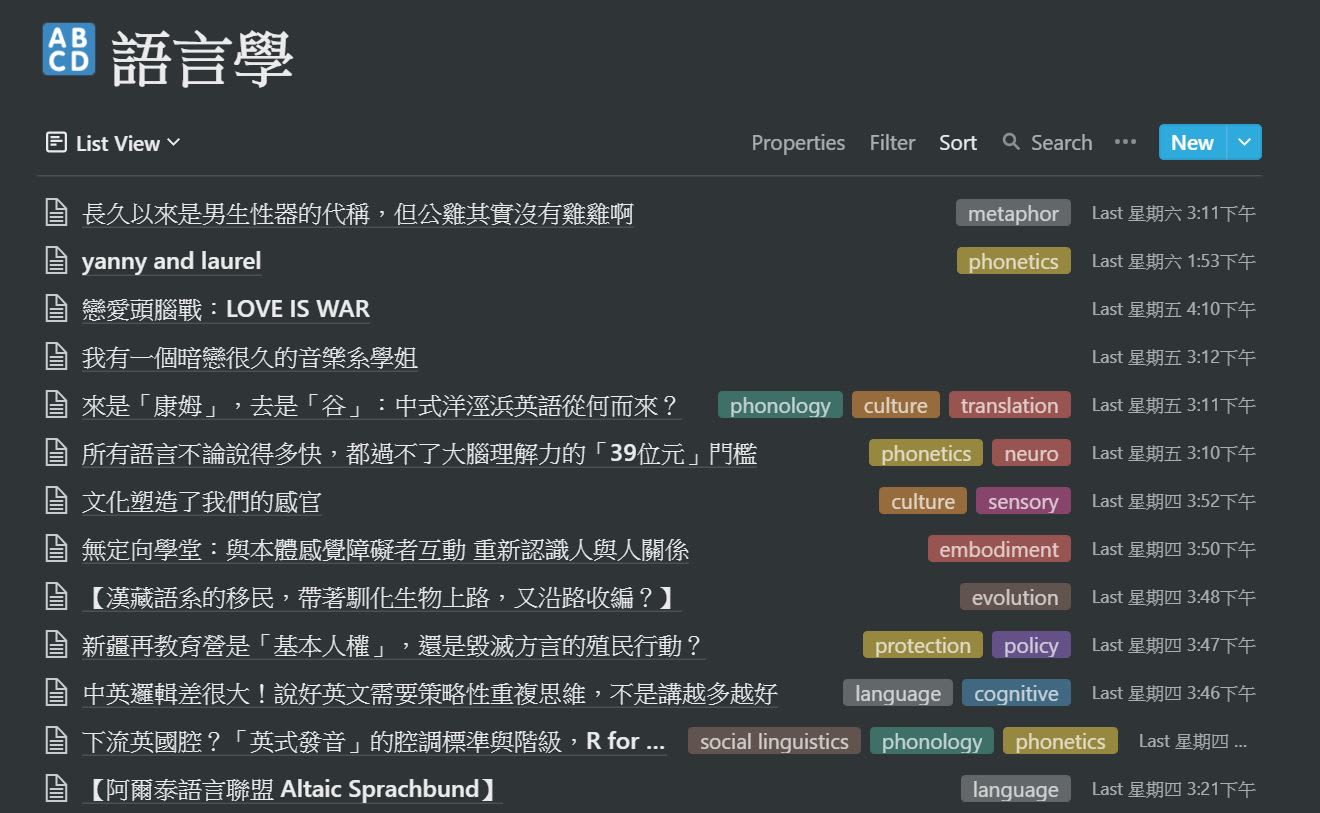
Beyond saving links, I also jot down the key passages I plan to cite. And don’t forget: always note your sources as you go!
To show what this looks like in practice, here’s how I prepped the interview outline for an episode with 馬雅人 (Maya Man). Since I wasn’t very familiar with Maya culture, I read everything he’d ever written (including PTT and Vocus posts), found additional references, and compiled everything here: https://www.notion.so/ijuforever/42011c48d6434aa3b968a696e428549d
I’m a categorization nerd — I love having things neatly organized. Using hierarchy well makes everything more efficient. Set out the main headings for each piece of material, attach your sources, and you’ll naturally find the angles worth exploring.
The episode that came out of all that prep is here: The Ambassador of Maya Nation Visits! Turns Out Virgos Are the Worst at Learning Mayan?!
Step 3: Plan the Meal — What Actually Goes In?
After gathering all your material, you probably feel like a chef who’s just come home from the market with way more ingredients than one meal can use. So what do you do?
If you’re running a casual chat show, you can just riff. But I find that having a clear arc — a compelling opening, a satisfying ending — is what keeps listeners going. So: what kind of meal are you cooking? A Chinese feast? Western fine dining? Japanese omakase? What seasonings will you use? These are the questions episode planning answers.
Planning the Flow
How do you actually choose what goes in?
Like I’d tell anyone: a show with two or three main threads works. Try to cover everything and you’ll end up covering nothing well. So first: commit to one central theme.
But even with one theme, I always have more than I can fit. Here’s where I recommend the Hahow course by 圖文不符: Making Visuals That Do More Than Look Good — Information Design Thinking. It covers how to translate information for different media formats. Genuinely worth every penny — and I want to borrow one concept from it here.
Once you’ve locked in your theme, spread out your material and sort it into two axes, creating four quadrants: relatable / not relatable × audience is interested / not interested.
The ideal starting point is material that’s interesting + relatable. A reasonable ending is material that’s not immediately interesting + relatable (think: call to action). See the diagram below:
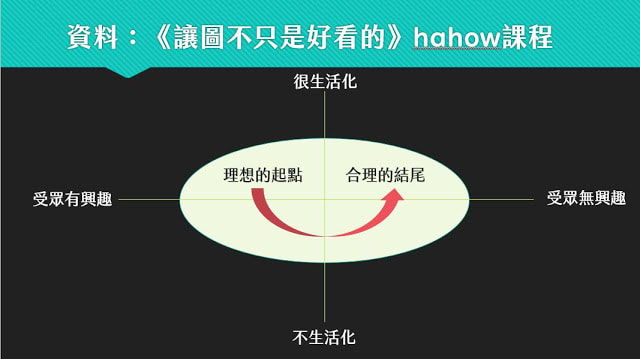
The logic makes sense. If the topic doesn’t interest your audience at all, they won’t even click. If it’s not relatable, they’ll file it under “maybe later.” So your opening needs to sit in quadrant two: relatable and interesting.
Losing your audience usually happens in quadrants three and four — especially the dreaded quadrant four. You need a great hook upfront to get them invested. Then, at the right moments, remind them why they started listening in the first place. XD
A Real Example
Let me walk through a concrete example. You can follow along with this episode: Can Language “Parasite”? What “the Fourth Floor” Reveals About Social Class
First, write out every angle and point you want to cover:
Main threads: sociolinguistics, accents, social class
Points/arguments:
How Labov’s experiment worked
Who is Labov? Why does he matter?
Why is the Labov experiment significant?
Historical shifts in British and American accents
Social class and accent history
Don’t discriminate based on accent
What is rhotic/non-rhotic?
Accent variation in Taiwan
Then I refine that list:
Labov and his experiment: Labov’s significance (brief overview), how the experiment worked, why it matters
British/American accent history: explain rhotic vs. non-rhotic
Social class + accent history → revised to: is there a connection between accents and social class?
Don’t discriminate based on accent: the call to action
Accent variation in Taiwan (not enough for a deep dive, but maybe useful as an entry point?)
Now, map everything to the quadrants:
- (Q2) Interested + relatable: Accent variation in Taiwan?
- (Q3) Interested + not relatable: Is there a connection between accents and social class?
- (Q4) Not interested + not relatable: Labov and his experiment, British/American accent history
- (Q1) Not interested + relatable: Don’t discriminate based on accent
Quadrant four is the hardest part. So think carefully about the internal logic: we need to cover British/American accent history and explain rhotic/non-rhotic before we can get into the Labov experiment. Fortunately, we’d touched on this topic before — so a brief refresher would do.
The experimental method might be too dry for listeners on its own, so we added a short dramatization to recreate Labov’s “fourth floor” study. We also invited listeners to try it themselves — say “Fourth Floor” aloud. XD
At this point most of the structure is taking shape. But the quadrant two entry point feels like it’s missing something…
Step 4: Cook — Should You Write a Script?
The content structure is mostly set, even if the opening still feels incomplete. I’ll start drafting the script anyway and revisit the opener before recording.
People ask me whether they should write a script.
Honestly, I hate reading from a script — I almost never look at my notes during presentations. But for solo podcast episodes, I always write one. Without another person to riff off, it’s hard to feel the rhythm of the show, and having a script ready is the best way to stay in control of the pacing.
Some podcasters lean hard into spontaneity. I get it. But I still feel responsible for giving listeners a clear, well-structured experience. I’ve tried just using bullet points, but I found myself going off on tangents and recording way too many takes. So now I always draft a full script first. It looks something like this:
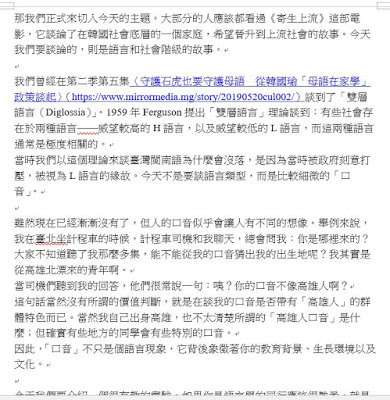
I write what I’d actually say while recording — almost verbatim — but I don’t read it word for word when the mic is on.
The benefit: it dramatically reduces the chances of misspeaking or rambling, and it keeps the overall structure solid. If you’re the kind of person who can stay organized without a script, or if a natural, unscripted feel is part of your brand, you don’t have to follow my approach.
Step 5: Serve It Up — Write a Great Title
The final step: the title. The title is the single most important part of the whole episode. My early titles were way too clever-for-my-own-good — the kind only I found interesting. It wasn’t until I had a social media editor on the show that I really understood how much craft goes into a title. Take a look at this episode: Serving Up the News — What Social Editors Know About Writing Headlines. The interviewee breaks down exactly what makes a headline irresistible.
Right — a great dish name makes people want to order it. XD
(Think: “Salt & Pepper Chicken” vs. “Taiwanese Basil-Infused Crispy Chicken Bites”)
Going back to that quadrant two entry point I felt was missing something: I suddenly thought of Parasite and the theme of social class. The film had just swept the Oscars, so it was perfectly timely. The episode became:
- (Q2) Interested + relatable: Parasite, accent variation in Taiwan
- (Q3) Interested + not relatable: Is there a connection between accents and social class?
- (Q4) Not interested + not relatable: Labov and his experiment, British/American accent history
- (Q1) Not interested + relatable: Don’t discriminate based on accent
Much more natural, and much more likely to pull listeners through to the end.
Once the title is locked, I start recording.
(Though sometimes I record first and title later — it depends on whether inspiration strikes in the moment. XD)
That’s the basic logic I apply to both solo episodes and interviews. It’s not always easy to categorize or place every piece of material, but at the very least: nail the opening.
This is my personal prep and thinking process for solo episodes. It won’t work for everyone — feel free to share your own approach in the comments! :D
Thanks for reading :D
If you enjoyed this post, feel free to click the coffee button in the lower right to support us and give Lottery a can 🐾
Comments