comic
Wu Ming-Yi × Croter × Ruan Guangmin: The Magician on the Skywalk (Graphic Novel) — Talk Review: "Our 2D World"
These are my notes from the talk “Our 2D World — Works That Once Shaped Our Aspirations, Aesthetics, and Worldview,” held to celebrate the publication of The Magician on the Skywalk (graphic novel). The three panelists were The Magician on the Skywalk original author Wu Ming-Yi, alongside Taiwanese comics artists Croter and Ruan Guangmin. The conversation focused on how animation and comics shaped these three creators’ worldviews, aesthetics, and career choices — a great read for fans of their work or anyone who loves comics.
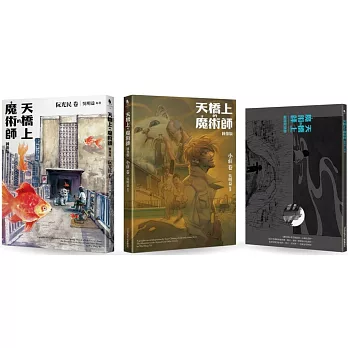 The Magician on the Skywalk (Graphic Novel), Aquarius Publishing.
All three panelists are creators I really admire. I’d strongly encourage everyone to seek out Croter’s and Ruan Guangmin’s manga — Taiwanese comics are genuinely incredible!
The organizers later shared a reading list from all three panelists — it’s fantastic, and it turns out they were all kids who grew up soaked in comics too! (This talk will make you want to buy a massive pile of comics without even realizing it.)
I’m presenting the content in a Q&A summary format. Since I was only taking handwritten notes, there may be some inaccuracies — please bear with me. Also, book links use affiliate links from Books.com.tw; feel free to search for the titles yourself if you’d prefer.
If you enjoy talk notes about comics, you might also like this one:
Brushes of Resistance — Hong Kong Anti-Extradition Movement Anniversary Exhibition Talk: “Like and Share — How Hongkongers Connected and Spoke Out in a Leaderless Movement”
Our 2D World — Works That Once Shaped Our Aspirations, Aesthetics, and Worldview
On the reason for this title: Wu Ming-Yi said he felt that if an author spends every talk praising their own work, that probably means the work isn’t good enough. So even when launching a new book, he rarely talks about his own writing. For this event, timed with the release of the graphic novel adaptation, why not talk about what other people’s work has given them instead?
The theme of “2D” — a shorthand for anime and manga — came up early. (The moderator: “Croter even asked me beforehand, ‘2D means comics, right?’”) The conversation explored how comics shaped each person’s philosophy, taste, and aesthetic sensibility, and showed just how rapidly “aesthetic” itself can change in the modern world.
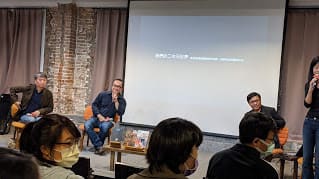
Q1: Was “manga artist” ever one of your goals? And that goal couldn’t have come from nowhere — if you had to name one to three works that shaped your image of what it means to be a comics artist, what would they be, and why?
Q1 — Croter
Croter laughed and said only kids say they want to be manga artists. Rather than calling his goal “comics artist,” he’d say it was more accurate to describe his calling as visual storytelling. He loves using images to tell a story and to communicate.
Under the influence of Taiwan’s old comics censorship laws, Taiwanese artists couldn’t create freely, and publishers turned to importing (or pirating) Japanese manga — titles like Doraemon and Black Jack were products of that era. As a result, the comics Croter grew up reading were all very similar in style and content. Because everything available was so uniform, he assumed for a long time that manga had some sort of “standard” look. It wasn’t until he encountered Western comics that he realized there were countless ways to tell a story visually, and there was no single standard at all.
For example, French comics artist Mœbius and his sci-fi and fantasy work, filmmaker-turned-comics-artist Bilal, and the erotic artist Milo Manara all opened his creative horizons.
Wu Ming-Yi added: aesthetics are very easily constrained by your environment. Ruan Guangmin was shaped by Japanese manga, and since Taiwanese audiences are already accustomed to that aesthetic, his work tends to be more widely accepted. Croter, leaning more toward European and American aesthetics, tends to have a narrower readership in Taiwan.
Q1 — Ruan Guangmin
Ruan Guangmin said that as a kid, he didn’t really know the word “manga” — he called it “drawing cartoons” or, in Taiwanese, “manga” (マンガ). His first encounter with the medium was Old Master Q.
He loved drawing and often got positive feedback from older relatives, which is how he discovered he was good at comics. His presentation included a slide of Candy Candy — he admitted he used to draw shojo manga as a kid. His great-aunt, who ran a barbershop, would even ask him to draw Candy Candy and paste the pictures on the shop window as decoration. (Ruan Guangmin: “And they never paid me.”)
Reading Marco and A Dog of Flanders when he was young — even without fully knowing why he was crying — influenced his artistic goal: he’s always wanted to create work that moves people.
Q1 — Wu Ming-Yi
Wu Ming-Yi — the only non-manga-artist in the room (though he can actually draw quite well) — described how as a child he’d trace lines and copy drawings from Science Ninja Team Gatchaman and similar shows. He later realized that his visual style and aesthetic sensibilities had been shaped, somewhat unconsciously, by those early works.
He eventually came to notice that every comics tradition reflects its own culture, ethnicity, or history. Japanese manga, for instance, tends to have a kind of obsession with youth — protagonists are almost always teenagers, adults are almost always useless — and the concept of the “ideal” shows up constantly in theme songs.
Early Western comics were frequently about orphans searching for their mothers — he later realized this reflected the post-war setting in which they were created.
In his idle moments, Wu Ming-Yi used to flip through manga magazines. He mentioned being struck the first time he read JoJo’s Bizarre Adventure — the visual style was so distinctive, and the vampire premise was unlike anything else. Though as the series went on, every character developed increasingly elaborate Stands with new abilities each arc, and he’d eventually lose track of what had happened in previous chapters.
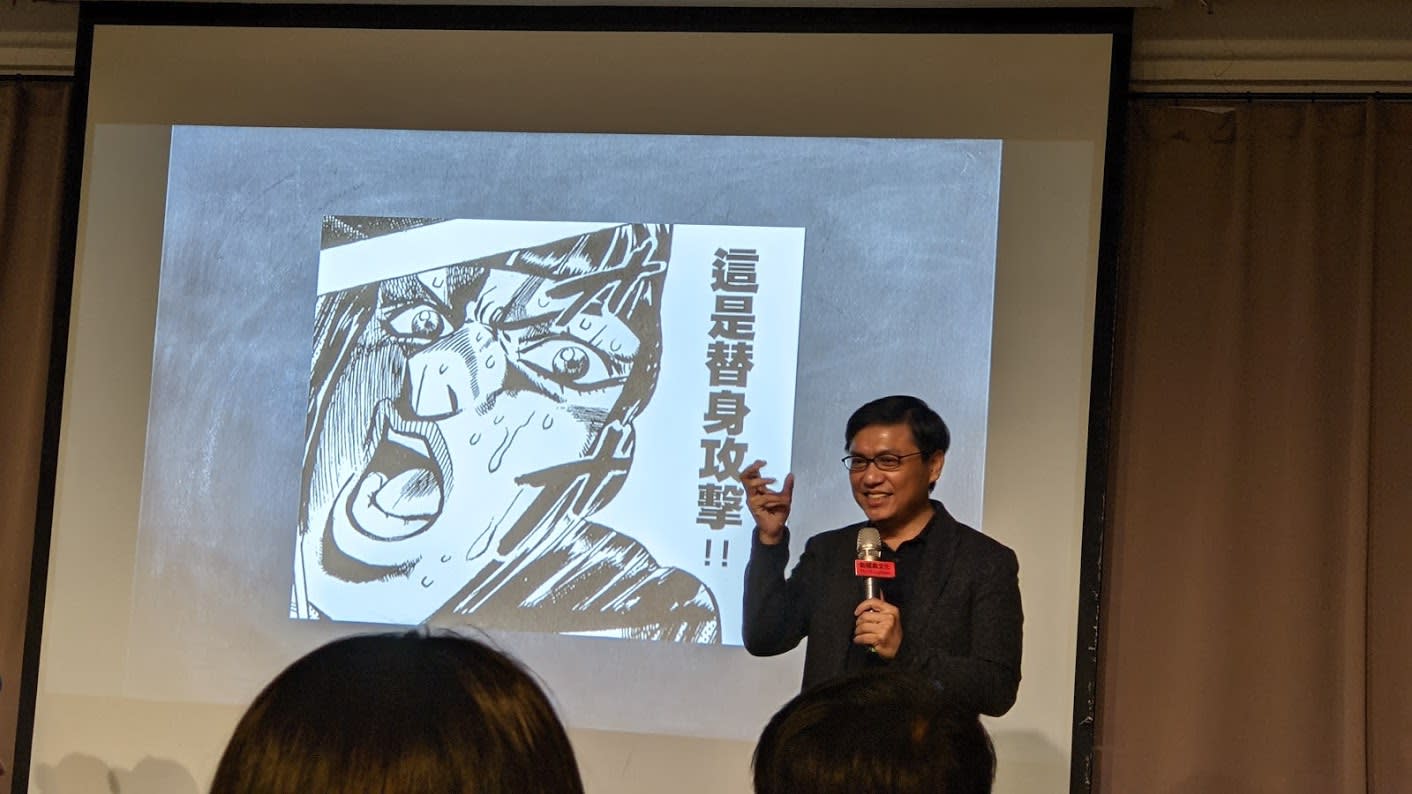
Wu Ming-Yi said Japanese manga demonstrates a storytelling power driven by external rules — specifically, the weekly ranking system. To climb the charts, stories need constant novelty, new developments, new abilities every chapter to stay attractive. But this made him wonder: is the artist truly in control of the story, or is the story being shaped by external pressures?
A relatively obscure title, Professor Munakata’s British Museum Adventure (lit. “The Genius Professor Yanagisawa”), gave him a new way of thinking about comics stories. The protagonist was completely unlike anything he’d seen before — the concept was unusual (and the professor reminded him of Sun Zhiwen at National Central University, who only ever walked in straight lines and had to arrange his pens by color before bed XD) — and it was genuinely memorable. It was the moment he realized: comics stories don’t have to be just for kids.
So when someone later asked whether his 2000 work Butterflies of Taiwan could be adapted into a comic, he imagined it might become something like The Gardener’s Garden — each chapter centered on a different species of butterfly as its symbol. (Though of course that adaptation never happened.)
On the question of his childhood aspirations: his first choice was film director, second was manga artist, and when he found he couldn’t do either, he became a novelist.
“Why didn’t you become a manga artist?” the two artists asked. Wu Ming-Yi replied a little sheepishly: the graphic novel collaboration on The Magician on the Skywalk with Croter and Ruan Guangmin took about five years, and throughout the whole process he kept wanting to ask the editor whether both artists had been paid upfront — because five years is an extraordinarily long creative journey. (He never actually asked XD)
On top of that, novels are built from words, and he can think about how to structure language while riding the MRT or commuting — but manga requires thinking through every single panel’s composition, which he finds incredibly difficult.
Q2: Comics in modern history evolved out of three distinct systems — European, American, and Japanese — and while they influence each other now, their aesthetics are quite different. Each person’s aesthetic grows out of the aesthetics they were immersed in. Using the same framing as before: name one to three works whose aesthetic influenced yours, and tell us why.
Q2 — Ruan Guangmin
On aesthetics, Ruan Guangmin acknowledged that it’s really hard to escape what publishers and the broader market feeds you. Taiwanese society has been so heavily influenced by Japanese manga’s visual language that it raises a real question: does the market only accept a Japanese aesthetic?
He mentioned several works with distinctive aesthetics. Zheng Wen’s A-Bi Sword and artists like Ryoichi Ikegami exemplify a kind of “beauty in freeze-frames.” Fist of the North Star is fascinating too — its structure was originally inspired by the Western film Mad Max 2, and the character designs drew from non-Japanese sources, yet after becoming a massive hit in Japan it circled back and became popular in the West again. That’s a really interesting example of how comics travel. Hong Kong comics, meanwhile, have a more storytelling-like narrative style — their production structure is highly specialized, almost factory-like.
As for why he was drawn to Japanese manga in particular: it has so many different artists with such different drawing styles and narrative approaches. That diversity is genuinely appealing.
Ruan Guangmin mentioned in his autobiographical work I Am a Manga Artist that he worked as an assistant in Lai Yuxian’s studio. He expanded on that here: that experience was transformative for his career. As a reader, you just flip through a manga and move on — but as an assistant, he learned how to actually look at comics.
Q2 — Croter
Croter was upfront: it’s not any one specific work that shapes your aesthetic, it’s a long accumulation. Style is a process of self-discovery. Still, he shared a few recent sources of nourishment:
He thinks Takehiko Inoue is exceptional at depicting characters — each one feels like a figure from a film. Taiyo Matsumoto, whose style sits well outside Japanese mainstream, draws characters brilliantly and uses a completely different line quality in each work. Croter especially loves Takemitsu Zamurai. He also mentioned Ping Pong, which uses wide-angle panel cuts and alternating brushwork as a deliberate tool to control how quickly — and how the reader moves through the page.
Next, Croter brought up French artist Nicolas de Crécy and his work Glacial Period. De Crécy’s use of color is striking, and because he prefers the feel of sketching and believes the energy of rough pencil work is best left untouched, his “no underdrawing” approach has become his signature style.
Finally, there’s Japanese artist Jiro Taniguchi, known as “the Ozu Yasujiro of manga.” Taniguchi was heavily influenced by European comics and was extraordinarily deliberate about rendering backgrounds — drawing them in such detail that readers can’t help but pause and study them. This intentional pacing, making readers slow down, is something Croter finds fascinating.
Q2 — Wu Ming-Yi
Right after Croter mentioned Jiro Taniguchi, Wu Ming-Yi picked up the mic and said the first time he read Taniguchi’s manga, he couldn’t help but think: how could anyone want to draw a comic this slow-paced with these kinds of subjects?! (Though I think it was meant as a compliment XD)
The first work Wu Ming-Yi brought up was Takao Yaguchi’s Fishing Genius Sanpei. He pulled up an image and simply marveled: the composition is so beautiful, you’d happily hang it in your home. He considers Yaguchi’s work deeply literary — each chapter reads like a short story, achieving remarkable narrative structure in a tiny space.
His novel The Man with the Compound Eyes was inspired in part by Daisuke Igarashi and Yukinobu Hoshino. He believes writing fiction requires a strong sense of spatial depth, and Igarashi’s work is exceptional in that regard. He also mentioned François Schuiten’s The Tower, a story of a parallel world in which every architectural scene is breathtakingly conceived.
Finally (I’m a bit hazy on how we got here), Wu Ming-Yi mentioned being asked while writing The Stolen Bicycle which was harder: the war scenes or writing from an elephant’s perspective? He laughed and said obviously the former — survivors of that war are still alive today, and writing about something that actually happened is inherently harder. An elephant’s inner life, though? Who would know? (The whole audience laughed.)
At this point, the moderator threw in an unexpected question:
Q (surprise): As the original author, does Wu Ming-Yi actually like the two graphic novel adaptations?
A brief, loaded silence fell over the room. Croter and Ruan Guangmin joked, “Should we step out for a moment?” Everyone watched Wu Ming-Yi pick up the mic and say:
“I’ve learned that not everything requires you to express an opinion.”
That line was absolutely begging for a “cue audience laughter” note — and sure enough, the whole room cracked up.
In fact, from various interviews and the booklet included with the graphic novel edition, it’s clear Wu Ming-Yi had certain hopes and requirements for the adaptation early on. But after much back-and-forth with Ruan Guangmin, he gradually let go and gave them the freedom to interpret the work as they saw fit.
Wu Ming-Yi also said that once his work started being translated, he began to realize he wasn’t as accomplished as he thought — because he can’t evaluate the quality of his own translated work. So if you’re going to collaborate, you have to fully trust your collaborators.
He also said that over the past few years he’s stopped offering opinions and critiques on new creators’ work, because:
“Twenty years from now, my aesthetic sensibilities will probably be obsolete. New aesthetics will rise. So what right do I have to tell anyone else what to do?”
Q3: Starting with our generation — and even more so the next one — our worldviews don’t necessarily come from “the classics.” For example, the worldviews I was given in school were quickly challenged and dismantled when I started reading literature. Has there ever been a manga that, consciously or subtly, shaped your worldview — something you only recognized much later looking back?
Q3 — Wu Ming-Yi
Wu Ming-Yi recalled a trip to Japan where he noticed shops everywhere displaying artwork from Ashita no Joe (Tomorrow’s Joe). It made him think: if a work and its characters can live so vividly in people’s hearts, that’s genuinely fulfilling. The series has plenty of what he called “adolescent-but-beautiful philosophy,” but its ending — “he has already burned out completely” — is truly captivating.
Another formative work was Mafalda (published in Taiwan as Mafalda, translated by Sanmao and hugely famous at the time). He recalls that it offered a view of world events completely different from Taiwan’s perspective, including passages of political satire — a way of carrying something heavy with something light that made a deep impression on him.
He also praised Naoki Urasawa’s Monster (often called a masterpiece): it has several layers of narrative, with each character carrying their own perspective and story arc, and even the picture book within the story functions as its own independent narrative, building a fully realized world. “That line — ‘The monster inside me has grown this large’ — how iconic is that.”
Q3 — Ruan Guangmin
Ruan Guangmin had always wondered what kind of stories he wanted to draw. Jiro Taniguchi’s A Distant Neighborhood was the turning point. Most manga he’d read centered on how powerful the protagonist was or how much they’d improved through training. But this story is about a middle-aged man’s soul traveling back to his own past. “This is such a boring premise on paper, and yet it becomes a story!” After that, he knew: what he actually wanted to draw was the emotional connections between people. This work also made him understand that a manga artist is like a film director — not working with long takes, but with words and visual depth, shaping how quickly readers move through the page and where their focus lands, so they can linger in a single frame for a long time.
The other two works he mentioned were Takehiko Inoue’s Vagabond — a work in which the artist’s pace slows and his own philosophy emerges — and Taiyo Matsumoto’s Sunny, which left a strong impression with its story of a young protagonist growing up.
Q3 — Croter
“This question… I don’t really think I have much of a worldview,” Croter said. But he noted that Yukinobu Hoshino’s work opened up his imagination about the universe from an early age. When Interstellar came out and many people were moved by its vision of the cosmos, he’d already experienced that kind of worldview from manga long before.
Croter doesn’t much enjoy drama-like storylines — he knows perfect people are rare in the real world, and imperfect characters feel closer to actual life.
He mentioned that most people only know Fujiko F. Fujio for Doraemon, but he was also a prolific sci-fi writer — Croter has a complete set of SF Short Stories at home. Earlier he’d mentioned Mœbius’s The Eyes of the Cat, which even inspired Croter to create his own work, Window.
He also introduced Thomas Ott’s R.I.P: Best of 1985–2004, a collection exploring the dark side of human nature. What stunned him most: all the white lines in the book were created by the artist scratching black paper with a craft knife (see the video below). That distinctive technique influenced Croter’s own Cases of the 80s — though he didn’t go through quite that much effort with paper-scratching himself.
Q&A
After Croter finished, the main session wrapped up — but the organizers (or rather Wu Ming-Yi) provided a Slido poll so the audience could submit questions, and generously, the three panelists answered most of them. Here are a few I found especially interesting.
Q: Could the two artists tell us whether the publisher or Wu Ming-Yi made any specific requests or revisions regarding the visual presentation of the characters when you were working on the graphic novel? Or were you given complete creative freedom?
Ruan Guangmin said that after taking on the adaptation in 2015, he’d share a photo of every ten pages with Wu Ming-Yi and ask for feedback. Wu Ming-Yi laughed and admitted that early on he’d nervously asked whether Ruan Guangmin could use the novel’s actual prose as dialogue and narration, since he’d wanted to preserve the voice of the words. (Ruan Guangmin: “I didn’t know I was allowed to use his text! I assumed I had to write everything myself!”) They eventually found a compromise: the novel’s language was used for interior states and more abstract passages, while Ruan Guangmin handled the dialogue freely.
Croter, listening from the side, smiled and said:
“I learned early on: never ask clients questions if you don’t have to.”
Croter joined the project after Ruan Guangmin, and figured Wu Ming-Yi had already been “broken in” — so he wasn’t worried about working with him. What he was worried about: “If something went wrong between us during the collaboration, I might lose an idol (Wu)” and “What if I disappointed his existing fans.”
Q: Does the graphic novel intentionally leave out more explicit content to make it more marketable? And I’d also like to ask Wu Ming-Yi: when you write, how do you step outside your role as a professor to depict whatever you want — including crude or erotic content — authentically?
The moment this question landed, Croter immediately said: “All the erotic bits were taken by Ruan Guangmin.” (Audience erupts.)
Wu Ming-Yi said that after the original novel came out, some readers asked: if this is a story about childhood, why include so much sexual content? Wouldn’t it be better without it? But if you restore the actual living conditions of the old Zhonghua Mall buildings, hearing the neighbors having sex was completely ordinary — sexual awakening came early for those kids. Besides, sex is a completely natural part of human experience — why should it be removed? Wu Ming-Yi later even asked Ruan Guangmin to draw more adult scenes. (Ruan Guangmin: “He kept telling me to add more! More!”)
Q: The person asking is a slow mover — too slow to be born before Zhonghua Mall was demolished. So how do you use words or images to help readers from a different era project their emotions onto work like this?
Ruan Guangmin is not from Taipei and didn’t experience Zhonghua Mall himself (he’s not even sure if he ever went there as a kid). But even so, he still remembers reading the novel for the first time and being able to piece together the shape of Zhonghua Mall in his imagination from the words alone.
Croter did experience Zhonghua Mall in its heyday, and put tremendous effort into recreating the place in his artwork. But he believes the emotional projection should land on the characters, not the building.
Wu Ming-Yi mentioned that the novel has been translated for overseas readers — in France, for instance — who not only don’t know Zhonghua Mall but might not even know where Taiwan is. And yet they’re still able to imagine the world of the story through association. “Human beings are imaginative creatures, capable of building virtual worlds.” So he doesn’t worry about what readers will think — he just does thorough research himself to reconstruct the setting as faithfully as he can.
Q: In Ruan Guangmin’s work, the protagonists of different stories cross over into each other’s childhoods. Was that intentional?
“Yes,” Ruan Guangmin replied. Even though each story in the novel is standalone, he imagined that since everyone lives in the same place, they’d probably be neighbors or acquaintances — so he put them all on the same stage to tell their stories.
Q: I love Croter’s Floor 99, especially the last page — it really stayed with me. I’m curious why you chose to present it that way.
Because the final page is the emotional resolution of the story, he deliberately arranged it that way. Based on his own childhood experiences, sometimes you don’t have to directly witness something — your imagination can make it feel even more visceral and immersive. So even though the source text didn’t dwell on it much, he intentionally created a lot of visual space in the adaptation.
Q: What are your expectations for the TV drama adaptation of The Magician on the Skywalk?
The director of the TV drama was in the audience that day. Wu Ming-Yi said “I personally have no expectations” — because he trusts these professionals completely. But his mother had brought it up over dinner and mentioned that she was staying alive specifically to see the drama. (Audible gasps from the audience.)
Even so, he said that despite claiming to have no expectations, he was genuinely curious what Yang Ya-Che would create.
Q: It feels like all three of you found your passions and interests very early. Did that affect your academic path? And do you think it’s a good idea for students who love drawing to enroll in art-focused middle schools or high schools?
All three panelists agreed: let the kids decide for themselves.
Wu Ming-Yi went further: he’s always done things his parents opposed. Rather than sneaking around like he did (he’d even stay up all night to secretly go film projects), which risks real regret if something goes wrong — it’s better to give kids the space to find their own interests.
Q: How do we find out when Wu Ming-Yi is giving talks?
Wu Ming-Yi left Facebook in April last year, and since then it’s been hard to track his speaking schedule. He said he thinks all creators are thin-skinned at heart — having Facebook meant constantly watching follower counts and likes. He also noticed that the same people kept showing up to his events; and no matter how engaging a speaker you are, you eventually just keep saying the same things. Rather than wearing each other out, better to face some new faces.
“Meeting is fate.”
Q: What does it mean to you to be moved through different media? You’ve settled on literature and words, but you’ve been exploring crossover into other forms — film, images, games, music, theatre. How has your thinking evolved? And what does literature offer that can hold its own against all the other forms of storytelling?
Wu Ming-Yi kept it brief due to time constraints: literature is made of words. Words are hard to change, but grammar evolves. People used to mock internet slang and text-speak — but those are actually living, breathing language.
He also mentioned that linguists say (linguists: deeply moved) language can change enormously in just thirty years — which is why time-travel stories where people communicate effortlessly are basically impossible XD
His advice to creators: embrace the changing language. Don’t keep using old-fashioned rhetoric in literary writing — find new ways to express things. He admitted he hasn’t managed to do this himself, because he’s gotten old and finds it harder to absorb new things. But echoing the talk’s opening theme of shifting “aesthetics,” his closing words to the audience:
“Don’t be attached to any one particular aesthetic. Aesthetics keep changing.”
Thanks for reading :D
If you enjoyed this post, feel free to click the coffee button in the lower right to support us and give Lottery a can 🐾
Comments