"I Hereby Renounce" — The Meme and Speech Act Theory (Starting from Li Mei-Chen's Thesis Withdrawal)
During the 2020 Kaohsiung mayoral by-election, KMT candidate Li Mei-Chen became embroiled in a plagiarism scandal and held a press conference to "announce her renunciation" of her master's degree. This post uses the linguistics concept of a declaration — a type of speech act — to examine whether her announcement actually worked, and why it spawned a wave of internet memes.
During the 2020 Kaohsiung mayoral by-election, KMT candidate Li Mei-Chen became embroiled in a thesis plagiarism scandal and subsequently held a press conference to announce her renunciation of her master’s degree from National Sun Yat-sen University. This post will not weigh in on whether the plagiarism occurred or what implications the incident has for Taiwan’s academic institutions. Instead, I want to use it as a case study in linguistics — specifically, the concept of a declaration within Speech Act theory — to examine whether Li’s announcement actually worked (see: 【Evidence of Full Plagiarism Exposed】Li Mei-Chen in Tears, Announces Renunciation of Sun Yat-sen University Master’s Degree), and to explain why it triggered a wave of internet memes.
 Following the thesis plagiarism controversy, Li Mei-Chen held a press conference and “announced her renunciation of her Sun Yat-sen University master’s degree.” (Photo: Li Mei-Chen campaign team)
Speech Act Theory
Before we get to the memes, let’s review a foundational concept in linguistics: Speech Act theory.
This theory belongs to the field of pragmatics — the study of how context shapes meaning in language use. It was first proposed by British philosopher J. L. Austin in his 1962 work How to Do Things with Words, and later expanded by John Searle.
The key insight: language isn’t just a string of words that conveys information. It also carries the speaker’s intentions, and in some cases, saying something actually changes the world.
The type of speech act we’re focused on today is the declaration. Some utterances, when spoken, directly bring about a change in the world. For example:
A minister: “I now pronounce you husband and wife.”
A judge: “I hereby declare the defendant not guilty.”
Me: “I quit.”
A few things to notice. First, certain words like “pronounce,” “declare,” and “renounce” are explicitly performative — they signal that a declaration is being made.
Second, these utterances can actually alter reality. When the minister says those words, in a country where a minister’s officiation is legally binding, two people transition from unmarried to married on the spot. When the judge declares the defendant not guilty, that person is legally acquitted from that moment forward (subject to appeal, of course). When I say “I quit,” I’ve just relinquished my position at the company. (Purely hypothetical, boss, please don’t read into this.)
Third — and this is crucial — whether these utterances actually change the world depends on the circumstances. The speaker’s identity matters enormously. If someone other than a minister — say, some random person at the wedding — pronounces a couple married, absolutely nothing changes legally. Only the presiding judge can declare a defendant not guilty; no one else has that authority. And the setting matters too: if a minister were muttering “I now pronounce you husband and wife” alone in a room, or a judge informally declared an acquittal in private conversation, neither would have any legal force.
So while declarations have the potential to change the world, whether they actually do depends on whether the right conditions are in place.
Li Mei-Chen’s “Announcement of Renunciation”
With that background in mind, let’s examine what Li Mei-Chen actually did.
First: using the phrase “announce my renunciation” is unambiguously a declaration — it signals that she is transitioning from holding a master’s degree to giving it up and no longer holding it.
Second: the speaker is Li Mei-Chen herself — someone with a genuine stake in the matter, not a random bystander.
Third: she made the announcement at a public press conference, meaning the declaration was made in a public setting where it could in principle take effect.
So all three basic conditions seem to be met. Why, then, did her announcement immediately spawn a flood of copycat memes?
The “I Hereby Renounce” Meme
After that press conference, a wave of parody “announcement of renunciation” statements appeared online. Before analyzing what went wrong with Li’s declaration, let’s look at some examples:
✔️ I hereby renounce my candidacy for Hokage
✔️ I hereby renounce my handsomeness
✔️ I hereby renounce the presidency
✔️ I hereby renounce my body fat
✔️ I hereby renounce my no-carbs diet
✔️ I hereby renounce my winning lottery ticket
✔️ I hereby renounce my alternative service status
✔️ I hereby renounce my marriage to Aragaki Yui
✔️ I hereby renounce the hair on top of my head (by a bald person)
✔️ I hereby renounce my 藝fun券 (because it’s a 1, 2, or 6)
✔️ I hereby renounce my physics credits (that I already failed)
These all got enormous traction online. Interesting, isn’t it? These people are also technically “announcing renunciations” — they’re performing what looks like a declaration — but the reaction is laughter rather than legal gravity. People responded with “this is gold” and “I’m deceased.”
Before answering why, let’s categorize these memes:
✅ Renouncing something that never existed in the first place (e.g., I hereby renounce my marriage to Aragaki Yui)
✅ Renouncing something you can’t actually relinquish just by saying so (e.g., I hereby renounce my body fat)
✅ Reclaiming ownership of something that was already taken from you — just so it sounds like you’re the one letting go (e.g., I hereby renounce the hair on top of my head)
These parodies make it obvious: people understood intuitively that Li Mei-Chen’s announcement had the same flavor as these jokes.
Going back to Li’s “announcement of renunciation” — she used the right performative language, she made the statement in public. So what condition did she fail to meet?
The answer, I think, is this: a degree is not the kind of thing you can renounce simply by saying so. The mechanism for revoking or returning a degree is an institutional and legal process, not a personal announcement. Many legal commentators covered this angle at the time; I won’t rehash the details here.
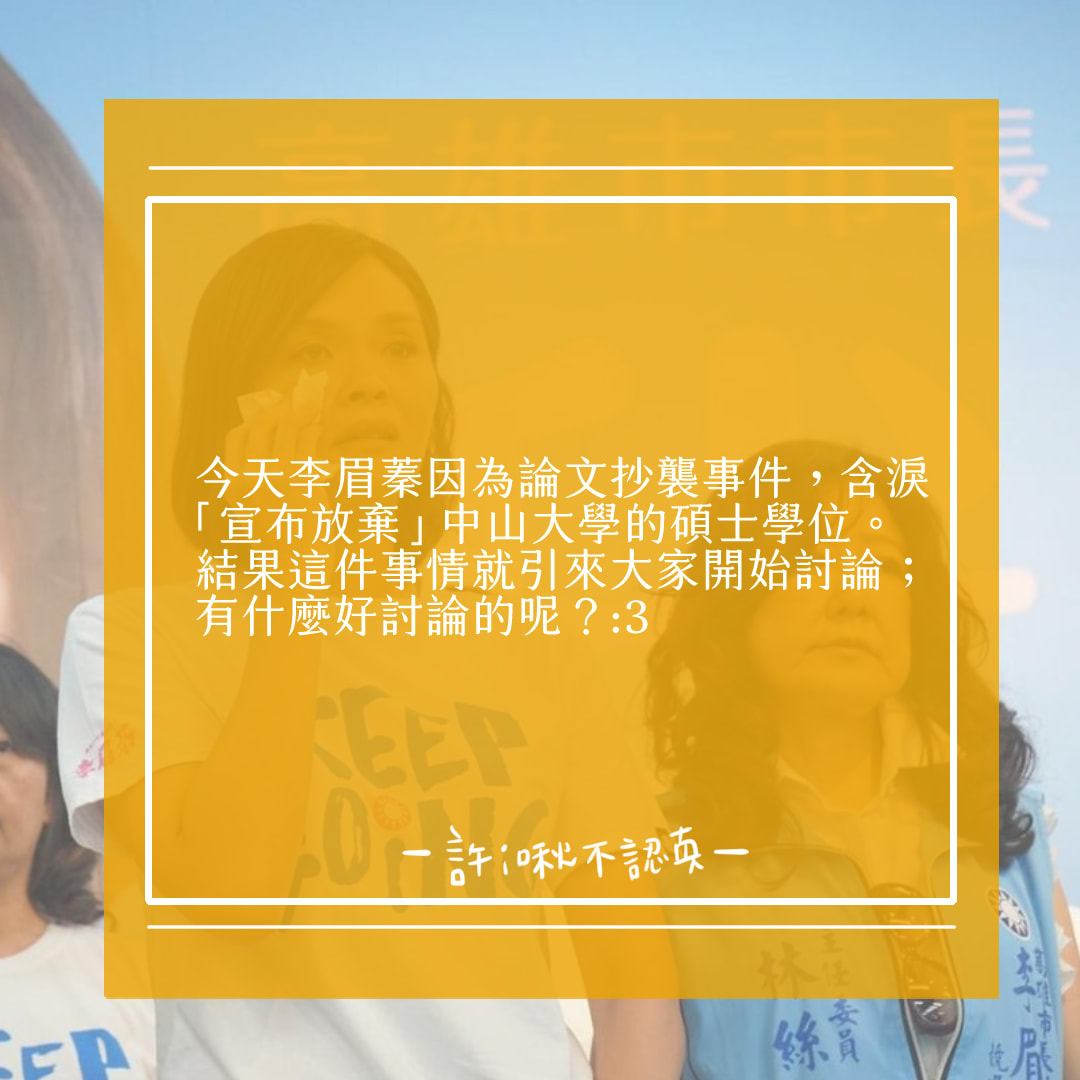
In short, this post has used Li Mei-Chen’s unsuccessful speech act as a quick introduction to what speech act theory is, why declarations don’t always work, and why this particular one became a meme. If you want to share this story with someone, feel free to use the image below! :)
See you next time!
Thanks for reading :D
If you enjoyed this post, feel free to click the coffee button in the lower right to support us and give Lottery a can 🐾
Comments