Tanzania Safari Cost Breakdown: 7 Days, USD 3,200 per Person (2026)
This trip covered the Serengeti and the Great Migration, a Mara River crossing, Ngorongoro Crater, a hot air balloon ride, and a hunting experience with the Hadzabe. If seeing the Great Migration is on your list too, here's everything from picking an operator to the budget to the packing list — all from an actual trip.
Before we start
“Around USD 10,000 per person.” That was the number I kept hitting every time I looked up the Great Migration, and every time I quietly closed the tab T_T Seeing the migration had been a dream of mine for years, and USD 10,000 is a genuinely painful number.
Then in September 2026, all six of us actually went to Tanzania and saw it — for about USD 3,200 per person, flights not included. Private tour, ate well, slept well, and we even went up in a hot air balloon.
Huge thanks to our friends H & Z, who are frankly amazing. They ran a Tanzania trip in 2025, and hearing them talk about it afterwards had me basically drooling — that was when I realised this was nowhere near as out of reach as I’d assumed.
I immediately asked them for their itinerary and operator details, locked in the dates with my family and the operator around December 2025, and we flew in September 2026 :D
If you’ve been circling this for a while, I hope this helps.
The Great Migration, and what “safari” actually means
What is the Great Migration?
If you’ve seen The Lion King, Mufasa’s death is probably burned into your memory — and that stampede of wildebeest is most people’s first mental image of the Great Migration.
I used to think the Great Migration happened once a year at one specific time. It turns out these animals (wildebeest especially) are migrating year-round. So you can see the migration in any season — the question is which stretch of it you want to see.
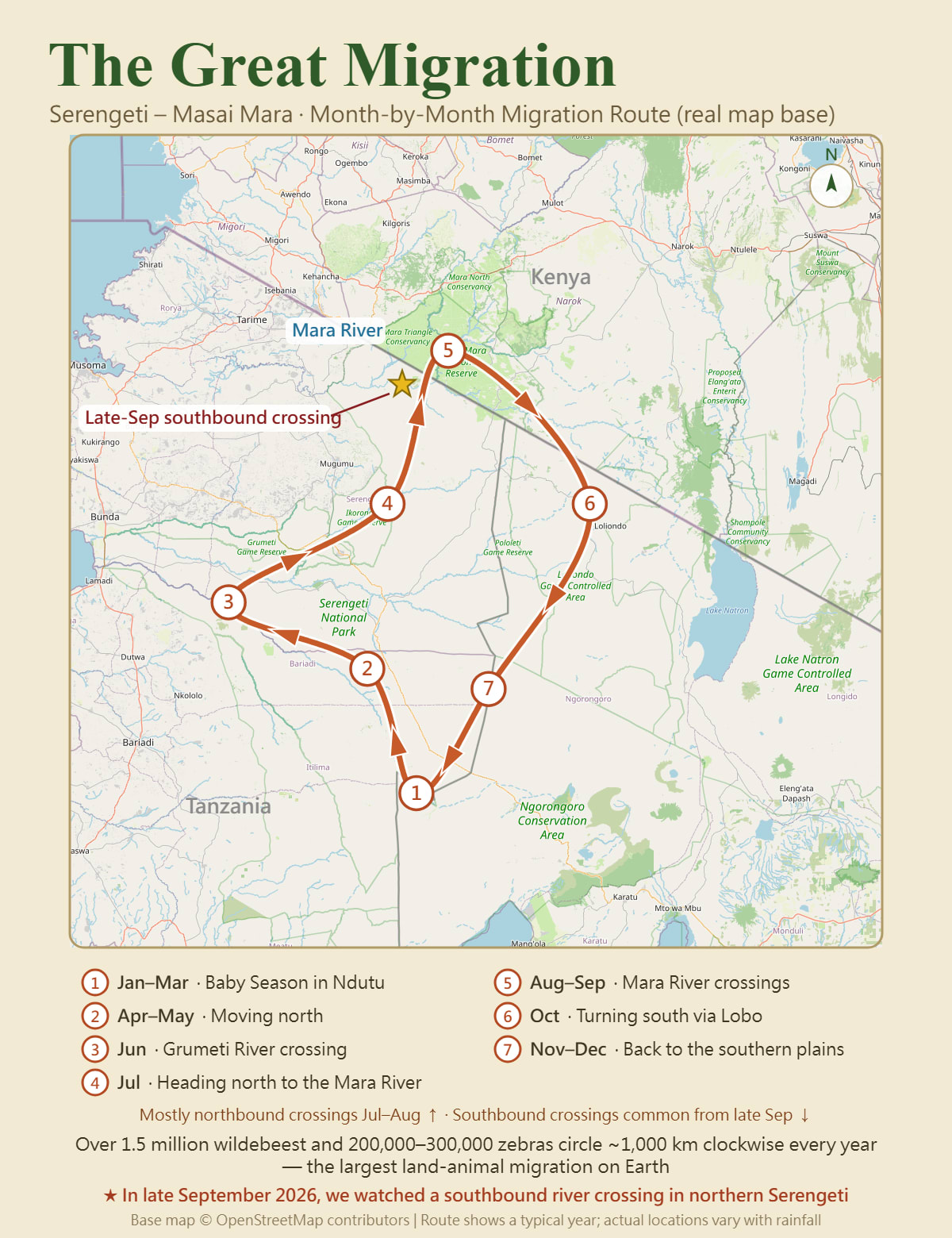
Every year from around April–May, over 1.5 million wildebeest and 200,000–300,000 zebras start moving north from the Ndutu plains in the southern Serengeti, chasing water and grass all the way to Kenya’s Masai Mara. From October–November they loop back south again — one enormous circular route.
It’s the largest land-animal migration on Earth.
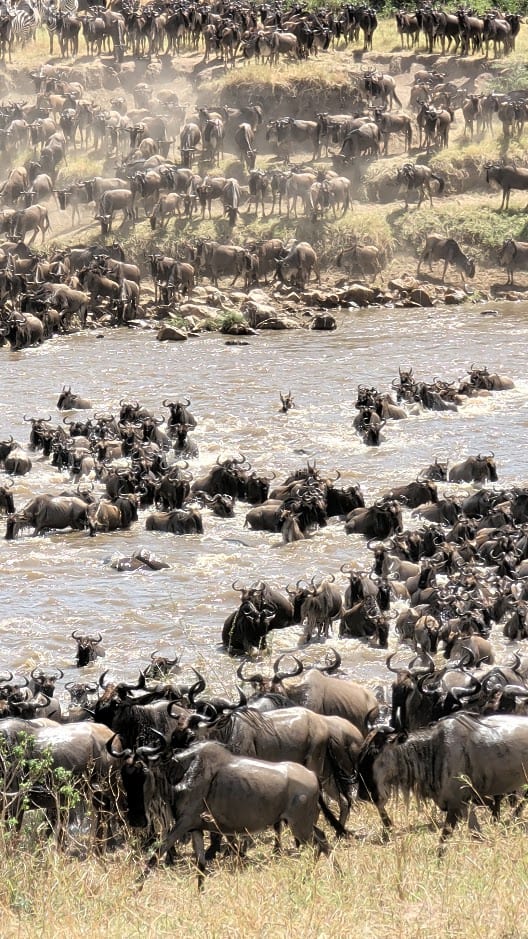
Along the way the herds have to cross the crocodile-filled Mara River. The Mara River Crossing is the most heart-stopping moment of the whole migration.
One thing worth spelling out: the crossing isn’t a one-way, one-time event. The herds cross back and forth repeatedly chasing water and grass — July–August is mostly northbound into the Masai Mara, and from late September you often see them crossing back south into the Serengeti.
What we watched in the northern Serengeti in late September was one of those southbound crossings.
The crossing isn't one-way — chasing water and grass, the herds cross the Mara River back and forth several times a year. ★ marks where we watched a southbound crossing in late September 2026 (around Kogatende)The crossing we saw. Wildebeest on both banks — and we watched one get taken by a crocodile, right in front of us Q_Q
What is a safari?
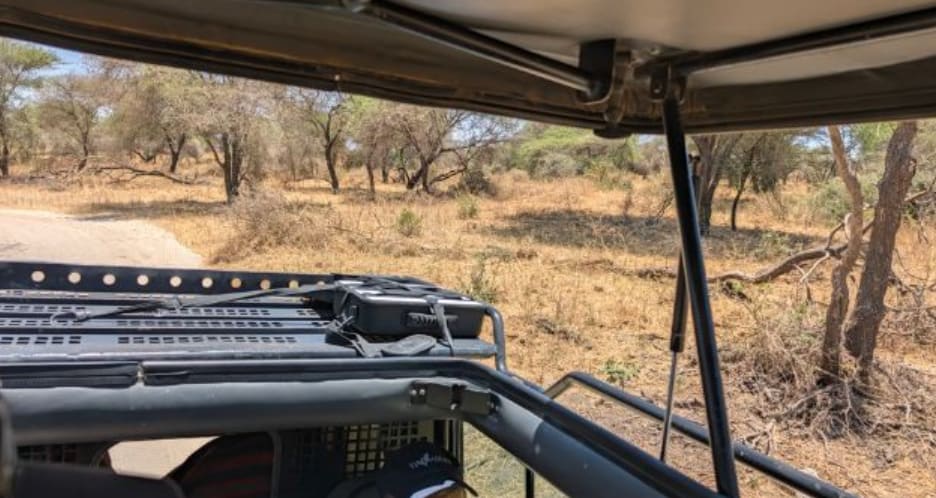
Safari is Swahili for “journey”. These days it means riding in a 4WD with a guide, tracking wildlife inside a protected area.
The biggest difference from a zoo is uncertainty. The animals are free. They don’t follow your itinerary.
Which is exactly why your guide’s experience matters enormously: a good guide shows you what other people drive straight past.
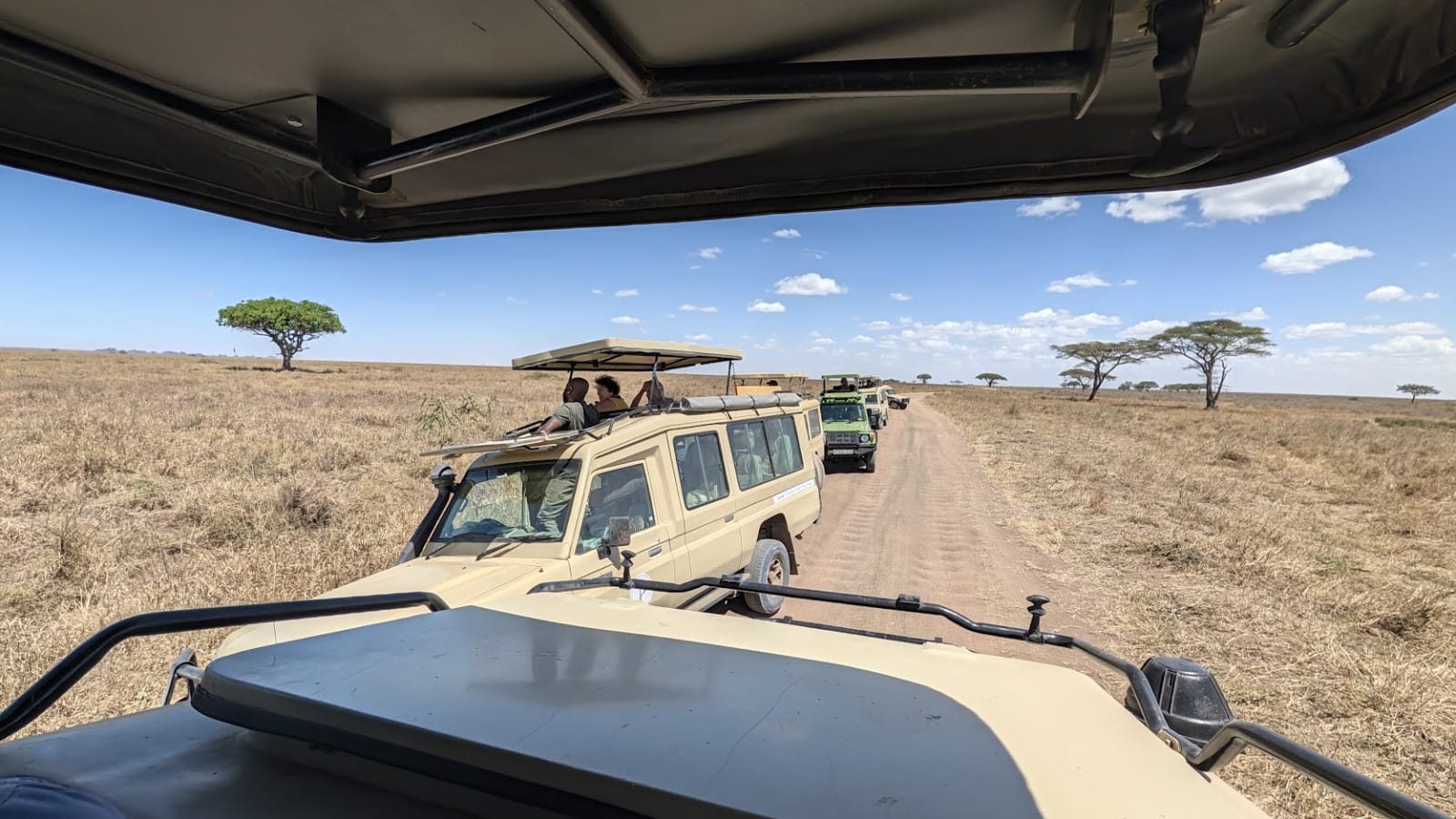
The whole roof pops open and you just stand on the seats. A line of vehicles parked up ahead usually means there's something worth seeing :P
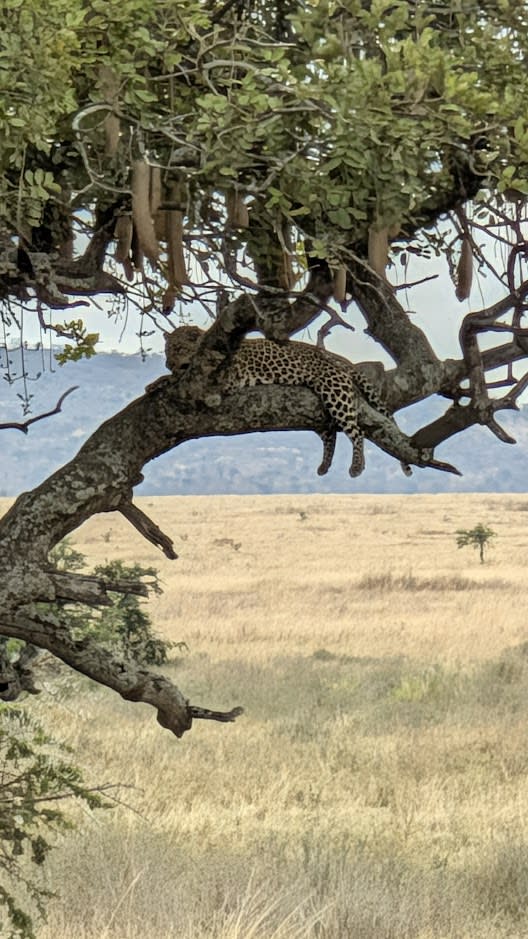
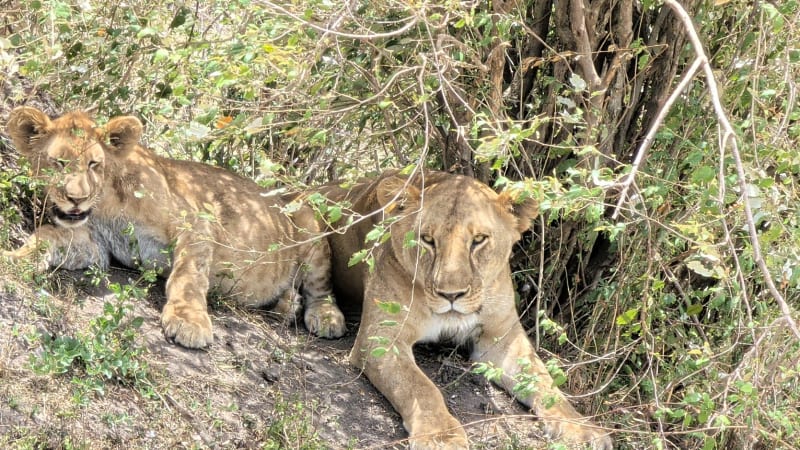
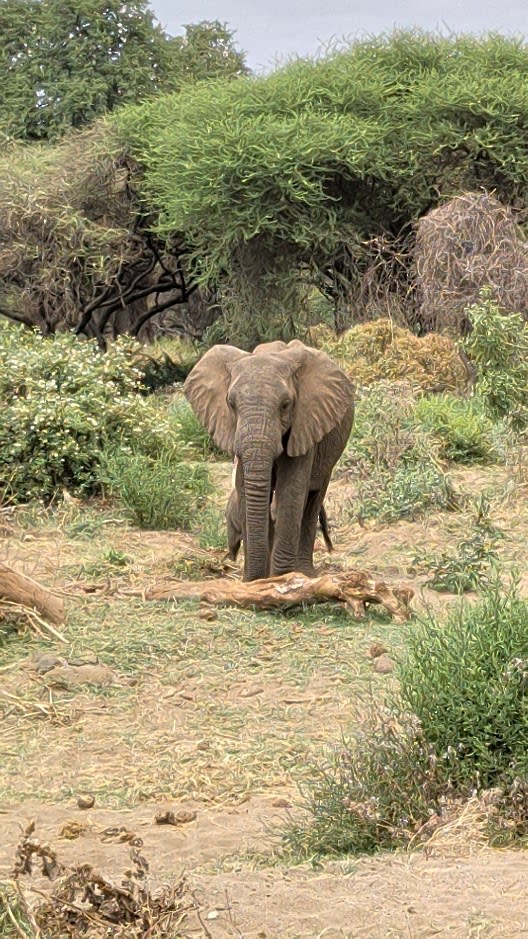
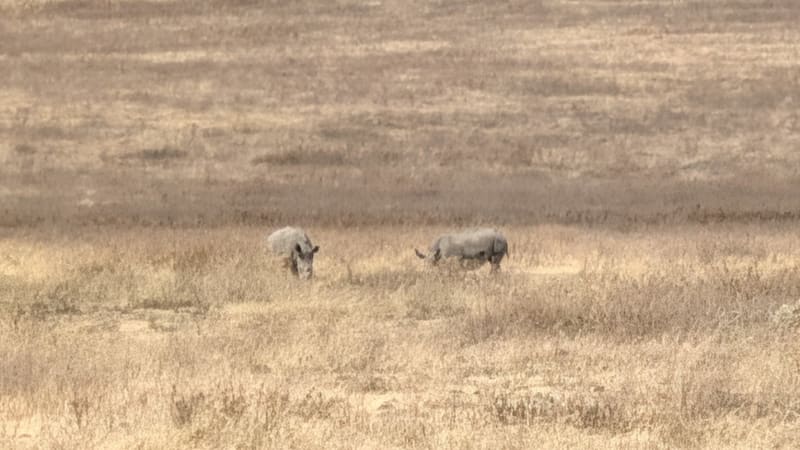
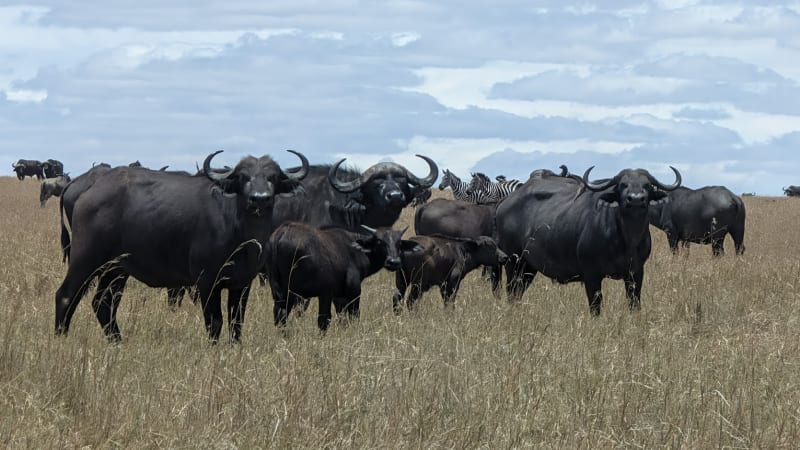
The famous “Big Five” are lion, leopard, elephant, rhino and buffalo — getting all five is genuinely lucky, and plenty of people only manage a few. We got all five:
The full Big Five: leopard, lion, elephant, rhino, buffalo
Where to see it: Kenya vs Tanzania
You can go on safari all over Africa — South Africa, Botswana, Namibia and more.
But if the Great Migration is your main goal, the two destinations that come up most are Kenya and Tanzania.
Both are excellent. Roughly how to choose:
Kenya
Tanzania
Tourism infrastructure
High, very well developed
Moderate, still developing
Time needed
4–7 days works
7–10 days to do it properly
Migration coverage
Masai Mara (the northern end)
Serengeti (most of the route)
Feel
More attractions, more convenient
Wilder, fewer crowds, more raw
We picked Tanzania — partly just copying our friends’ homework :P and partly because we’d heard the experience there was wonderful. It was. I’ve been missing the place and the people ever since :)
Tanzania, here we go! But… where, and when?
The main safari destinations
Tanzania is enormous — roughly 26 times the size of Taiwan.
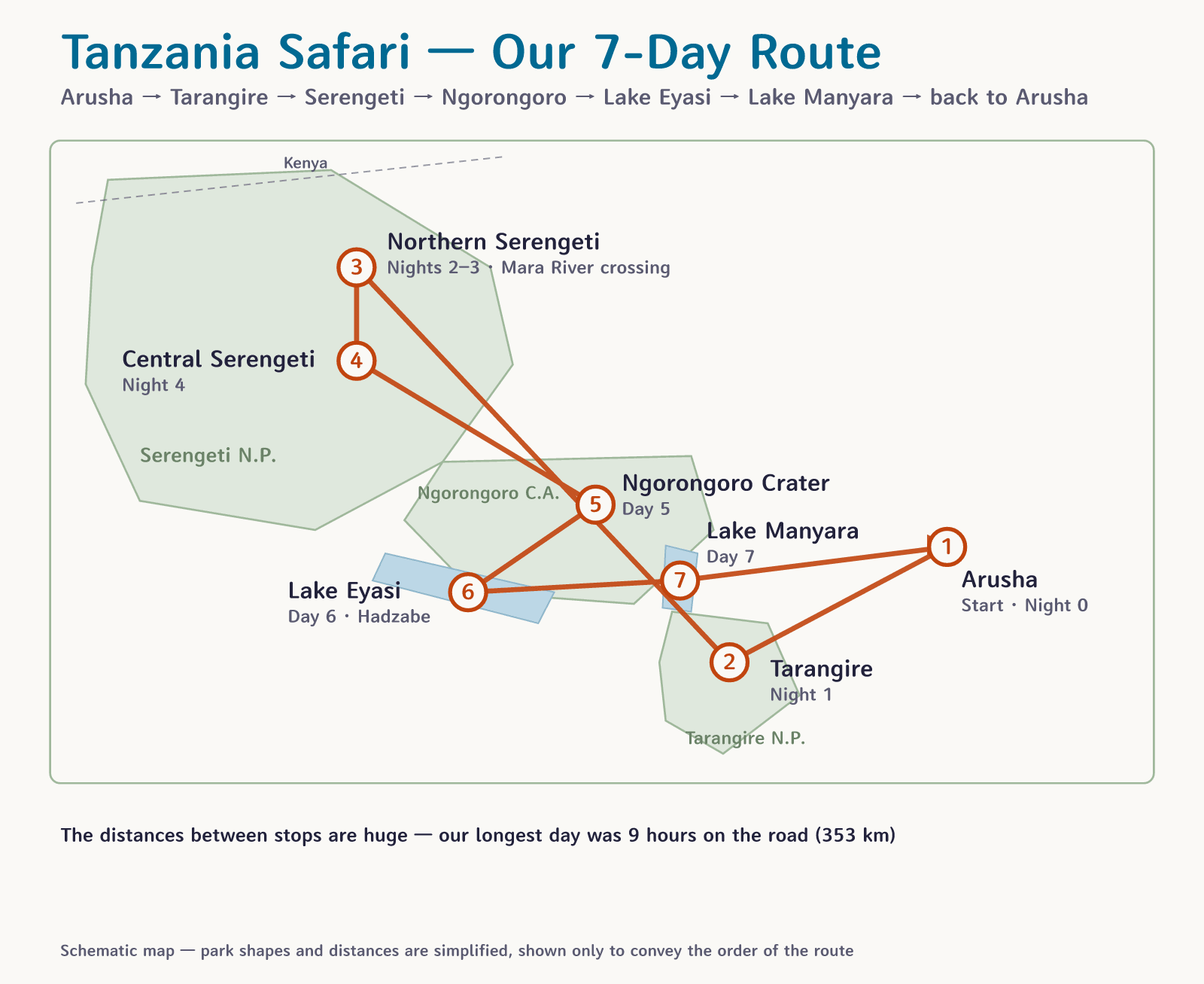
We did seven days and six nights, and we were out the door early basically every single day, mostly because the distances between places are huge. One day we were on the road for nine hours (353 km).
Here’s the route we actually drove — out of Arusha, a full loop, and back to Arusha:
The seven-day loop: out of Arusha, round Tarangire, the Serengeti, Ngorongoro, Lake Eyasi and Lake Manyara, then back. Park shapes are schematic, not to scale
The best-known safari spots in Tanzania, roughly matched to how many days you have and what you want to see:
Tarangire National Park: not what I pictured at all — lots of trees rather than open grassland. Loads of antelope species (waterbuck, impala, dik-dik, eland), plus lions, elephant herds, buffalo, and the famous baobabs.
Northern Serengeti: the Great Migration and the Mara River crossings (July–September is peak, still going in October)
Central Serengeti: where the Big Five concentrate — high odds on lion, leopard and cheetah
Ngorongoro Crater: a caldera about 19 km across, rhinos, a natural circular enclosure
Lake Manyara: tree-climbing lions (low odds), flamingos, salt-lake scenery
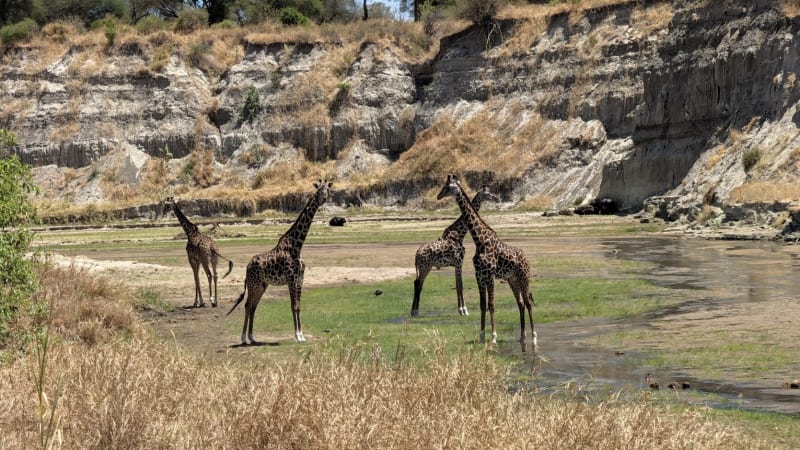
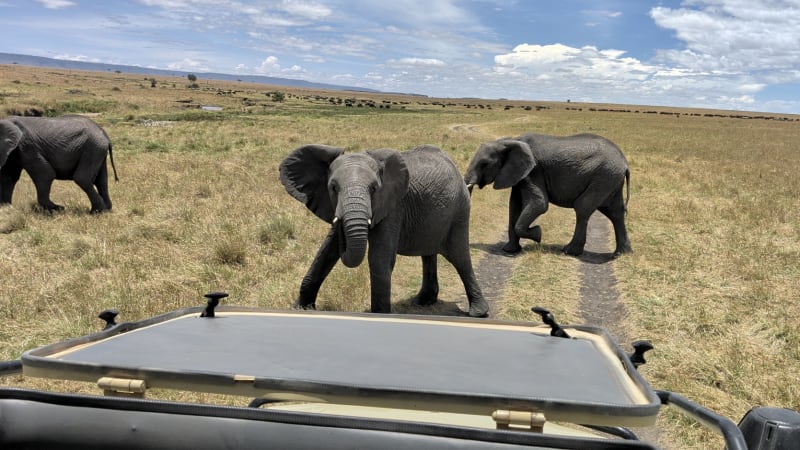
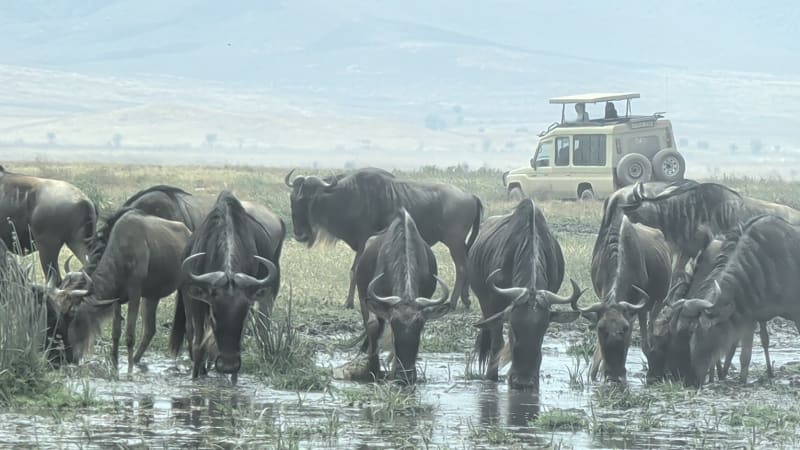
The parks look completely different from each other — worth factoring into your itinerary. Above: Tarangire, the Serengeti, and Ngorongoro Crater
Season decides what you’ll see
The Serengeti is the heart of the Great Migration. You can safari year-round; what changes is the scene you get:
When
The herds
Weather
Verdict
Jan–Mar
Calving season (huge numbers of newborns)
Warm, short rains
✅ High odds on lion, leopard, cheetah
Apr–May
In the south
Warm, long rains (wettest)
Good if you want to avoid crowds
Jun–Aug
Moving north into the northern Serengeti, northbound Mara crossings begin
Cool, dry season
Peak migration
Sep
Peak Mara River crossings (southbound crossings start appearing late in the month)
Cold mornings and evenings, warm days
✅ Best pick
Oct–Nov
Still crossing south, heading back
Warming up, pre-rains
Transitional
Dec
Back in the south
Warm, rains starting
Getting ready
We went in September, specifically for the peak of the Mara River crossings. That said, plenty of people recommend the January–March calving season instead — all those newborn wildebeest draw in predators, so your odds on lion, leopard and cheetah go way up.
Choosing an operator
Thanks again to our friends H & Z — we basically just used their operator, Kilimanjaro Adventure Safari Club, and I’d recommend them without hesitation.
We did still do our own homework first, since prices can shift year to year and staff turn over.
They’re not as well known as some of the bigger outfits, but Mary, who handled all our pre-trip questions, answered every single one — and our guide in Tanzania, Langeni, was, if the scale goes to 100, about a 120.
Our itinerary and accommodation were both genuinely good, which is why I wanted to put this in writing.
On price:
I fed the full itinerary and quote to several different AIs and cross-checked against other operators’ published rates, and they all came back with “this is good value.”
But honestly: I never actually got quotes from other operators, and I never haggled :P So I can’t promise you this is the lowest price on the market. I’d just strongly suggest including them when you compare.
Who this operator suits: everything runs in English — Mary beforehand, Langeni’s wildlife commentary on the ground. So the minimum bar is one person in your group willing to carry the English: translating, handling communication with the operator and the guide. With that person on board, it genuinely doesn’t matter if nobody else speaks any English.
If nobody in your group can take that role — while writing this post I discovered their website actually lists guides in other languages (English, Spanish, French, German, Italian, Chinese), so you could just ask Mary. We didn’t use it, so I can’t tell you how it’s staffed or what it adds to the price.
There are other local operators running tours in other languages too, but since I’ve never dealt with any of them and don’t know any personally, I’m not recommending any — you’ll have to get your own quotes (and feel free to tell me what you find :P).
It makes sense that they cost more. My guess is the setup becomes a local guide plus an interpreter — two people: the local guide finds the animals, the interpreter translates. That’s one more salary, so the cost goes up. Which means when you’re getting quotes, ask which arrangement it is:
Local guide + interpreter (two people): more expensive, but you don’t sacrifice the local guide’s experience — you get both
One guide who speaks your language (one person): cheaper, but check their years of experience carefully — the pool of guides who are both fluent in your language and highly experienced is a lot smaller than the English-speaking pool (more on why experience matters below)
If you genuinely need it, I think the money is worth spending.
The best part of a safari is your guide explaining animal behaviour and ecology. Without that, you’re just staring at animals.
What to look at when picking an operator
About the company:
Is the price all-inclusive — any hidden costs or vaguely-defined extras?
Medical and first aid — do they carry medical staff or emergency equipment?
Registration — are they legally registered and licensed?
Vehicle condition — how old is the 4WD, does it have air conditioning, is the safety equipment complete?
Reviews — real past-customer reviews (Google, TripAdvisor, forums)
Responsiveness — do they reply quickly and professionally during the enquiry stage?
About the itinerary:
Days and route — how long you have, and which parks it covers
Budget range — a clear quote, and whether that price is reasonable for the market
Accommodation — is it already booked, and is it one consistent tier or a mix of Mid-Range and Luxury?
Group type — private (just you) or shared (with strangers)?
Guide request — can you request a specific guide, or at least find out their experience level?
Flexibility — if the weather or the herds’ movements change, can the route be adjusted?
The big one: your guide’s experience
The thing I most want to stress is how much your guide’s years of experience matter.
Finding animals has nothing to do with GPS — guides rely on years of accumulated memory of the landscape, deep knowledge of animal behaviour, and a radio network with other guides, to locate wildlife across an enormous park.
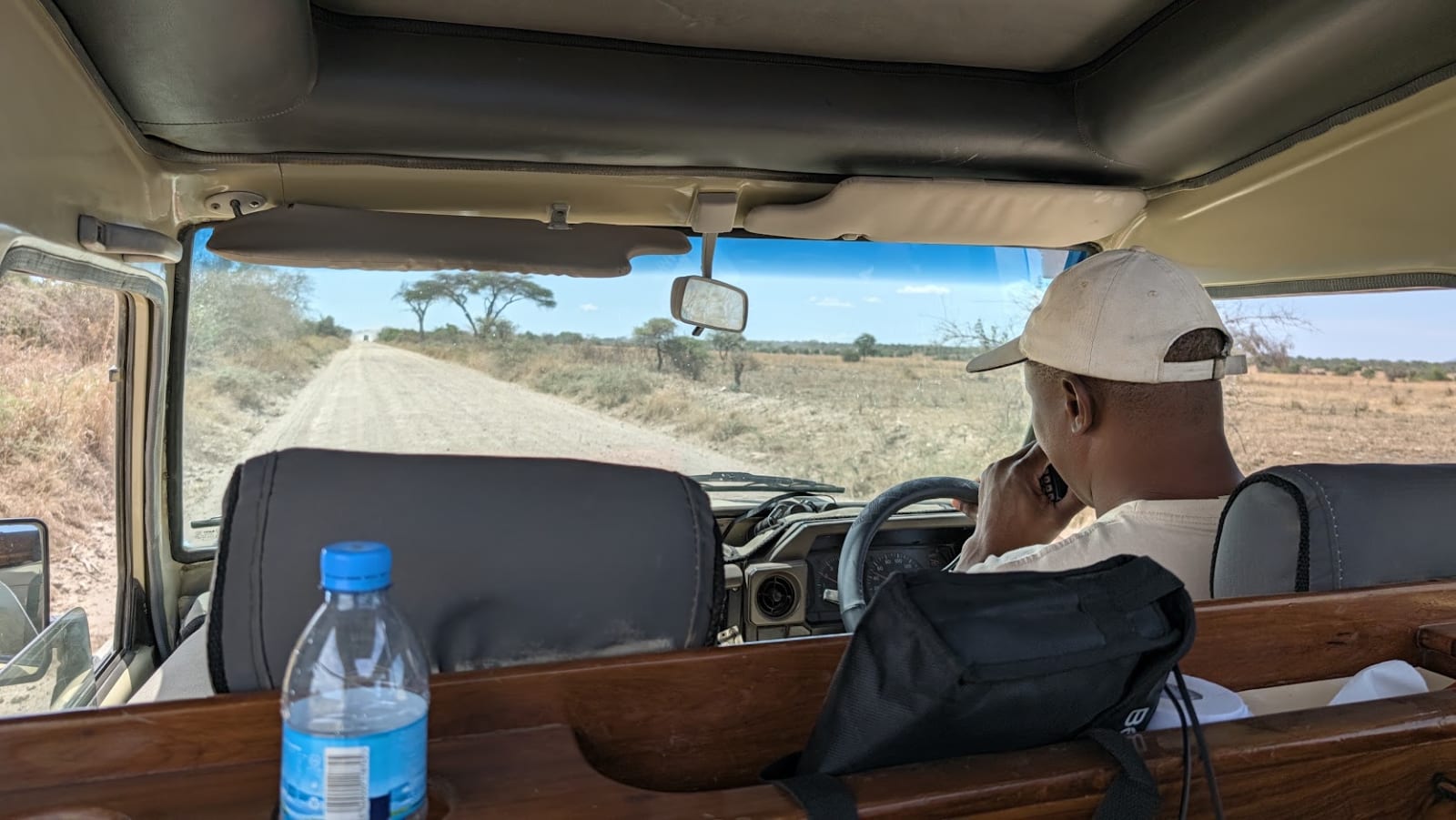
Langeni driving and working the radio with other guides — that network is how you find animals in a park this size
Becoming a guide means going to a dedicated school first, but after graduating it still takes 3–5 years to build basic experience, and it’s the senior guides (10+ years) who show you what other people miss.
Langeni has 20+ years. Every time we found an animal, he’d position the vehicle at the best possible angle for photos.
And his knowledge of animal behaviour is extraordinary — the man is a walking encyclopedia.
If you go with Kilimanjaro Adventure Safari Club like we did, I’d strongly suggest asking whether Langeni is available. He is absolutely worth shifting your dates for.
Budget breakdown
Six people, seven days and six nights, September 2026, Mid-Range accommodation, flights excluded.
The “USD 3,200” in the title means with the balloon, without flights; skip the balloon and you’re looking at about USD 2,660.
Why flights aren’t included: airfare varies far too much — you might redeem miles, take a different number of connections, or fly a different cabin, and the same route can easily differ by several times over. Folding that in would make the number less useful, not more, so I’ve kept flights separate and listed them on their own below (my parents’ actual fare is further down).
Broken down (the Taiwan-side costs converted at roughly USD 1 ≈ TWD 31):
Item
Per person
Safari package (food + lodging included)
USD 2,350
Night 0 hotel in Arusha
USD 46
e-Visa
USD 50
Guide tips (7 days)
~USD 100
Yellow fever vaccine + malaria pills
USD 116
Hot air balloon
USD 500
Total (excl. flights and insurance)
~USD 3,160
These figures come from a quote made in December 2025 for a September 2026 departure (6 people, 7 days / 6 nights, Mid-Range), and are for reference only. Actual prices shift with group size, season, accommodation tier, and park fees that rise every year — always go by the operator’s current quote.
My parents’ flights were about USD 1,330 each, and then there are the odds and ends (souvenirs, hotel drinks and so on) — add those and you have the full cost of the trip.
Want to know what that money actually buys? The “Where we stayed” section below has photos and short reviews of all six nights.
Item by item:
Safari package, 7 days / 6 nights: USD 2,350 per person
Booked through Kilimanjaro Adventure Safari Club. The core package covers:
Seven days / six nights of accommodation, all meals, drinking water
4WD vehicle and guide
Park entry fees and vehicle fees
Basic first aid
Portable toilets and tent cleaning at the camps
That’s the price we locked in December 2025 for a September 2026 trip.
Tourism costs in Tanzania rise every year (roughly 5–10% annually). The 2026 foreign-visitor park fees I could find:
Serengeti National Park: USD 83 per person per day
Ngorongoro: conservation fee USD 70.80 per person per day, plus a USD 295 per-vehicle crater service fee if you descend into the crater
If you want to see the Great Migration, for your wallet’s sake, go sooner rather than later. These numbers only go up :’)
Pricing varies with group size — anywhere from 2 to 6 people works.
We saw a lot of vehicles running with just two passengers, which looks extremely comfortable.
Six of us in one vehicle was about right (I wouldn’t do seven) — comfortable seats (the back two are a little tighter), and it brings the per-person cost down.
Our operator mentioned they can help match you into a shared group too, so if you’re trying to save, it’s worth asking.
In practice you’re in the vehicle most of the time and rarely get out, so you don’t really run into people holding the group up; and at the hotels everyone goes their own way. Sharing a vehicle is genuinely worth considering.
Some itineraries add other destinations or include light aircraft hops, and those are a completely different price bracket.
My parents flew from Taiwan at about USD 1,330 each, two connections — thanks to Settour for the help
Travel insurance
Book yourself
From Taiwan: Chubb travel insurance. From Japan: World Nomads
Yellow fever vaccine + malaria pills
~USD 116/person
That’s the Kaohsiung Municipal United Hospital price, including all the registration fees. Varies with which malaria drug you pick
Night 0 hotel in Arusha
Book yourself
We booked on Booking.com, about USD 46 per person; the operator can also book it for you
The optional extra
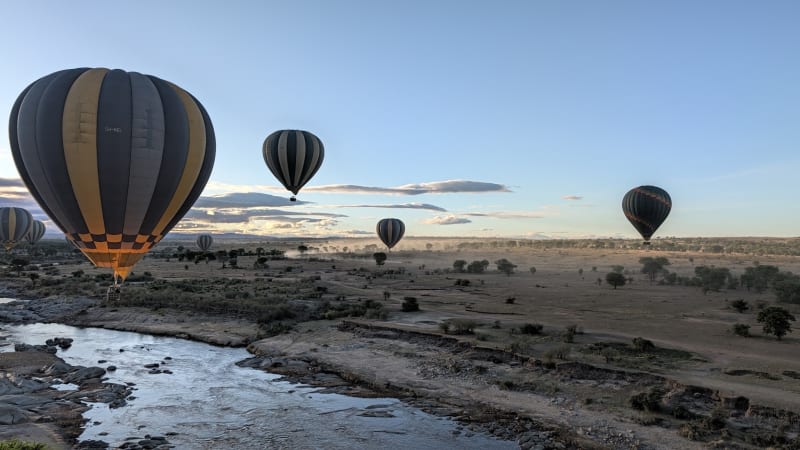
The balloon is entirely optional, but if you’ve never done it, I’d push hard — it was one of the highlights of the whole trip.
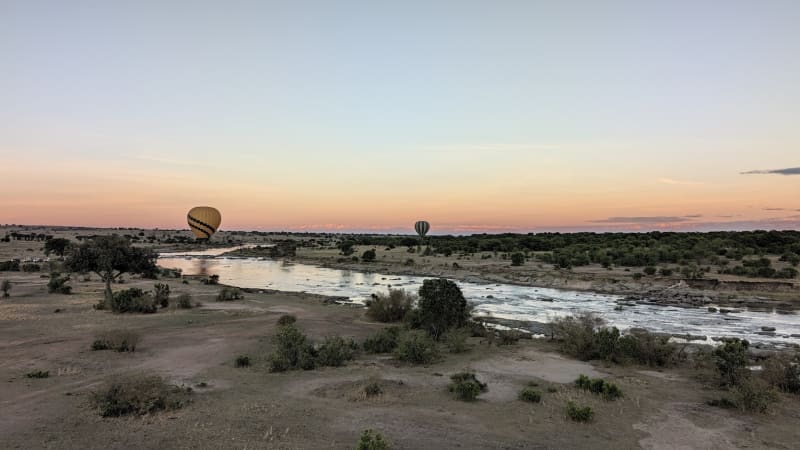
Going up at dawn over the open plains is absolutely worth it.
The moment we lifted off, this song was all I could think of Q_Q
Carmen Twillie, Lebo M. — Circle of Life | Disney Music
Lifting off at dawn, with the Mara River below us
Item
Price
Total for 6
Hot air balloon
USD 500/person
USD 3,000
There are also tips for hotel staff, tips along the way, extra hotel drinks, souvenirs and so on, which I haven’t itemised here.
Where we stayed
Your accommodation tier depends on the range you book, but operators can usually shift you between tiers — and the earlier you book, the better your odds of an upgrade.
Every operator works with different properties, so here are the six nights we actually had, as a reference point for “what does Mid-Range actually feel like.”
Our six nights
Night
Park that day
Hotel
Tier
Type
Night 0
Arusha
Venus Premier Hotel
Booked ourselves
Building
Night 1
Tarangire National Park
Farm of Dreams Lodge
Mid-Range
Building
Night 2
Northern Serengeti NP
Intimate Camp Zebra
Luxury (upgraded)
Tent
Night 3
Northern Serengeti NP
Intimate Camp Zebra
Luxury (upgraded)
Tent
Night 4
Central Serengeti NP
Signature Serengeti Luxury Tented Safari Camp
Luxury (upgraded)
Tent
Night 5
Ngorongoro Crater
Lake Eyasi Safari Lodge
Mid-Range
Building
Night 6
Lake Eyasi
Heart & Soul Lodge Manyara
Mid-Range
Building
Short reviews:
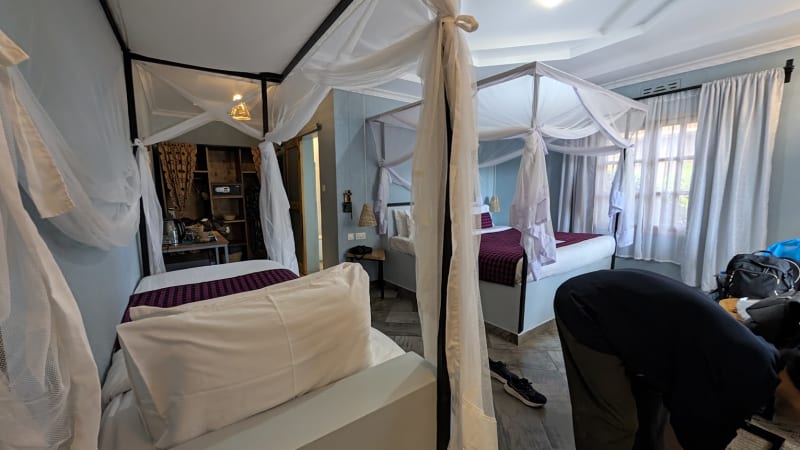
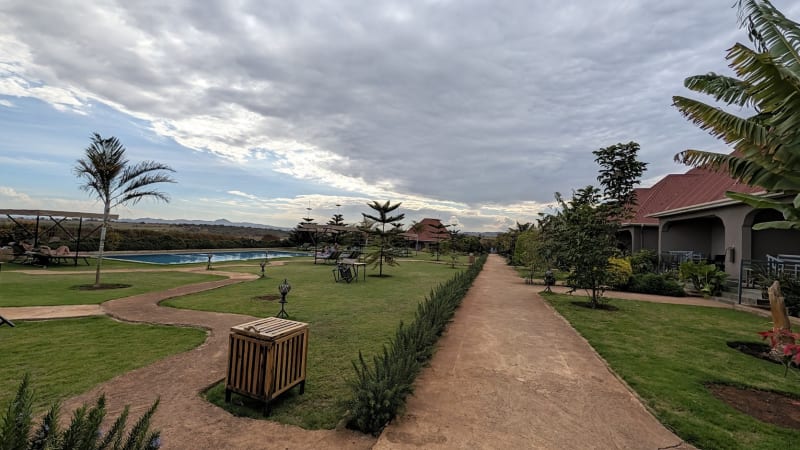
Farm of Dreams Lodge (Night 1)
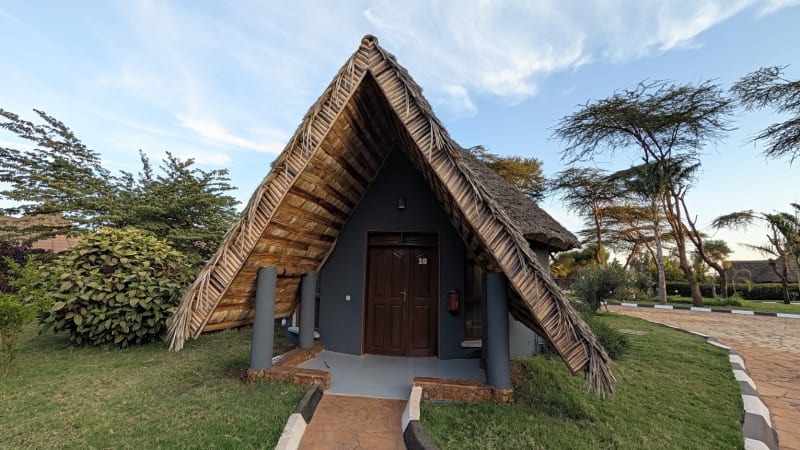
Labelled Mid-Range, but it felt better than that. They put on a welcome performance.
Farm of Dreams Lodge — the first night already exceeded expectations
Intimate Camp Zebra (two nights)
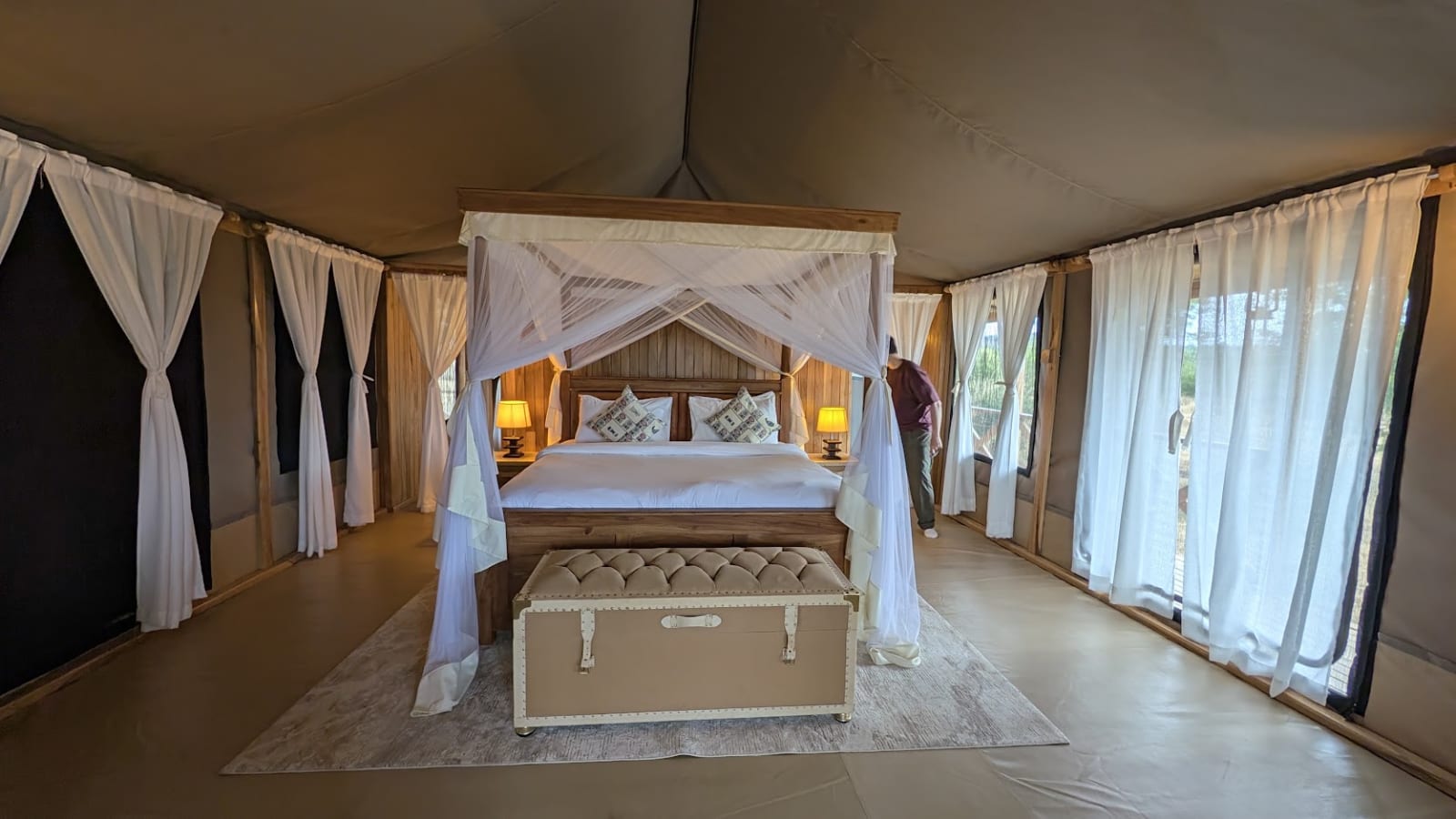
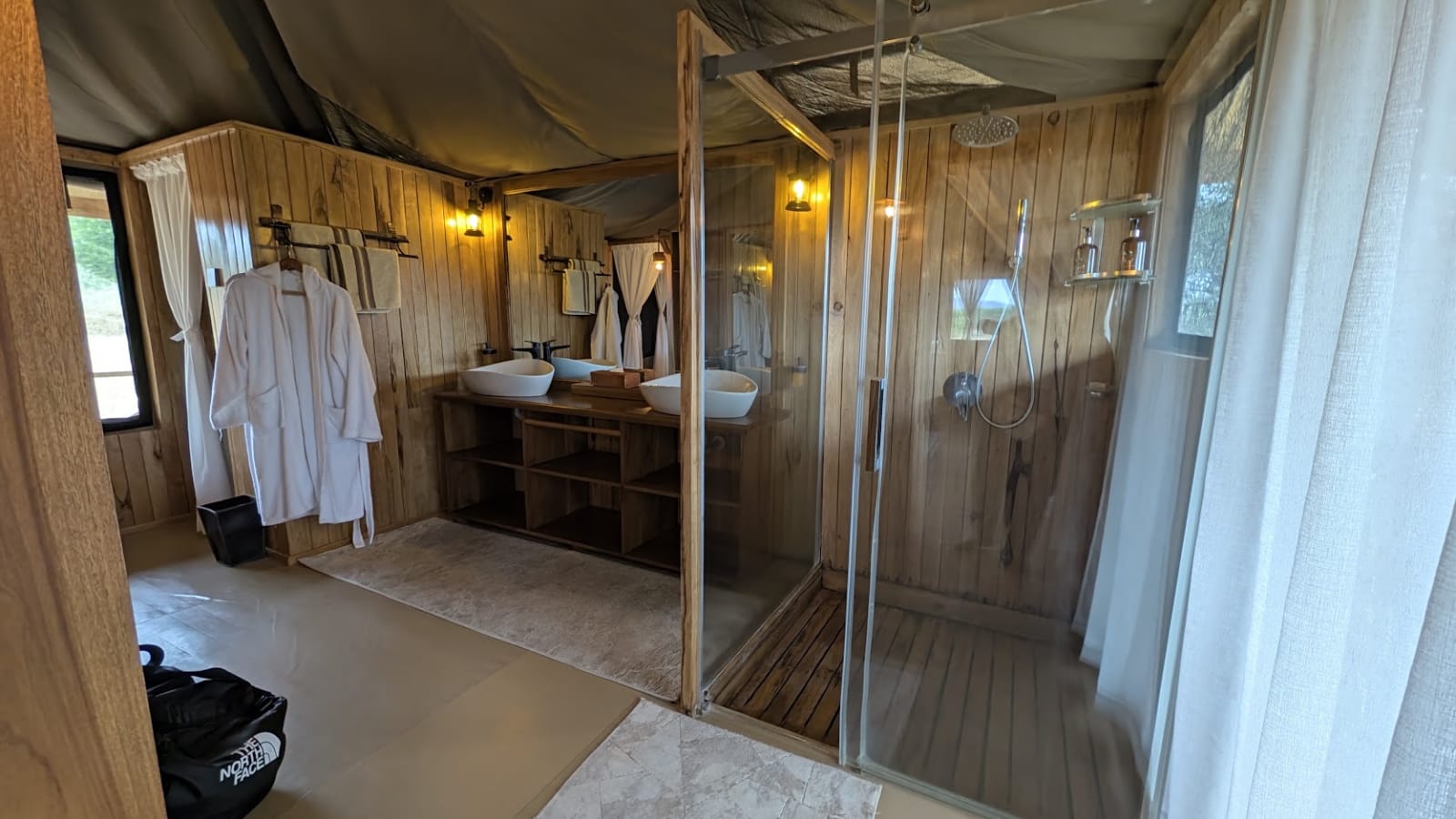
At first I genuinely didn’t understand how a tent could be “Luxury” — then we came back after dinner and I got it. The towels were scented and there were hot water bottles tucked into the bed.
Came back from dinner to scented towels and hot water bottles in the bed
Signature Serengeti Luxury Tented Safari Camp
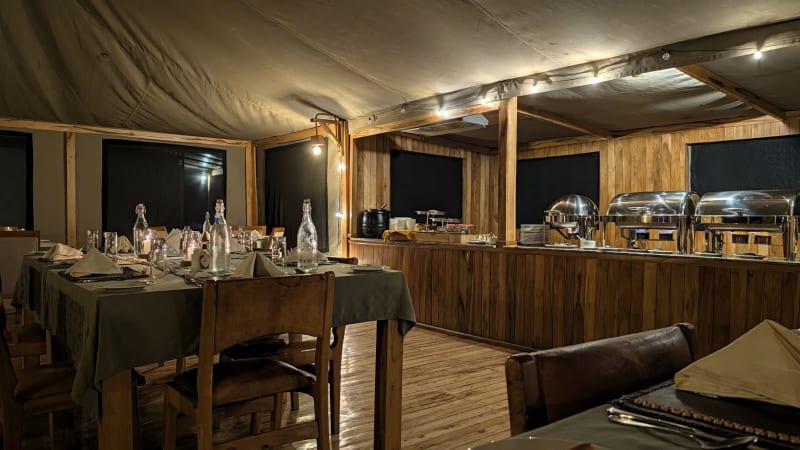
This one was almost too luxurious — excellent staff, delicious dinner, the single best night of the trip.
The best night of the whole trip
Lake Eyasi Safari Lodge
After a few nights that good, the drop felt bigger than it was — less polished, and no Wi-Fi in the room (thank goodness for Starlink). But the sunset was genuinely beautiful.
No Wi-Fi in the room, but the sunset made up for it
Heart & Soul Lodge Manyara
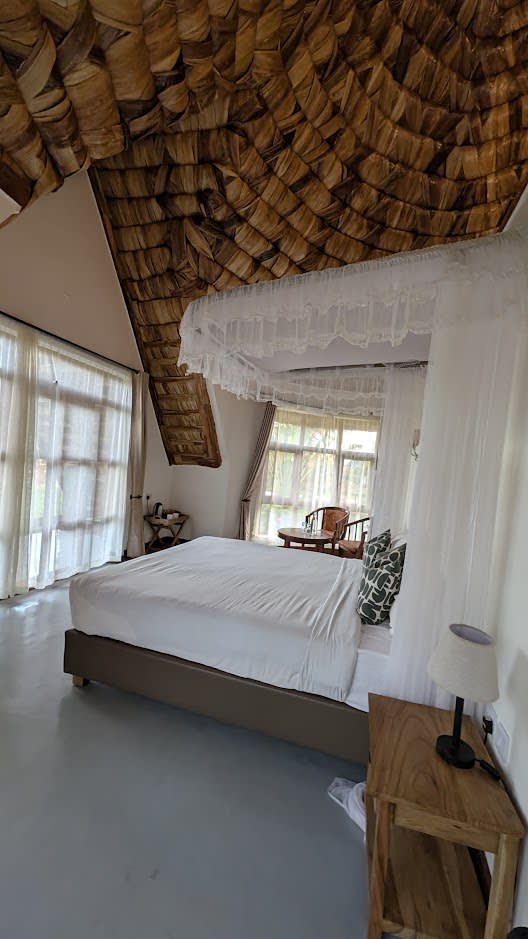
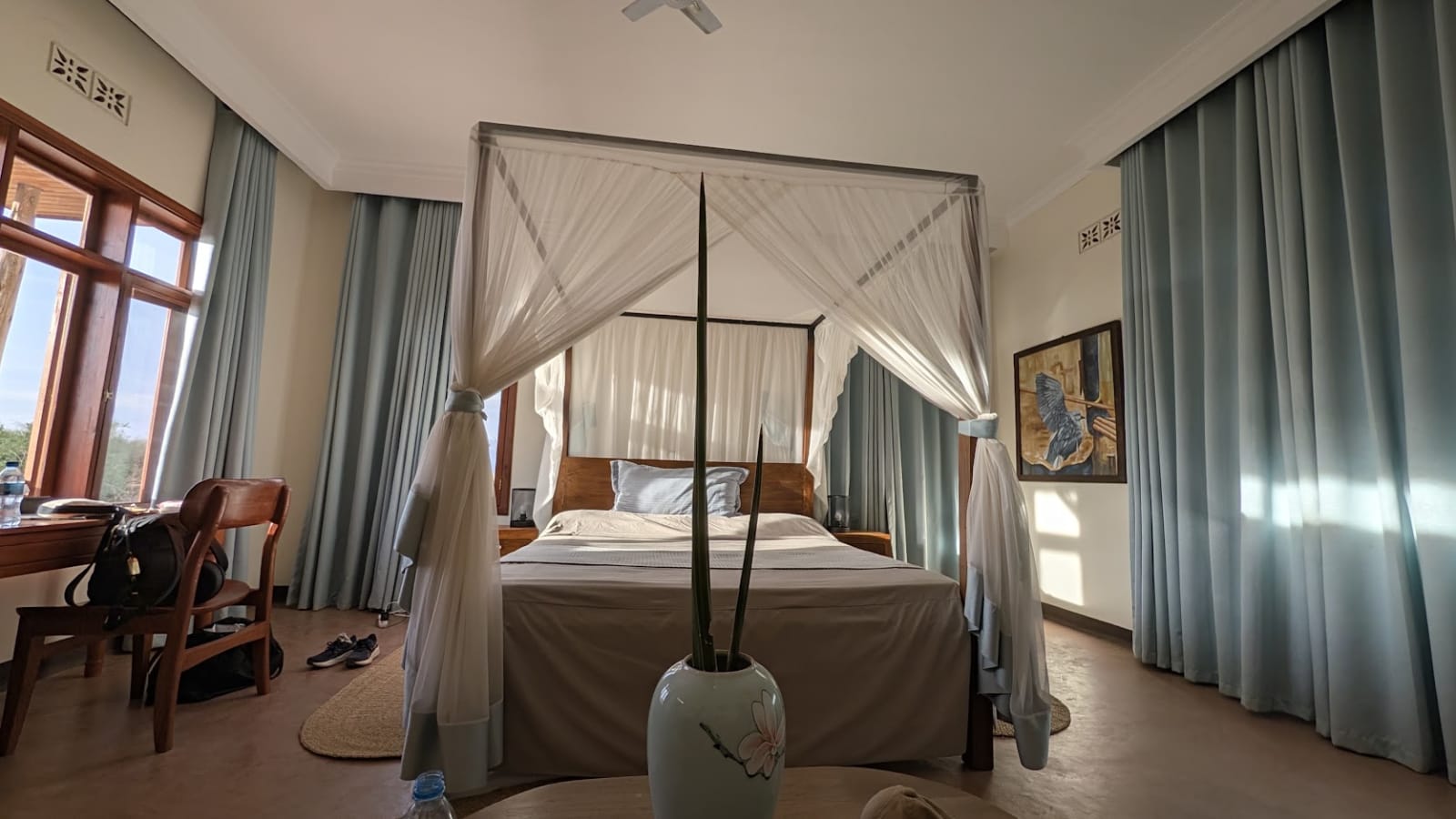
Back to the kind of Mid-Range that surprises you — comfortable, well finished, excellent staff.
Heart & Soul Lodge Manyara — the last night, back to a Mid-Range that impresses
A few general observations
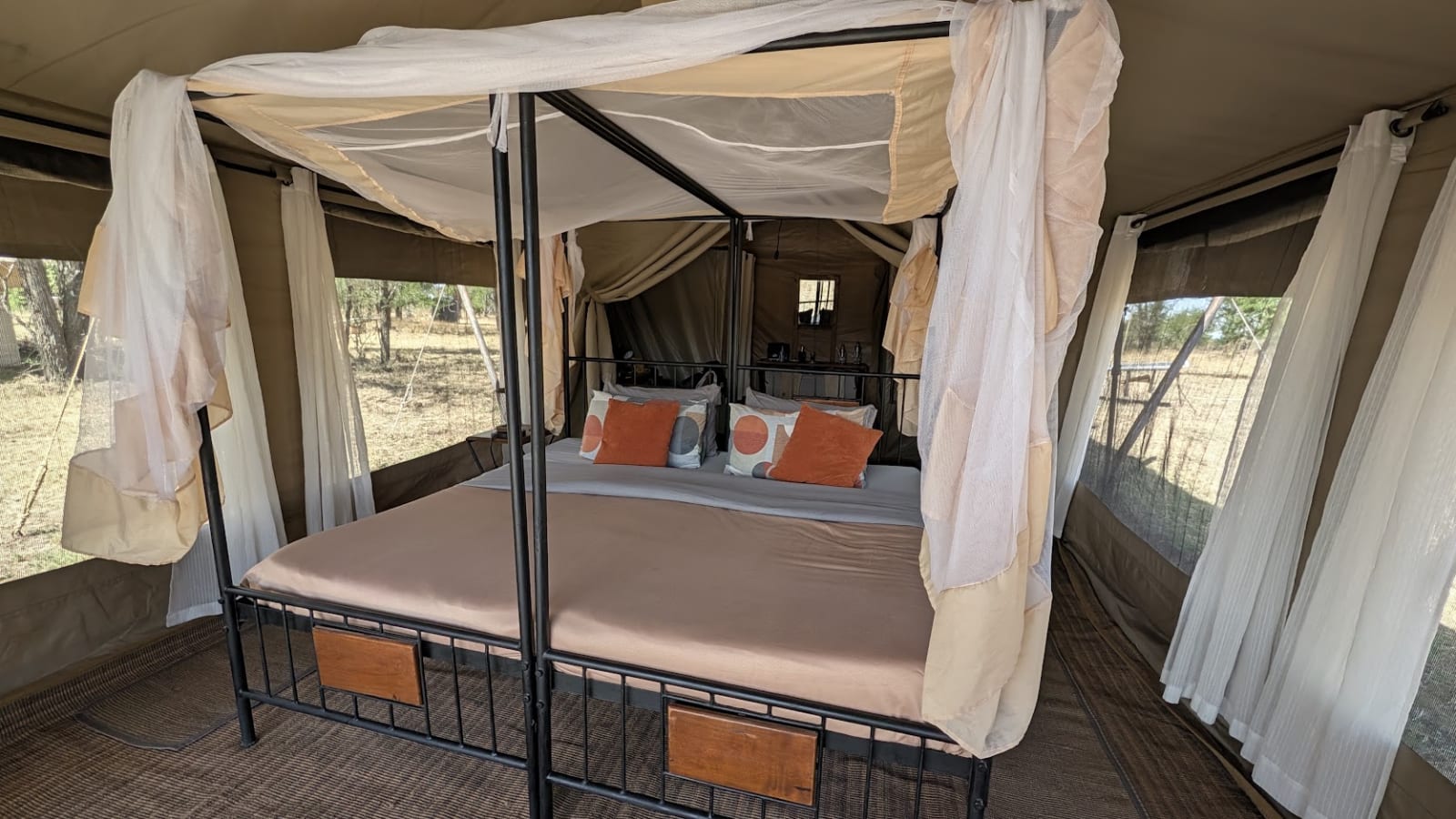
“Mid-Range” and “Luxury” mean local standards: hotels inside the national parks are heavily restricted, so they can’t be too lavish (or they’d be absurdly expensive) — which is why a tent counts as Luxury (and to be clear, the tents there are lovely, flush toilets included). Outside the parks you get actual buildings
Every Mid-Range room I stayed in had a flush toilet!!! This matters!!!
Even in a tent, there's a flush toilet inside — this really does matter
Not spotless, but clean and comfortable: you do get the occasional insect, but I’m quite bug-averse and I was fine — in the tented camps they deliberately fumigate the room, so it was all OK. And they come turn down your bed and set up the mosquito net while you’re at dinner!
Most hotels don’t have hair dryers, or you have to go to the main building. Of the five we stayed in, exactly one had one in the room Q_Q Worth knowing if you have long hair
Animals really do walk through at night, so never go out without a staff member. The night we were in the Serengeti we heard zebra, hyena and lion
Q&A: things to decide and arrange before you go
Q: What ages can handle this trip?
Kids are fine as long as they’re old enough to understand instructions, and older travellers are fine as long as they can move around on their own and sit still in a vehicle.
My parents are 65+ and had no problems at all; a lot of the travellers we saw were retired
The real bar is mobility: most of the time you’re climbing onto the vehicle seats to stand and look out, and at camp you walk yourself to your tent. If you can’t move around freely, the experience is more limited
Q: What if you have a health condition?
The most important thing is to tell the operator when you book. Common ones:
Heart or respiratory conditions: altitude isn’t high (the Serengeti is around 1,500 m; the Ngorongoro Crater floor is around 1,800 m and the lodges on the rim are 2,200–2,400 m), but between early starts, late finishes and long drives, talk to your doctor first
Knee or back problems: the drives are long and rough — 7–9 hours a day on the road. My parents were fine, but factor in comfort if this affects you
Blood sugar / blood pressure: meals are regular, three proper ones a day; bring enough of any medication
Altitude sickness: basically not a concern, it just isn’t high enough (unless you’re also climbing Kilimanjaro)
Q: How good does your English need to be?
Not fluent, but being able to follow basic English helps a lot.
Your guide narrates everything in English — the animals, their behaviour, the stories. Missing that is a real loss; knowing some common animal names in advance helps a lot (some animals are gone in seconds!)
At dinner the camp staff brief the next day’s plan in English. It’s simple stuff, and you can always just ask your guide
Not understanding won’t strand you: the explanations are very visual — you’re looking right at the animal
One person in the group carrying the English is enough: everyone else can have zero. If nobody can, consider a tour in your own language — I wrote more about that under “Choosing an operator”
Q: Are the animals dangerous?
No. The logic of a safari is viewing from a safe distance, and your guide knows exactly how far that is.
In the vehicle: completely safe. Lions, elephants and leopards have all seen vehicles before and won’t initiate
At camp: tented camps have security patrolling at night who chase off anything that comes close. Don’t wander around alone at night — always go with a staff member
Q: What should I know about flights and connections?
Strongly recommend a single ticket (one ticket covering the whole journey): when there’s a delay, somebody is actually responsible for you. Our return flight was delayed about an hour and our next flight out of ADD should long since have departed — but because everything was booked through Ethiopian Airlines, they were obliged to get us on it
Everyone in the group should book together, so you’re guaranteed to travel together. One person in our group booked separately, their seat got changed, and it took a lot of time to sort out
Routing: from Taiwan or Tokyo you’ll usually connect once in Asia (commonly Singapore, Korea or Bangkok), then again in Addis Ababa (ADD) or Nairobi (NBO). Delays are very common — get good trip-disruption coverage and leave generous connection times
Layovers over 8 hours at ADD come with a transit hotel: applies if both legs are Ethiopian Airlines. The process is more involved than you’d expect — see the appendix at the end
Q: How do you pay locally? Do you need local currency?
Use US dollars. You don’t need to change money.
US dollars in cash: Tanzania has its own currency, the shilling, but foreigners use USD almost everywhere. As of October 2026, USD 1 is about 2,630 shillings. Bring plenty of small bills (1s and 5s)
Bill series matters: US notes need to be the post-2006 series
Deposit: operators usually take a fixed percentage — pick the smallest option (it’s a large sum with a lot of variables), then bring USD cash for the rest. The operator comes to collect on Night 0
Wire transfer fees: if you’re paying the deposit by international transfer, use Revolut or Wise — dramatically lower fees (we already held USD; Revolut charged USD 18.54 on a USD 2,100 transfer). Feel free to use my referral links :D
Cards: most hotels and rest stops take cards. Settling in local currency is cheaper; converting to USD adds a noticeable markup :P though still within reason
Q: What about internet and connectivity?
Don’t count on hotel Wi-Fi. If you need reliability, bring Starlink or get an eSIM.
Hotel / camp Wi-Fi: most have it, but it’s unreliable; some only have it in the main building
eSIM: runs on local infrastructure, so the signal isn’t great. I used the free 1GB global eSIM from ShopBack (where I work) — decent speed when it connects
Starlink: by far the most reliable thing we had. Details in the next question
Q: Does Starlink work in Tanzania?
Yes. Tanzania isn’t inside Starlink’s official service area, but in practice it works.
Thanks to H & Z, we borrowed their Starlink Mini and activated it in Japan on the Starlink Travel plan — incredibly stable and incredibly fast. On the nights when hotel Wi-Fi was useless, we just used it.
But… the roads are so rough that looking at your phone makes you carsick, and the scenery is too good anyway, so on several days we barely turned it on and only used it back at the hotel XD
How we actually carried it:
Case: bought the dedicated one on Amazon Japan
Mounting: added the kind of bungee cords Taiwanese scooter riders use and asked our guide to strap it to the vehicle
Orientation: the Starlink Mini’s panel needs to face up
Power: three power banks + the Starlink Mini’s USB-C cable. Two numbers matter here:
Output spec: you need a USB-C PD 100W (20V/5A) power bank — that’s the minimum in the official spec sheet, and Starlink explicitly says anything 65W or below won’t work. Ordinary USB-C won’t get it running at all
Capacity: we carried 95Wh units, each good for about 3–4 hours. 95Wh because anything under 100Wh can go straight onto a plane; above that you need airline approval first
Starlink Mini strapped to the vehicle with the bungee cords Taiwanese scooter riders use, panel facing up
Q: Can I bring a camera and a drone?
Camera: absolutely, and I’d strongly recommend it. I upgraded to a Pixel 11 Pro before this trip, which claims 120x zoom, but there were still plenty of moments it couldn’t reach. If you already shoot with a camera, bring the big lens. Just know the dust is serious — dust protection, weather sealing and spare batteries all matter
Binoculars: essential, and this is not the place to save money. One caveat: binoculars are restricted in Ethiopia — if you’re entering the country or going to the ADD transit hotel, you have to check them at the airport and collect them on the way back (genuinely annoying… see the appendix)
Drone: honestly, don’t bring one for a leisure trip. From what I could find, inside the national parks they only issue professional filming or research permits — you’d need to clear TCAA (licence + USD 100 registration + USD 10–20/day permit fee), the Ministry of Defence and the Filming Board, then get final sign-off from the TANAPA conservation commissioner, and fly under a ranger’s supervision. Flying unpermitted in the Serengeti means confiscation and fines. If you’re determined, start the process at least a month before you travel
Q: Is it safe? What do you do with your luggage?
Valuables: the tourist areas felt safe. We each carried a small bag with passport, camera, cash and phone, and left everything else in the vehicle; if somewhere genuinely isn’t safe, your guide will tell you
Luggage: with a small group, the back seats fit your bags and it’s a non-issue. With more than four people, bring soft luggage (a backpack is even better). The boot isn’t big — six of us filled it with two large cases, two small cases and 2–3 big bags. If it doesn’t fit, apparently the operator will take you to their office to transfer everything into soft bags and return your cases on the way back to the airport. I wouldn’t recommend it though — repacking is a hassle, and if you only get your suitcase back on the last day, why bring it at all XD plus traffic back to the airport is bad and you’d be panicking the whole way QQ
Q&A: things you only run into once you’re there
Q: What’s the time difference, and how do you adjust?
Taiwan to Tanzania: 5 hours behind. Taiwan is GMT+8, Tanzania is GMT+3 — noon in Taiwan is 7am in Tanzania
Adjusting: honestly the gap isn’t big, and the itinerary does the work for you XD You’re out by 7 or 8am, outdoors all day, and asleep early after dinner, so you adapt fast
Q: How are hygiene conditions on safari?
Better than I expected — but if you’re genuinely squeamish, think it over XD
Toilets: I’m a bit particular about toilets. They’re not Japan, but the rest-stop toilets are constantly being cleaned and have toilet paper, and were often cleaner than public toilets in Taiwan (with one or two exceptions). Carry hand sanitiser
Hotels: we booked Mid-Range, but three of the six nights were upgraded to Luxury. Those three were tents, and every one had a flush toilet inside the room — one was so nice it had proper hardwood floors
Brush your teeth with drinking water (bottled or the filtered water the hotel provides): both the hotel staff and the operator made a point of telling us, which suggests there are stories
Q: How’s the food? What if you have dietary restrictions?
Much better than expected.
Breakfast: bread, jam, fruit, tea and coffee, plus bacon and eggs cooked to order (sunny-side up, omelette, whatever you want)
Lunch: a packed lunch out in the field
Dinner: usually meat, vegetables, and rice or pasta. The camp cooks are good
Dietary restrictions (vegetarian, allergies, religious): tell the operator when you book and they’ll prepare alternatives, but you have to tell them early. Vegetarian options are limited, but there will always be something you can eat
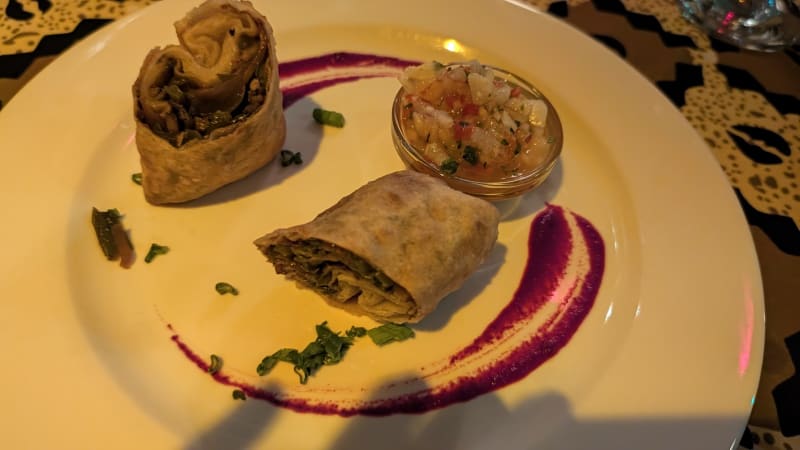
Camp food was more generous than I expected, and different every day — mostly buffet, though the last night was plated course by course :D
Q: Is tipping expected in Tanzania?
Not really — it isn’t mandatory, it depends on how you felt about the service.
Use the tip box, don’t just tip the people you can see: the operator pointed out that tipping only front-of-house staff is unfair to the cooks and cleaners behind the scenes, and the tip box is how everyone gets a share (I really like this)
My rule of thumb: a guide driving 6+ hours a day is USD 10–20/person/day, and I scaled hotel service from there
No pressure: nobody knows who put what in the box. But if you’re genuinely grateful, give
Q: What’s the voltage? What about electronics?
230V / 50Hz, and the official socket standards are the British Type D and Type G (three square pins).
Bring at least one adapter per group: officially it’s the British three-pin, but nearly every hotel we stayed in had universal sockets and Taiwanese/Japanese plugs went straight in. Your hotels might differ though, so bring one anyway (it’s on the essentials list below)
Phone and camera chargers are fine: almost all of them handle 100–240V, so just plug in
Don’t bring a Taiwanese or Japanese hair dryer: some guides recommend bringing one, I don’t — Taiwan is 110V and Japan is 100V, and plugging those into 230V will fry them instantly. Hair dryers also draw a lot of power, and camp electricity is limited, so using one can trip the whole area. Plenty of hotels don’t have one anyway; if you really need it, ask at the main building
Ready? Pre-trip prep and packing list
2–3 months before you go
We did vaccines and malaria pills a little over three months out, and the visa about two months out. Handling it early is much less stressful.
Contact the operator: the earlier you do, the more say you have in which hotels and what tier
Get US dollars: large bills for paying the operator and guide tips, small bills for camp tips and whatever else comes up
Travel clinic for the yellow fever vaccine and malaria pills (bring your passport)
You must have the yellow card: you get it after the yellow fever shot, and Tanzanian immigration checks it before you enter. One shot is valid for life — but it only takes effect 10 days after vaccination, so you can’t do it last minute
Strictly speaking, Tanzania only requires it if you’re arriving from or transiting an endemic country — which includes connecting through ADD (Ethiopia), but not a routing via Dubai or Doha. I’d still say get it: routings change, and you’re heading into a malaria zone anyway, so it’s one less thing to worry about
Malaria pills are also necessary. There are daily and weekly options, and the daily ones vary in type and duration: in Taiwan I was given Doxycycline, taken from 2 days before departure until 4 weeks after returning (40 days straight, in my case); my husband was given Malarone in Japan, taken from 1–2 days before until 7 days after returning (18 days). Ask your doctor which suits your situation
Tanzania eVisa: USD 50, apply online — visa on arrival exists but the queue is very long. There is no “Taiwan” option in the nationality field at all; the only choice is China. The official processing time is 10 working days (ours came through in 3–5 days, but it can take longer in peak season — don’t gamble), so apply early; and keep a careful record of your reference number
Temperature and what to wear
It’s “Africa,” but Tanzania sits at a fairly high elevation — cool mornings and evenings (like autumn in Tokyo), hot at midday. Layering matters.
The chill in the morning and evening isn’t wind, it’s just the temperature (around 10–15°C in September when we went). A light jacket is enough.
Stick to earth tones. A few to avoid:
Black and dark blue — they attract tsetse flies (honestly it seemed fine on our trip, but I’d still follow the advice)
Very bright colours — too conspicuous out in the bush
White — it gets so dirty
Also, leave anything expensive or sentimental at home. I brought a Tumi bag and it got trampled Q_Q and the wheels were filthy by the time we cleared customs.
On laundry: camps offer a laundry service, but you usually leave so early it won’t be done in time; hotel laundry is charged per item.
The afternoon sun is strong and it’s dry all day, so quick-dry clothes hung overnight will be dry by morning (and if you’re at one hotel two nights, or get back early, you can wash in the sun) — which is why quick-dry fabrics really are worth packing.
One more: if you normally get your nails done, I wouldn’t. Nails get dirty fast out there.
Packing list
Clothing
Tops: quick-dry short sleeves and thin long sleeves
Trousers: quick-dry long trousers. Shorts aren’t ideal — a lot of insects
Shoes: easy-walking shoes you don’t mind getting filthy. Not much walking, but still (earth tones here too — tsetse flies especially go for ankles and especially like dark colours)
Bag: a comfortable backpack you don’t mind beating up
Sandals: you’re in the vehicle most of the time, and they’re nice on the flights; you’ll also be standing on the seats a lot, so something easy to slip on and off is great
Hat: one that won’t blow away and actually shades you
Underwear: disposable underwear is genuinely convenient here
Other essentials
Personal medication: critical — carry it on you, never check it. Pack 3 extra days’ worth if you can
Sunscreen: midday sun is brutal, SPF 50+ strongly recommended
Binoculars: if your operator doesn’t provide them, bring your own. Two people can share one
Credit cards: pick one with good overseas cashback, stick to Visa and Mastercard, and bring one of each if you can in case one fails
Paper documents: passport copy, flight itinerary, Tanzania eVisa approval (we weren’t asked at immigration, but we were checked at our departure airport)
Insect repellent: DEET is worth considering, but citronella-based ones genuinely help too
Universal plug adapter: one per group is fine
Strongly recommended
Neck pillow: your best friend on both the long flights and the long drives
Other medications:
Motion sickness pills: the roads are worse than I could have imagined. If you’re prone to it, sit in the front row and take something
Anti-diarrhoeal: strongly recommended, stomach upsets are common
Stomach medicine: if your digestion is sensitive
Cold medicine: bring whatever actually works for you. We brought Japan’s Taisho gold-box one and knocked symptoms down the moment they appeared
Plasters
Eye drops: it’s extremely dry
eSIM or Starlink: as far as I know Chunghwa Telecom’s global roaming doesn’t cover Tanzania, so get an eSIM online. I used the free 1GB one ShopBack gives staff, which was handy
AirTag: someone on our trip had delayed luggage, and with flights often delayed, connections tight and multiple transfers, an AirTag is a lot of peace of mind
Snacks: you’re in the vehicle for a long time. Bring snacks XD
Earplugs: good on the plane and if you’re sleeping in a tent
Sunglasses: you’re mostly in the vehicle, but worth having
Wet wipes and alcohol wipes: for dust and general cleaning
Moisturiser and lip balm: the air is genuinely dry (and we live in Japan, so that’s saying something)
Mask or dust scarf: strongly recommended — by the end it gets dry enough to give you a cough, and the dust keeps coming in
Nice to have
Torch / headlamp: tented camps are very dark at night and you want to see your footing. We mostly didn’t need one, but if anyone in your group has poor night vision, bring it
This safari was the trip I’d been dreaming of
Seeing animals running free outside a zoo, sunrise from a balloon, the complete Big Five, the sheer scale of the Mara River crossing, the Circle of Life, setting foot in Africa for the first time, watching the Hadzabe hunt — and doing all of it with the people I love most.
But the thing I remember most isn’t any of the big moments. It’s lying in a tent in the Serengeti at night, falling asleep to zebra, hyena and lion calling outside.
Two Swahili phrases from this trip also genuinely shifted how I see things:
Pole pole: slowly, slowly — take it easy
Hakuna Matata: no worries
Like a safari, you can never predict what the next moment will bring — so there isn’t much point worrying about it in advance. Life is Hakuna Matata.
Hakuna Matata | Disney
This trip really isn’t hard to do. If you want to go, leave a comment any time and ask me anything.
I hope this helps you make it happen too :)
Appendix: how Ethiopian Airlines’ ADD transit hotel actually works
Ethiopian Airlines has a formal transit hotel programme — if your layover in ADD is long enough, you get a free night.
8–24 hour layover — note the upper limit; over 24 hours and you’re out
Both the inbound and outbound ADD flights must be operated by Ethiopian, on the same ticket — this is one of the reasons I push the single-ticket advice so hard. Book separately and you lose even this
You still get it even if an earlier flight was available (we did have an earlier option, and they gave us the hotel anyway — the official page explicitly says “regardless of whether an alternative flight with a shorter connection is available,” though several English travel blogs claim the opposite)
It’s not just the room, either — it includes the transit visa, meals, and transfers both ways.
Where you stay depends on your cabin: business and first get the Ethiopian Skylight Hotel inside the airport, economy gets a partner hotel outside plus a shuttle.
(Ours was not great, honestly — just somewhere to rest. Don’t go in with high expectations XD)
How it actually goes
Get the paper hotel voucher — you normally collect it at the airport you’re flying to ADD from. Departing Taiwan/Tokyo we didn’t get one at the counter (only an electronic version), but they handed us the paper one in Singapore as we were boarding. It has to be the paper copy, because both ADD immigration and the hotel will want to see it. If your departure counter doesn’t give you one, the transit desk at ADD can
After landing, head for Immigration — ADD is chaotic when you get off the plane; we asked several people before we were sure we needed to go through immigration. The transit visa comes with the programme and doesn’t need to be applied for in advance, but they will check your passport and voucher
After immigration, your carry-on goes through X-ray — you can’t get at your checked bags, so make sure anything you need at the hotel is in your carry-on
If you have binoculars in your carry-on, note that they’re restricted in Ethiopia. They’ll walk you back to Ethiopian Airlines’ baggage storage to check them, give you a baggage tag, and then send you on to the exit
Find the Ethiopian Airlines desk near the exit — hand over the voucher and they’ll tell you where to catch the shuttle
Give the voucher to the hotel (they keep it), then get some rest
A shuttle takes you back to the airport
If you checked binoculars or anything else, don’t clear departures first. Take your baggage tag and go alone (you can’t bring anyone with you) back through security to the arrivals-side baggage storage to collect it; afterwards someone will walk you back to the departures building (and watch you leave XDDD)
Thanks for reading :D
If you enjoyed this post, feel free to click the coffee button in the lower right to support us and give Lottery a can 🐾

Comments