comic
Brushes of Resistance — Hong Kong Anti-Extradition Movement Anniversary Exhibition Talk: "Like and Share — How Hongkongers Connected and Spoke Out in a Leaderless Movement"
Brushes of Resistance — Hong Kong Anti-Extradition Movement Anniversary Exhibition was a special exhibition at Taiwan Comic Base (TCB) running from Wednesday, June 24 through Sunday, July 26, 2020. It documented the resistance art produced during Hong Kong’s anti-extradition movement. This post covers the talk “Like and Share — How Hongkongers Connected and Spoke Out in a Leaderless Movement,” featuring Liu Huiwen, Associate Dean of the College of Communication at National Chengchi University, and veteran journalist Chen Yijing. The conversation focused on how Hongkongers used digital technology to organize, and the relationship between people and their tools.
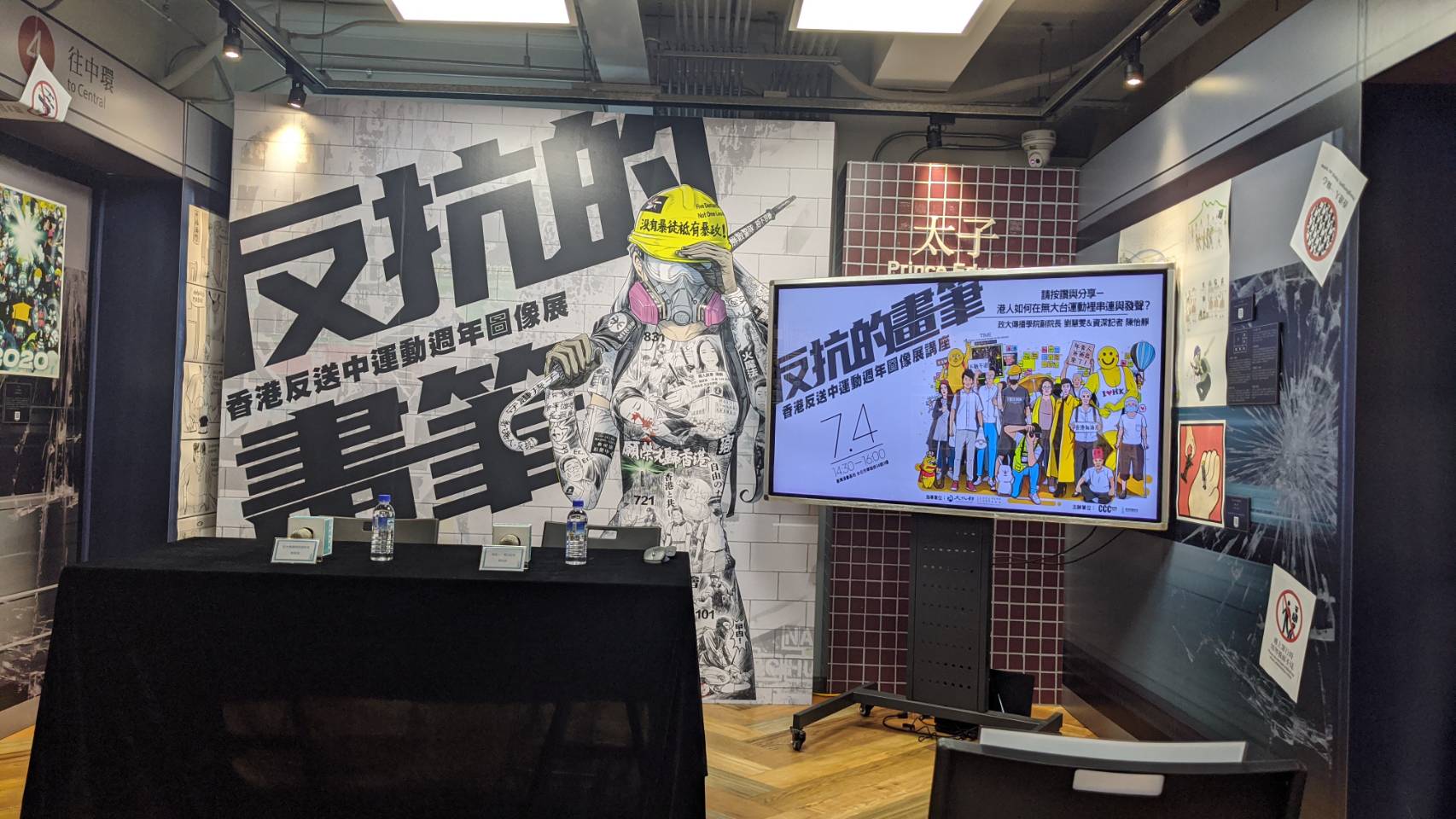
Exhibition dates: Wednesday, June 24 – Sunday, July 26, 2020 (closed Mondays)
Hours: 10:00–21:00
Location: Taiwan Comic Base, 2F & 3F (No. 38, Huayin St., Datong District, Taipei)
Guidance: Ministry of Culture; Institute for Information Industry
Organizers: CCC Creative Quarterly; Taiwan Comic Base
Free admission. Pets not allowed (guide dogs excepted)
COVID protocols: temperature check and mask required upon entry
Exhibition page: https://tcb.culture.tw/special-exhibition-anti-elab-movement/
The core theme of the talk was: how did Hongkongers use digital technology to connect with one another during the anti-extradition movement? It also touched on the relationship between people and digital tools more broadly. Since I had no recording device and was just taking notes by hand, what follows isn’t a verbatim transcript, and it’s mixed with some of my own thoughts and interpretations. Please read accordingly.
The exhibition itself was absolutely worth seeing. It recreated the underground walkway of Kwai Fong MTR station and the Prince Edward MTR station, and featured artists from Hong Kong, Taiwan, and Australia, documenting the movement’s history through visual art.
OPENING: Protest Art 1.0 and 2.0
In CCC Creative Quarterly: We Resist, Therefore We Draw, Weng Ji’an wrote about the importance of visual imagery in protests:
“Images often play a critical role in political resistance. Image-based communication — paired with concise, powerful slogans — serves to spread ideas and energize people at protest sites and across related media. At times it even gives a movement a defining visual identity.
This is why ‘comics’ and ‘resistance’ have been so closely linked. Unlike fine art, comics have always targeted ordinary people. They’re direct and accessible — not gatekept by class or education — and are one of the most effective tools for mass mobilization.”
So how exactly does imagery become part of a protest? This exhibition centered on resistance, art, and voice — examining how Hong Kong artists used art to support the movement.
When images become important tools of social movements and eventually evolve into protest art, the Lennon Wall is what most people know best. The Lennon Wall originated in Prague as a form of youth resistance.
 Image source: Wikipedia. The Lennon Wall originated in Prague.
Chen Yijing, who had reported from Hong Kong many times, observed that the forms of Hong Kong’s protests — and the art they generated — had evolved significantly over time.
Ver. 1.0 — 2014 Umbrella Revolution
The 2014 Umbrella Revolution is the defining example of protest art Ver. 1.0.
The art then was primarily Lennon Walls — fixed in location, designed to persist over time, made mainly from sticky notes.
Ver. 2.0 — 2019 Anti-Extradition Movement
By 2019, protest art had evolved.
Lennon Walls began appearing everywhere (partly because works were frequently destroyed), and creative output exploded — large-format banners, illustrated posters, handbills, all kinds of formats.
In this 2.0 era, online and offline were deeply intertwined.
Physical events and on-the-ground developments spread online in real time; artists would see something happen and immediately create for social media; digital works would then be printed out and pasted onto Lennon Walls around the city, transforming into a kind of distributed street art.
The second floor of the exhibition hall, themed “Do You Hear the People Sing?”, recreated the underground walkway of Kwai Fong MTR station. The walkway had become an unofficial gallery dubbed the “Kwai Fong Museum,” featuring a large image of the “Brave Fighter” character alongside all kinds of illustrated posters and handwritten signs — but it was a gallery in constant flux, with different faces each day.
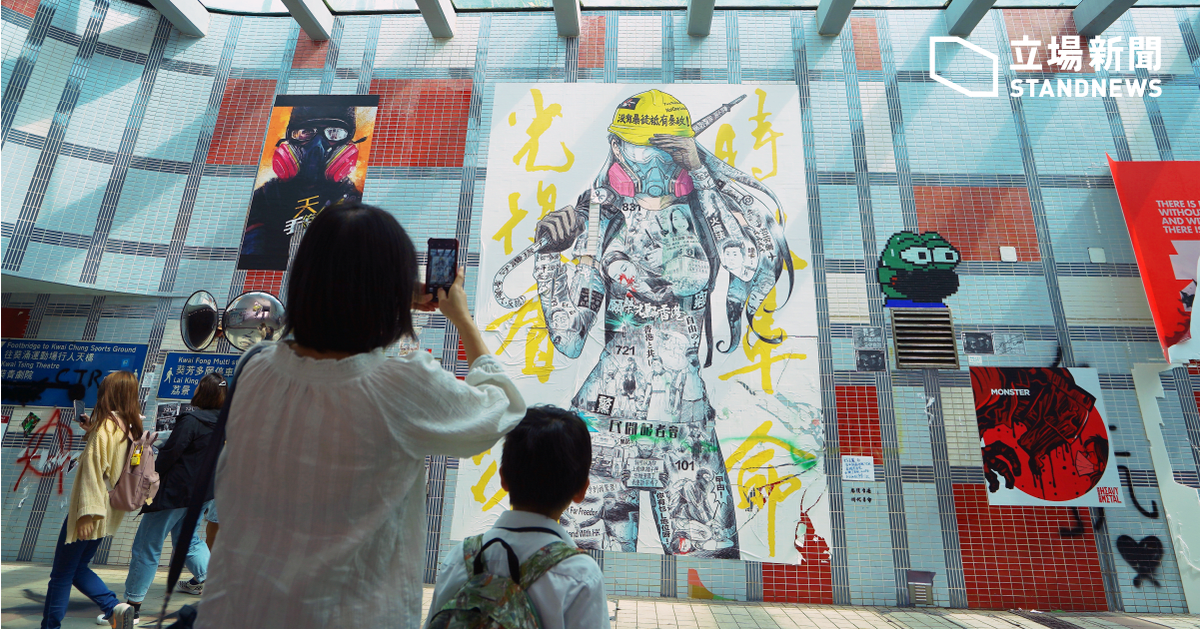 Image source: Stand News. The large “Brave Fighter” mural in Kwai Fong underpass was created by artist Gai Lan Chao Ji Dan, as a tribute to Shohei Otomo’s “Heisei Madonna.”
Even the destruction of art became a form of artistic performance. So many works were being vandalized that an exhibition called Whitewash emerged — rather than restoring the originals, it displayed blank canvases to show viewers which works had been “disappeared.”
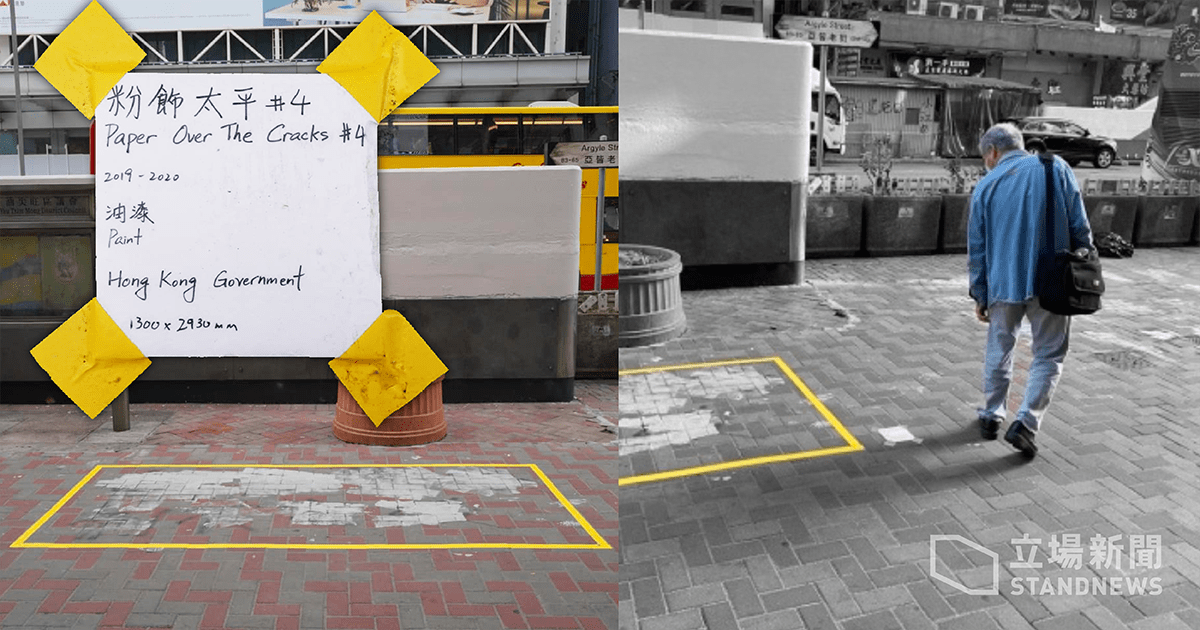 Image source: Stand News. Erased works themselves became the “Whitewash” exhibition.
The themes of protest art also shifted as the movement evolved.
Initially, slogans and imagery centered on demands and calls to action — rallying more people to join, support, and stand alongside the movement.
But as state and police violence intensified, the themes began to change. Works expressing the artists’ own grief, pain, and helplessness began to appear — as did comforting content, offering warmth and solidarity to those still fighting.
Two Foundations of Hong Kong’s Anti-Extradition Tech:
Digital Footprints and Digital Natives
Liu Huiwen began by remarking that she found it meaningful to hold this exhibition at Taiwan Comic Base.
The Comic Base was created by society to serve creators — yet this exhibition showed how artists use their art to serve society. A beautiful cycle between the two.
Digital Footprints
She opened with her own research.
Starting with the 2014 Sunflower Movement in Taiwan, her research team began learning how to scrape data from the internet. Facebook was still open to data collection at the time, so from March 18 (when the movement began) through April 11 (when protesters withdrew from the Legislative Yuan), they collected 680,000 Facebook IDs, 7–8 million comments on public posts, and behavioral data (shares, 12 million likes, etc.). All of this is called a Digital Footprint.
Compared to analog media (TV, print magazines) which required enormous resources, social media has an extremely low barrier to entry — but that also means users are highly exposed to being tracked. Bad actors can use digital footprints to identify the original person behind an action.
Generating digital footprints was a problem protesters urgently needed to solve.
Think about it: protesters in physical spaces wore masks and face coverings to avoid being identified by people or AI.
But in online spaces, the opposite was true — they needed mass sharing and wide circulation to spread information and build support. So even when physically invisible, their digital footprints left a trail of everything they did, every action tracked.
The question of how to erase digital footprints while still using technology to spread your message became one of the defining challenges of this movement — the goal being: use technology, without being used by it.
Digital Natives
Being able to use technology without being used by it is closely tied to being a Digital Native.
The concept of the Digital Native comes from Marc Prensky’s 2001 article “Digital Natives, Digital Immigrants.” The distinction between Digital Natives and Digital Immigrants isn’t based on age, but on the depth of one’s immersion in digital tools — meaning Digital Immigrants can gradually become Digital Natives over time.
For Digital Natives, the relationship with digital tools is almost physical — like an extension of the body.
They know these tools intimately and understand how to use them effectively.
In the Hong Kong movement, many young people were Digital Natives. They could transform existing digital tools — repurposing them from their original design into instruments of protest.
The Distinctive Tech of Hong Kong’s Anti-Extradition Movement
A technology’s original purpose and how users eventually apply it can be very different.
For example: AI that was designed to make recognition and management faster (like facial recognition on phones) was later weaponized by authoritarian governments as a tool of surveillance and control. Or using Google’s search ranking algorithm as a vehicle for political expression (e.g., the “Google bombing” that turned searches into a protest — though the example in the original talk was a different one).
Of course, no social media platform was ever built specifically for protest. So how did Hongkongers repurpose these tools? Liu Huiwen deliberately used the word Technique rather than Technology to describe these protest tools — because the emphasis is on how they’re used.
Given those two foundations:
Users — protesters were mostly Digital Natives;
Goal — mass social media sharing for information spread, while needing to erase digital footprints to avoid counter-tracking;
Many technologies were reimagined and given new meaning during this movement — and in turn, those tools shaped how the movement itself developed.
AirDrop
AirDrop, Apple’s iOS tool, was given a completely new use during the protests. The technology turns every device into a relay node, allowing information to “hop” from device to device; and because users can toggle it on and off at will, switching it off severs the connection and makes counter-tracking impossible — achieving the goal of erasing digital footprints.
Chen Yijing gave her own example from covering the Hong Kong district council elections.
A friend told her that once she landed in Hong Kong, she should turn on AirDrop — she’d receive all kinds of messages. So she did.
On November 11, 2019, Hong Kong launched a general strike (no work, no school, no business). She was stuck at Kwun Tong station for hours. Police shot a young man at Sai Wan Ho station — even though the stations were far apart, within fifteen minutes she’d already received multiple videos of the incident via AirDrop. She was stunned: how could information travel that quickly across that physical distance?
 Image source: Wikipedia. The Sai Wan Ho shooting on November 11, 2019.
Blockchain
Beyond its conventional use for cryptocurrency, blockchain technology has properties — content is extremely difficult to alter and no third-party arbitration is required — that made it useful during the protests for preserving things people didn’t want distorted or erased. It also aligned well with the movement’s “Be Water” philosophy.
(Example: Ethereum blockchain used to support Hong Kong’s anti-extradition movement — police data uploaded to prevent deletion)
Telegram
Telegram’s anonymity, encryption, and self-destructing message features made it one of the most critical technologies of this movement. Enormous volumes of information flowed through its channels daily.
The Relationship Between People and Technology: Crowdsourcing Built by Tech
Let’s go back to the Sunflower Movement for a moment.
You may remember: inside the Legislative Yuan, people were streaming live on iPads; dedicated people managed the network traffic; telecom companies even set up additional base stations to maintain bandwidth. Technology and the internet pushed the information out; translators in multiple languages brought Taiwan’s story to the world; it also launched careers, sparked interest in GitHub, and people crowdfunded a full-page ad in the New York Times.
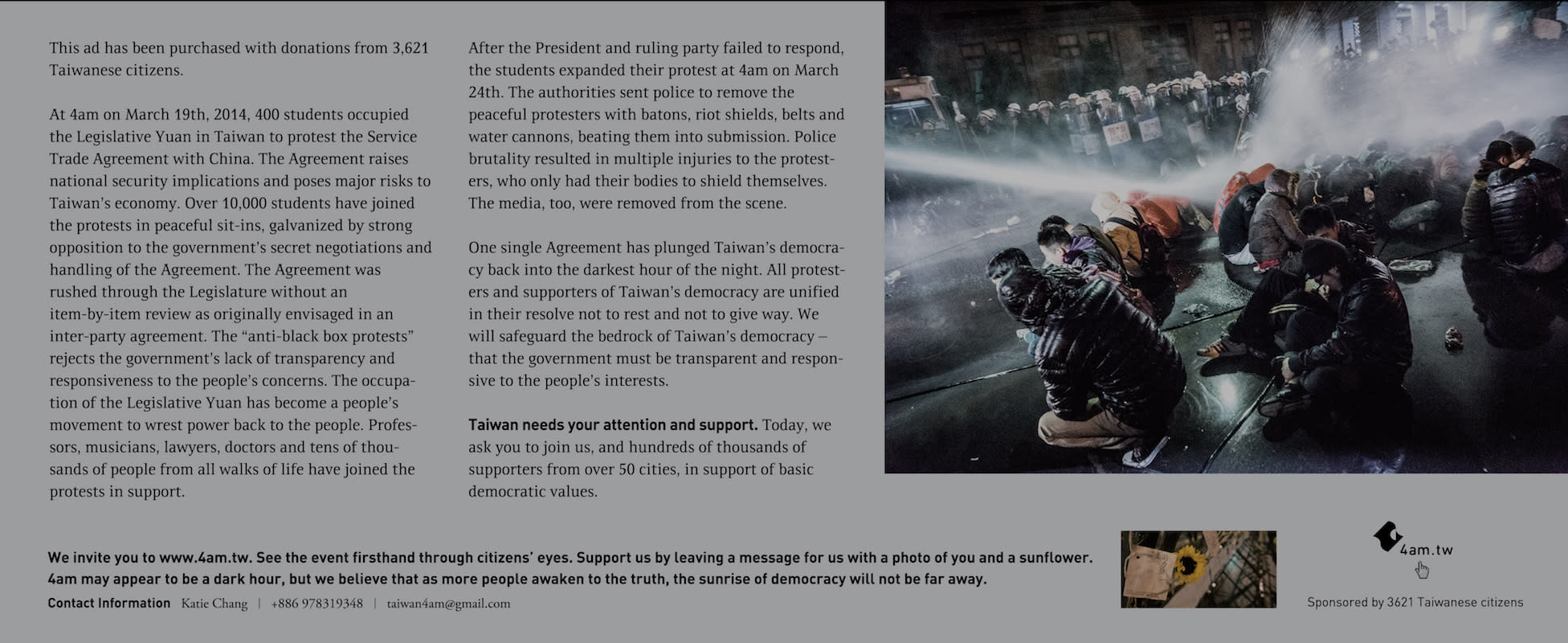 Photo credit: The News Lens. Under the name 4am.tw, the Sunflower Movement crowdfunded a full-page ad in the New York Times.
But what actually sustained that movement wasn’t the movement leaders on stage or the multilingual translators. It was every single person inside and outside the Legislative Yuan — and at home, across Taiwan. As Liu Huiwen put it:
The crowd is the real driving force.
That’s the idea behind Crowdsourcing.
The internet and digital tools create a channel that lets anyone contribute to something they care about. Technology and user goals are tightly intertwined. In this anti-extradition movement, tools like Telegram and AirDrop “served” the protests in unprecedented ways — people gave the technology new meaning, and the technology, in turn, helped shape and direct the movement.
Liu Huiwen closed with a reminder:
The more we understand technology, the better we can use it — and the sooner we can stop its negative effects.
The “Technique” mastered by Digital Natives during the anti-extradition movement is proof of exactly that.
Post-Talk Q&A
Q: Can Telegram’s encryption really be trusted? Could it be secretly acquired by someone?
Based on Telegram’s current political and economic structure, it appears trustworthy for now. Could it turn a profit? Would anyone actually want to buy it?
With politics and money, nothing is impossible. But for now, it seems fine.
Q: In a protest situation, is it a problem to rely on just one tool?
Yes. Tools always change alongside the goals and demands of the movement; as a tool’s features shift, people can switch to different ones.
Liu Huiwen added: traditional mass media was anonymous in the sense that it reached “anonymous anybody.” Social media, by contrast, is designed for personal interaction — everyone you interact with has a face and a name, which creates attachment. Most social media platforms can’t “Be Water” for that reason.
AirDrop can — because the connection can be cut and has to be re-established each time.
So the key question is: what form does the technology take?
The tools we use today may be abandoned tomorrow; there’s always something more appropriate waiting to be found.
Q: After Hong Kong’s National Security Law passed, many Hongkongers mass-deleted their past posts. Does this mark the death of protest tech?
There will certainly be a chilling effect, but new methods and tools will always emerge.
Liu Huiwen also reminded everyone: even without a National Security Law, you should be careful about your digital footprints.
This was a genuinely fascinating talk. Those of us rolling around in the internet every day — our digital footprints record our every move even under normal circumstances. And here were Hongkongers, in the middle of a struggle, turning digital technology into something that worked for them. That kind of boundless creativity and resilience deserves real respect.
After the National Security Law passed, would we ever get to go back to Hong Kong?
This exhibition recreated several key sites from the anti-extradition movement and showcased a remarkable body of protest art. Please go support it if you can!
Thanks for reading :D
If you enjoyed this post, feel free to click the coffee button in the lower right to support us and give Lottery a can 🐾
Comments