Linguistics → UXR | Applying for UXR (2): Resume (with ChatGPT Prompts)
Format, content, ATS, LinkedIn vs. resume, how to write about your experience using STAR, and how to use ChatGPT to level up your resume — all in one post.
Intro
Welcome to Part 2 of the Applying for UXR series. 🙂
For background on my own pivot, see:
Linguistics → UXR | Career Pivot Prep & ShopBack UXR Intern Interview
Linguistics → UXR | Academia vs. Industry
For Part 1:
Linguistics → UXR | Applying for UXR (1): Qualifications & Mindset
Besides ADPList mentorship, I also help friends review resumes occasionally. This post covers resume Q&A. The main audience is people applying for UXR — but most of it applies broadly.
I originally planned to include portfolios here, but there was already enough to say about resumes (four hours of writing already 😄). Portfolio Q&A will come in the next post.
Disclaimer: none of this is absolute. I’m synthesizing experience and conversations with peers. Pushback welcome. 😛
Resume Q&A
Q: CV or Resume? What’s it for?
In foreign companies and tech roles, you’ll often see both terms. Briefly:
- CV (Curriculum Vitae): Comprehensive, no page limit, typical in academia
- Resume: Concise, usually one page, typical in industry
In Taiwan’s tech industry, they’re used nearly interchangeably — both mean essentially a resume:
A one-page document that markets your skills and achievements to make a company want to hire you.
The framing I like from CakeResume: a resume is like a phone ad flyer. You have seconds to make someone want to keep reading. That means: simple, punchy, clearly communicating your strengths.
Q: What format should I use?
PDF or Word, single-column, no heavy design.
This might sound counterintuitive for UX people — but for UXR or PM roles specifically, I’d recommend against multi-column layouts and graphic-heavy formats. The key test: can you highlight the text in your file and paste it somewhere else cleanly? If yes, you’re fine.
Why does this matter? ATS (Applicant Tracking Systems).
Applicant tracking systems read most resumes before a human does.
Most companies run resumes through ATS before a human ever sees them. ATS extracts your information and auto-fills it into the system — but multi-column or design-heavy formats often confuse it. If the machine can’t read your resume, even the most brilliant content won’t pass the first filter.
My first resume version had a two-column layout with contact info and education on the left side. It looked great. A friend reviewing it warned me about ATS — and when I tested both versions on several ATS-check platforms, the two-column version required manual re-entry almost every time. The plain version was auto-filled almost perfectly.
ATS-friendly is non-negotiable.
I now write mine in Google Docs — easy to update from anywhere, works reliably.
Before and after versions for reference:
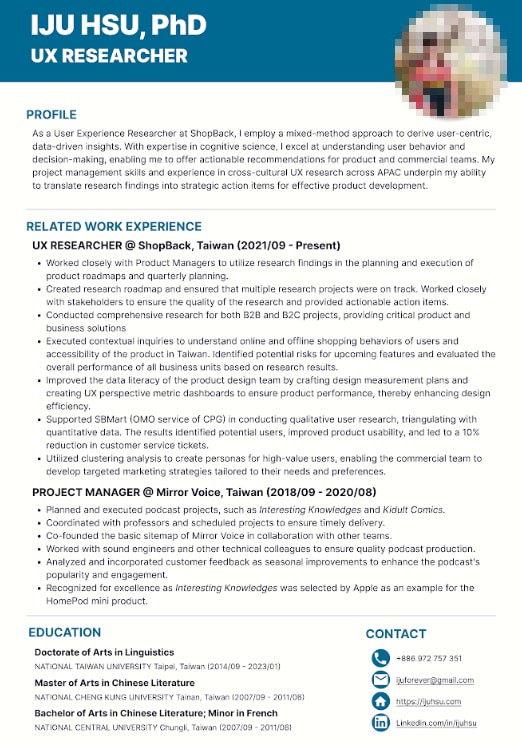
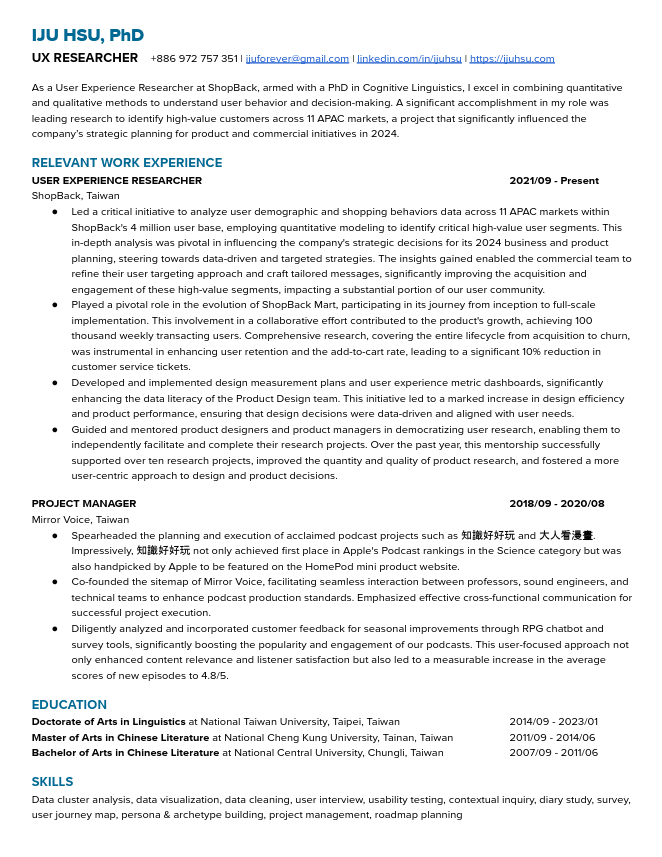
Also keep an eye on the basics: readable fonts (no novelty script fonts), minimal color (two or three max).
If you want to use my Google Docs resume as a template, feel free to leave a comment or reach out. 🙂
Q: Chinese or English resume?
If you’re applying for UXR, write in English.
Even for Taiwan-based roles, most companies hiring UXRs are international or foreign companies, and English proficiency matters. Writing in English from the start saves you from having to translate later — and ChatGPT can help if you’re not confident.
Q: How do I maintain my resume and LinkedIn?
The most common issue I see when reviewing resumes: too much content.
When I ask why, the answer is usually: “Everything should be in chronological order” or “It feels wasteful to leave things out.”
But go back to the flyer analogy. If you receive a ten-page phone flyer that covers the company’s founding story, the designer’s biography, and the phone itself — do you read it all?
Hiring managers receive hundreds of applications. After ATS, they may spend 1–2 minutes per resume. If yours has no clear highlights, or feels cluttered, it gets filtered out.
My recommendation: treat LinkedIn as your CV; the resume you submit is a highlight reel.
LinkedIn is your complete story — list everything. Your submitted resume is a curated selection of what’s most relevant to this role.
For example: I’ve been a journalist, social media editor, PM, lecturer, and research assistant. LinkedIn has all of that. But my resume only includes what’s relevant to the job I’m applying for. If I’m applying for UXR, I emphasize PM and research assistant experience — anything else disappears from the resume. If they’re interested, they can click to my LinkedIn for the full picture.
The added benefit: when applying for multiple different roles, you can pull different sections from LinkedIn to create tailored resumes without starting from scratch each time. UXR? Lead with research + PM. SEO? Lead with PM + social media editing. Efficient. 😛
Q: What content should a resume include?
Typically:
- Name
- Contact information
- Job title (current or target role)
- Summary / personal bio
- Relevant work experience
- Education
- Skills
Publications, patents, certifications are all fine to include.
The order of sections depends on your background. If you have relevant work experience, put it right after your summary — lead with achievements. If you’re new to the field or switching careers without much direct experience, put education after your summary and emphasize your skills.
Also: for ATS-friendliness, don’t deviate too much from standard template structure. Machines parse what they expect to find.
Good template sources: Indeed, Microsoft
Q: How do I write my personal summary?
When I review resumes, most summaries are modest to the point of being invisible. Lots of qualifiers, nothing distinctive — if I were a hiring manager, I wouldn’t know why I should hire this person over anyone else.
Compare:
“I’m a qualitative researcher. I specialize in user interviews, diary studies, and usability testing. I’m passionate about the e-commerce industry.”
vs.
“Qualitative researcher with a background in e-commerce social media. Beyond core research methods, I bring skills in user preference analysis, data interpretation, and trend identification. Used A/B testing and desk research to increase beauty content engagement 20%.”
The second version is still not perfect, but it shows what makes this person different, and backs it up with a concrete result.
Your summary is where you should highlight what makes you distinctive and what you’ve achieved. Don’t be shy.
Q: How do I write work experience for a UXR application?
UXR values logical thinking and analytical process. That applies to academic experience too — not just industry.
A simple, effective framework: STAR.
- Situation: the context or research background
- Task: the objective or question
- Action: what you did, what method you used
- Result: what the outcome was
We use this for performance reviews at ShopBack; I’ve heard some companies even prompt candidates to use STAR format during interviews.
I don’t follow STAR rigidly in my writing, but I keep the spirit. Here’s one of my real LinkedIn experience entries:
Led a critical initiative to analyze user demographic and shopping behaviors data across 11 APAC markets within ShopBack’s 4 million user base, employing quantitative modeling to identify critical high-value user segments. (1)
This in-depth analysis was pivotal in influencing the company’s strategic decisions for its 2024 business and product planning, steering towards data-driven and targeted strategies. (2)
The insights gained enabled the commercial team to refine their user targeting approach and craft tailored messages, significantly improving the acquisition and engagement of these high-value segments, impacting a substantial portion of our user community. (3)
Paragraph 1: scope (11 markets, 4M users) → Situation + Action → goal (identify high-value segments) → Task
Paragraph 2: strategic impact → Result
Paragraph 3: downstream application → Action + Result
All four STAR elements are there, just not in rigid order.
Q: Resume Do’s and Don’ts
Do’s
Keep the format simple and update it regularly.
I used to build resumes in Figma — beautiful, but hard to maintain and ATS-unfriendly. Switched to Google Docs and Notion. Now I can update from anywhere, on any device.
Triple-check everything, especially company names and the recipient’s information.
Before submitting, verify all details. If you reference a specific company, do not misspell their name.
(Every time someone writes “LJU” instead of “IJU” in a message to me, I… no comment. 😄)
Don’ts
Don’t copy-paste from the JD.
Your resume tells your story, not the company’s wishlist. Use the JD as a reference, write your own content first. Otherwise there’s nothing distinctive about yours.
Don’t include irrelevant personal details.
One A4 page is precious real estate. Leave out anything that doesn’t speak to your professional fit. This includes MBTI, blood type, horoscope. 😄 These might be fun conversation starters, but they don’t belong in a professional resume — especially since researchers (particularly psych-background ones) tend to react… skeptically to MBTI on a resume.
Q: How do I use ChatGPT to polish my resume?
Here’s my actual workflow:
Step 1: Draft using a template, in your own voice.
This preserves your story and distinctiveness.
Step 2: Check each experience entry against STAR.
ChatGPT Prompt:
Could you help me check if the following experience aligns with the STAR principle?
[Paste the working experience]
Step 3: Translate if needed.
ChatGPT Prompt:
Could you help me translate the following sentences into English?
[Paste the contents]
Step 4: Feed ChatGPT the target JD.
ChatGPT Prompt:
Hi, I'm writing a resume to apply for a [job title]. I am going to paste the job description (JD) for you. Please just let me know whether you receive it. You don't need to reply to me now.
[Paste the JD]
Step 5: Ask ChatGPT to review your resume against the JD.
ChatGPT Prompt:
Based on the JD I just provided, could you check if my resume matches the JD? Then, please provide me with an edited version that aligns with the JD.
Done. 🙂
A few caveats: ChatGPT is powerful but imperfect. Review its suggestions item by item rather than accepting everything wholesale (especially on older models). Use it to polish, not to replace your judgment. It’s a great grammar checker and translator, and can save significant time — but your voice and story need to be there first.
Wrap-Up
Hope this helped with your UXR resume. 🙂
Next up: portfolios and interviews. Questions in the comments welcome anytime.
And if you want to talk through your materials 1:1, find me on ADPList. 🙂
Thanks for reading :D
If you enjoyed this post, feel free to click the coffee button in the lower right to support us and give Lottery a can 🐾
Comments