comic
[Taiwanese Comics] Q-Series Comic: What She Put on the Table — Fu Pei-Mei's Culinary Legacy (Don't Read This at Night)
This is an introduction to What She Put on the Table, published by Proton Media and part of the Q-Series Comic line. The manga was drawn by renowned Taiwanese comics artist Zuo Xuan, and the TV drama script was adapted by Wen Yufang and Zhang Kexin from Fu Pei-Mei’s original novel of the same name. The comic follows a fictional character named Xiaochun as the primary viewpoint — a bystander who watches Fu Pei-Mei’s culinary journey and rise to fame from the outside.
How the Q-Series Comic What She Put on the Table Came to Be
What She Put on the Table is one of the Q-Series Comic titles, drawn by Taiwanese comics artist Zuo Xuan. The TV drama script was adapted by Wen Yufang and Zhang Kexin from Fu Pei-Mei’s original novel. But to accommodate the story’s scope and keep the focus sharp, the adaptation took significant liberties — screenwriter Wen Yufang mentioned that the directorial vision from Wang Xiaodi was to give the drama a specific message:
Let today’s young people see the hardships of those who came before, and in doing so reflect on and appreciate what they have now.
The plan was to interweave past and present, which called for a fictional character — “Xiaochun.” In the story, she becomes Fu Pei-Mei’s domestic helper later in life, offering a bystander’s perspective on Fu Pei-Mei’s entire journey. It’s a clever device, and as it happens, Fu Pei-Mei did employ domestic help in real life and was known to have warm relationships with her household staff — so it’s grounded in historical fact.
Fair warning though: this is genuinely not a book to read at night. You will quietly open your phone and order a late-night snack… orz
In terms of what kind of story it is, What She Put on the Table sits apart from food-centric manga like Cooking Master Boy or Food Wars! — it puts much more emphasis on the warmth of human bonds. The dishes Fu Pei-Mei makes in the story are elaborate Chinese banquet-style fare, but paired with Zuo Xuan’s tender and detailed artwork and this particular screenplay, the feeling it actually evokes is more like Japanese nikujaga — simple, homey, and comforting.
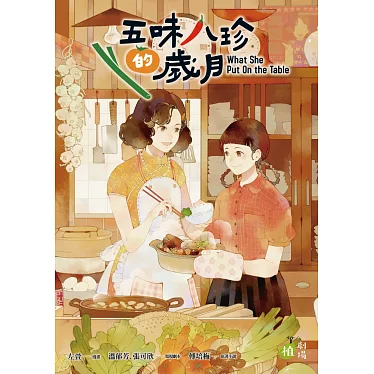 What She Put on the Table. Comics: Zuo Xuan; TV script: Wen Yufang, Zhang Kexin; original novel: Fu Pei-Mei. Proton Media. (Image source: Books.com.tw)
Story Summary
What She Put on the Table contains five chapters: “Rice Noodle Soup,” “Dumplings,” “Stir-Fried Pork,” “The Cheng Family’s Braised Pork,” and “Sweet and Sour Squirrel Fish.” These five dishes each represent a different stage of Fu Pei-Mei’s life.
The story opens with an elderly white-haired woman looking at a group photo and a portrait of Fu Pei-Mei. Then the perspective shifts, and we’re suddenly transported back to the past.
That old woman is Xiaochun — Fu Pei-Mei’s (fictional) housekeeper. We learn that Xiaochun grew up poor; her elder brother appears to have an intellectual disability, and just getting by was a struggle for both of them. She happens to rescue a mainlander soldier on the run named Wang Guxia, but to survive, Xiaochun ends up traveling alone to Taipei for work.
Things don’t go smoothly in Taipei. Fortunately, Liu Yifu, the owner of a grain store, takes a liking to her — he looks out for her, and even teaches her to read and write. Though it turns out Liu Yifu has joined a group he’d rather keep secret…
After losing her job, Xiaochun is taken in by Liu Yifu for a while. One day, she has a chance encounter with a well-dressed pregnant woman — that’s Fu Pei-Mei. Xiaochun volunteers to become her housekeeper, and Fu Pei-Mei accepts immediately. But Fu Pei-Mei’s husband takes a dislike to Xiaochun and finds a pretext to dismiss her — until a twist of fate has Xiaochun saving Fu Pei-Mei’s life. After that, the whole family accepts her, and her life in the Fu household begins.
The story makes clear that Fu Pei-Mei could barely cook at the start. She was enthusiastic, but the family’s reactions at the dinner table said it all. Xiaochun helped where she could, but Fu Pei-Mei wanted to learn more elaborate dishes and even spent money seeking out professional chefs as teachers. Perhaps through sheer passion and natural talent, her cooking kept improving, and the family increasingly looked forward to her meals.
As for what happens next? I’ll leave that for you to discover.
Fu Pei-Mei’s Biography Through Someone Else’s Eyes
I personally wasn’t very familiar with Fu Pei-Mei before reading this, though I’d always heard she was a remarkable cook. With a biographical story, it’s usually hard to avoid a self-aggrandizing perspective — but going all praise feels hollow. In the comic, viewing Fu Pei-Mei through Xiaochun’s eyes neatly sidesteps that problem. The relationship between them is also a window into Fu Pei-Mei’s personality.
I like the idea of using dishes to mark Fu Pei-Mei’s growth stages (even if I can never quite locate the “rice noodle soup” moment). Going from barely managing dumplings to making meals her family suffered through — and eventually becoming a celebrated cooking teacher — using food as a metaphor for her culinary journey is genuinely well done.
Whether it’s Zuo Xuan’s gentle brushwork or something intrinsic to Fu Pei-Mei herself, the portrait you get is of someone warm and deeply caring. She has her scattered moments, her fixations, her frustrations — but in that era, for someone of Fu Pei-Mei’s social standing to get along with her housekeeper Xiaochun so naturally, almost like family and friends, feels genuinely rare and worth noting.
The story deliberately includes a major turning point in Xiaochun’s life that has nothing to do with Fu Pei-Mei’s actual history — but it illuminates what life was like in that period. And it becomes the most emotionally affecting moment in the whole story: Fu Pei-Mei cooks a meal to lift Xiaochun’s spirits. That meal isn’t just the result of all her years of kitchen work — it’s a testament to the deep bond between them.
That said, I do think that while the third-person perspective on Fu Pei-Mei avoids certain pitfalls, giving Xiaochun such a substantial role means Fu Pei-Mei herself is somewhat overshadowed. The screenwriter actually mentioned in the afterword that choosing the main storyline was difficult, which led to focusing on Fu Pei-Mei’s time in Taiwan. But because Xiaochun’s arc takes up so much space, Fu Pei-Mei becomes something closer to a supporting character, and the impression she leaves is less vivid than Xiaochun’s story. The narrative sometimes feels like it’s missing something — a small but real regret.
Minor reservations aside, this is a genuinely warm and enjoyable work. Zuo Xuan’s style is well-suited to the story — light and gentle, yet each character has distinct presence. The food she draws looks absolutely delicious — you’ll find yourself immediately looking up which restaurants might serve dishes like this XD
If good food warms the stomach, then What She Put on the Table warms the heart.
Title: 五味八珍的歲月 / What She Put on the Table
Comics: Zuo Xuan
TV script: Wen Yufang, Zhang Kexin
Original novel: Fu Pei-Mei
Publisher: Proton Media
Thanks for reading :D
If you enjoyed this post, feel free to click the coffee button in the lower right to support us and give Lottery a can 🐾
Comments